tiny homes (512)

Tiny Home in Maine

April 6, 2020

Dear Lloyd,

A photo of our daughter’s house

I have been reading your books for years (and have given them to my kids) and, more recently, your blog. I studied architecture in college (in the 70’s) and when your Shelter book came out I wore it out reading it. It has influenced the last forty years of my life as a builder/carpenter.

Ours is a relatively sustainable and self sufficient lifestyle, and one our kids have adopted as well. Our daughter has been living for the last 5 years in a 7′×10′ house she built, with no electricity or running water, and is building a traditional Washington County peapod (a double-ended wooden rowboat). Our son is currently living in a 42″ wide × 10′ long shelter he built to live in, while building a tiny house for a college acquaintance. before that he was living on a 36′ sailboat he fixed up and sailed solo across the Atlantic to the Azores.

We are preparing to sell the house in which our two kids were born and grew up, and on which we have worked for the last forty years. My wife created a website so we can sell the house ourselves and I thought, perhaps, you might like to see the photos of the house.

Here’s a link to the website richmondmainefarmhouse.com

Thanks for all the inspiration — just wanted you to know that you’ve had quite an impact on our lives.

Best wishes to you,
Joe Stanley

Post a comment

Wonderful Houses Around the World

Yesterday I read in the paper that sales of children’s books are booming, due to schools being closed. This brought to mind our one and only children’s book, Wonderful Houses Around the World, by photographer Yoshio Komatsu and artist Akira Nishiyama.

There are 10 photographs by Yoshio of homes in different parts of the world. All the homes are built of natural materials — earth, wood, thatch, sod, bamboo, and stone.

Each photo is followed by a watercolor drawing of the inside of that home, showing the children and their parents going about their everyday activities: food gathering and processing, cooking, sleeping, working and playing.

The book is timely in this day and age: it shows what people do in their homes. Timely also because it’s great educational material for kids being home-schooled: look at what what kids your age are doing in other parts of the planet.

Yoshio is my favorite photographer of homes in the world. Not only are the homes invariably soulful, but his composition and lighting are perfect — and he has a knack for making people feel comfortable, so that the homeowners look natural, often laughing.

The book is $12.95 and you can order it through your independent bookstore, or from:

Note: We have a money-back guarantee on all of our books (no matter where you buy them). If for any reason you are dissatisfied, call us and we’ll return the full purchase price plus shipping. No need to return the book.

Post a comment (1 comment)

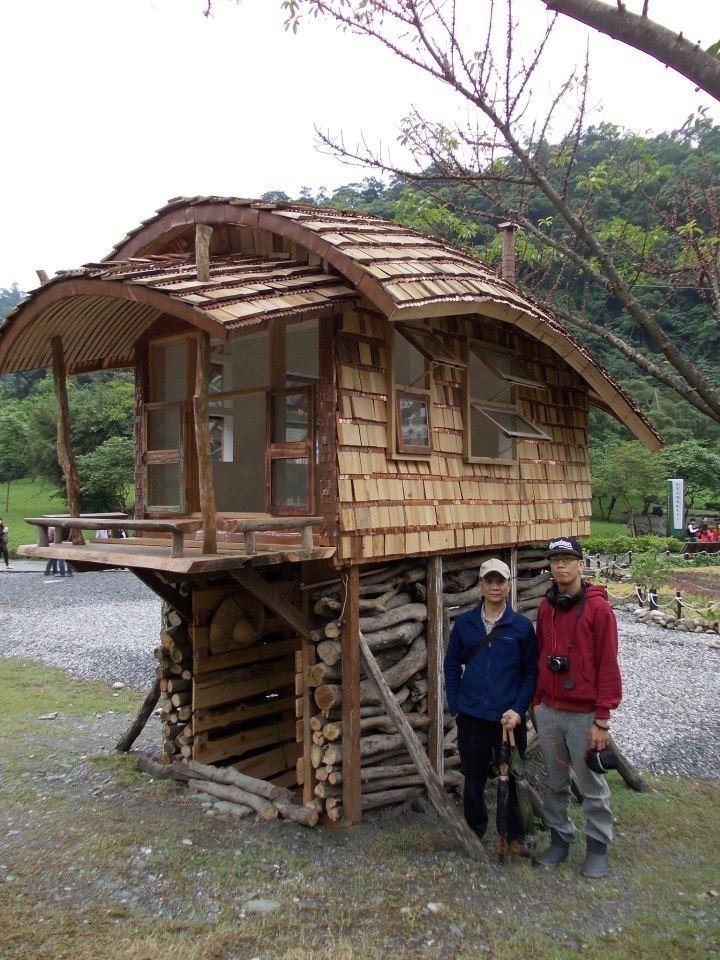
Tiny Curved House in Taiwan

Just ran across this photo from a blog post in 2013. It was sent us by Island Woman MJ. She wrote the photographer (whose name we didn’t get), who replied (Google Translate wasn’t that good 6 years ago):

Hello

Thank you like my photos

This little house in a green park

The park is located in Yilan, Taiwan

Taiwan is a rainy island

After the rain from upstream many Driftwood

There are several college students using driftwood and some abandoned building materials to build a small house

This cute little house is now the Green Park show

Taiwan is a mountainous and river country inhabited by friendly people

I hope you have the opportunity to travel to this country

Post a comment (1 comment)

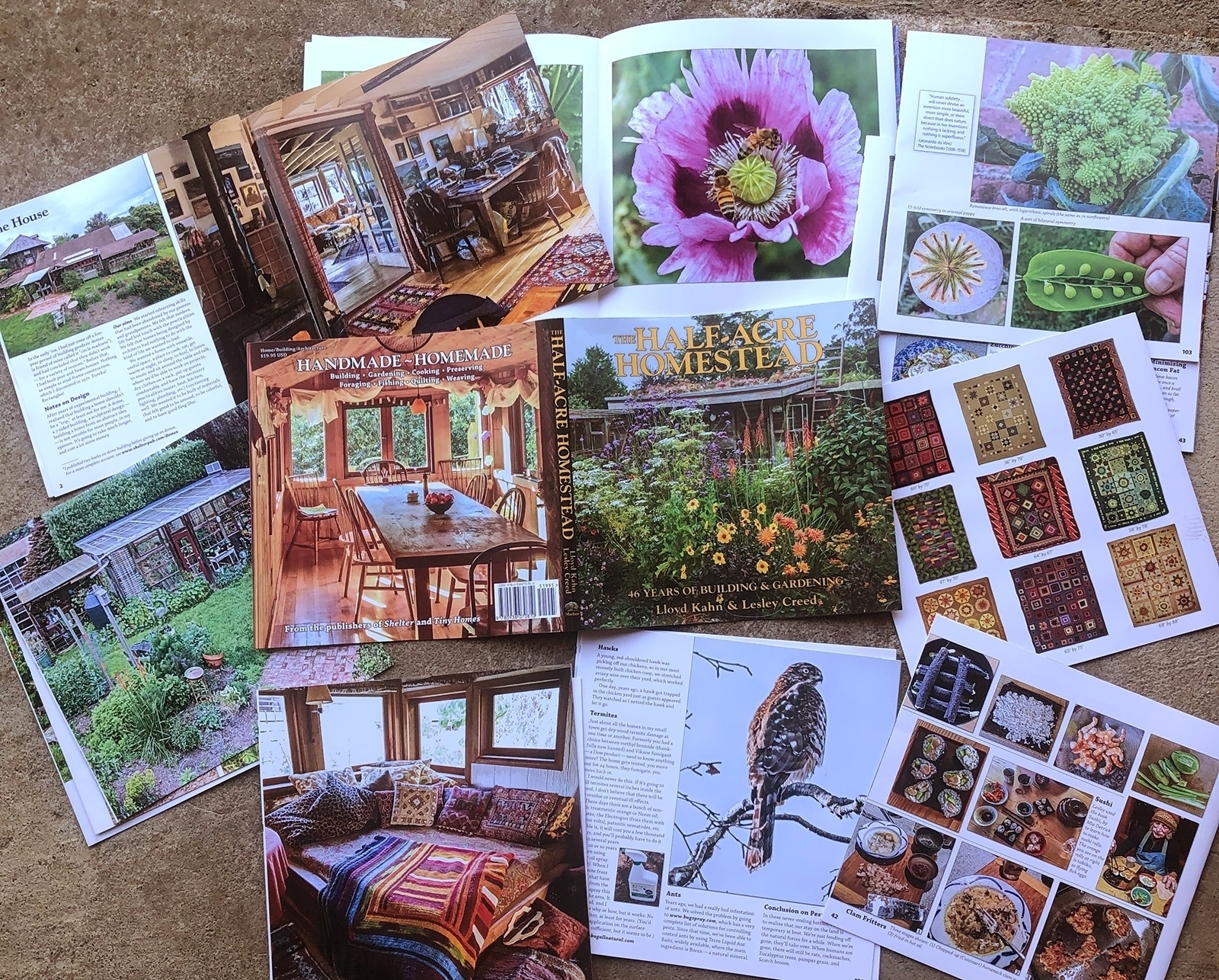
The Half-Acre Homestead Book Is Finished!

(Subtitle: 46 Years of Building & Gardening)

You know, it’s Thanksgiving morning, both boys are off for the holiday with spouses’ families, and Lesley and I are working on our separate crafts. What a difference with no phones, no email, no business necessities, no one else around. Witness the fact that I’ve hardly blogged at all lately. Gonna have to get one day a week here with no distractions. A right-brain day!

The unbound pages came in from the printers a few days ago. What a thrill! The book’s getting bound (in Hong Kong) this week, shipped and will be available in early March, 2020. When we get it together, we’re going to take pre-orders.

I’m still getting used to the book. After covering hundreds of builders over the years, this is the first on my own (and Lesley’s) work.

Stay tuned.

These photos shot with iPhone. We just got these early pages.

Music de éste día: The Gilded Palace of Sin by The Flying Burrito Brothers, 1969
www.youtube.com/watch?v=LUeFJ7QIRbE

Here’s how I make books:

Read More …

Post a comment (24 comments)

Tiny Home on Wheels from Recycled Materials in Australia

Dear Lloyd,

I’ve been meaning to write you this email for some time now, it feels long overdue.

I just wanted to express my gratitude for the inspiration that I have taken from your books (specifically Tiny Homes: Simple Shelter) which have helped lead me on a wonderful journey of DIY carpentry, natural building and constructing my own tiny houses on wheels from recycled materials. This book was the first time I’d ever seen a tiny house on wheels (8 years ago) and it blew my mind! I love the concept of being able to build and own my home without crippling debt, as well as separating land and home ownership. It has provided me with an ethical, soulful, affordable and flexible housing solution as a stepping stone to something bigger and more permanent in the future, as I know that I do not wish to raise a family in such a small space and am now getting into my mid-30s. Building my first tiny house took me out of the office as a left-leaning progressive town planner and into the world of creative carpentry and the DIY makers movement where I could lead by example and walk the talk. I’ve also now run workshops and helped on many other sustainable building and tiny house projects since taking the leap.

I designed and built my house in the eclectic woodbutcher’s style, which I know you were a part of pioneering in the ’60s and ’70s. A mix of recycled doors, windows and lovely cedar, Oregon cypress and Baltic pine, much of it old-growth timber reclaimed for free from old houses here in Australia. I even ended up with a beautiful geodesic dome lead-light window, a result of a carpenter mentor with a very mathematical brain who came up with the design and helped me to build it — but lesson learned, I don’t think I’ll be making too many more domes. Waterproofing them effectively is certainly a challenge…

Here is a link to some photos and a video tour of my first tiny house and recycled bathhouse in Byron Bay: www.livingbiginatinyhouse.com/tiny-home-with-bath-house-made-from-salvaged-windows

Read More …

Post a comment

Learning to Build Tiny Homes in Prison

Dear Lloyd,

Well, the books you were kind enough to send to me, I put to good use, as I’m teaching a tiny homes class at the prison as an ACE class, which stands for Adult Continued Education program. I’m now on my second class. The first one had 16 guys and this one has 21 guys. It’s a 10 week class and each person has to design his own tiny home to scale and they have to pass two tests to get a certificate. The hope is that they will then be able to design a tiny home when they get out of prison.

Here in North Carolina, they just announced that they are building a whole village of tiny homes for the homeless. I think it’s a great thing and when I’m teaching, I tell these guys getting out of prison that it really is perfect for them also. If I can get even one or two guys to buy in and build one, I will be very happy that I’ll have gotten someone to improve his life.

I try and explain that when you first get out, you won’t have a good enough paying job or the work history for a bank to give you a home loan. Nor do you have a credit score that’s high enough. And with homeless rates rising, most people are a paycheck or two from being that way. I go on and explain that if you rent a one bedroom (the average rent here is about $550 or $600.) In 10 years that’s $66,000-$72,000 and if you spent $10,000-$15,000 on your tiny home you’d save over $50,000 in the 10 years.

So I thank you for my teaching gig now my friend.

Sincerely,
DW
Federal Correctional Complex, Butner, North Carolina

Post a comment (2 comments)

Tiny Home in Scottish Highlands

Hi Lloyd,

Just a quick email to update you, and send a photo of our small house in the NW Highlands.
We spoke a few years ago, when you were over in Scotland, heading up this way see Bernard Planterose. Sadly we could not meet, but I thought you would like to see our tiny, but much loved home.

It is approx 40msq (about 430 sq. ft.) – the exterior is larch timber and ‘wriggley’ tin. The interior is CLP – heavily insulated with sheep’s wool.

We have a small office, a compost loo, a main living, cooking and sleeping area with a climb up bed and a compact bathroom. There are floor to ceiling windows to the front of the house – we feel like we are sitting on the deck of a ship – watching the ever changing sea loch and the birds and mammals that call it home. Heat comes from an old Jotul wood stove, power from 6 solar panels, a battery bank and inverter (we have a 24 +12v system) and we use bottled gas for a cooker and boiler. In the summer we run a small freezer and camping fridge, in the winter a hole in an outside wall!

“Twoflower Croft” has been our home for almost two years. We are still finishing soak aways and retaining walls, planting trees, planting gardens – but we are getting there.
… Our friend Sam Booth from Echo Living made our plans a reality, and it is to him, and to you we owe a huge debt. It is wonderful to know that there are people out there celebrating the fact that that simple, small houses – designed for the life that the owners live – make the most perfect homes.

Huge respect and best wishes from Scotland, hope you find yourself here again soon.

Sara Garnett

Post a comment (1 comment)