publishing (101)

Stewart Brand on Nils Gilman and "Deviant Globalization"

From Stewart Brand, https://longnow.org/:

“Growing twice as fast as the global legitimate economy is the global hidden economy of trade in drugs, weapons, laundered money, sex workers, illegal immigrants, hostages, human organs, pirated intellectual property, looted archeological artifacts, stolen art, endangered species, illegal waste, and massively sophisticated computer hacking. In some parts of the world, with the decline of state sovereignty and growth of grassroots communication technology, outlaw organizations are taking over statelike duties.

Historian Nils Gilman, a consultant at Global Business Network/Monitor, is co-author of a forthcoming book on the subject.

(Talk next week:) ‘Deviant Globalization,’ Nils Gilman, Cowell Theater, Fort Mason Center, San Francisco, 7pm, Monday, May 3.”

Post a comment

A few random factoids about the future of publishing

In the world I grew up in (grad. high school 52, college 57), communication was by phone and letter. I was comfortable with that. It never occurred to me it would change. When the fax machine came along, I was stunned. How could text and even drawings be sent over a phone line? Well, look where we’re at now. I don’t remember when I last wrote a (non e-mail) letter.

And in publishing books, we used to prepare “mechanicals” (text and graphics) — large paper sheets and take them into the printers to be photographed for film, which was used to prepare aluminum plates for the press. Then the Macintosh came along, and all that changed. We adapted. In fact, the film for our 1973 book Shelter is now being scanned and converted to digital files, since printing plants are ceasing film-based printing.

Now, we’re apparently headed for a sea of change in the publishing industry. I haven’t studied it extensively, since I barely have enough time to work on book projects as is, but I’m keenly interested in what’s now going on out in the publishosphere..

For some reason, I feel a bit like the South Pacific natives in the last scene of Mondo Cane (1962 documentary) who thought that cargo planes were gods (I refer to the clueless, not reverential aspect of this scenario).

Our books are distributed by Publishers Group West, who in turn are owned by Perseus Books Group. Perseus has just set up a facility called Constellation to assist their client/publishers in navigating the digital world (“towards a digital strategy”). I went to a Constellation seminar in Berkeley a few days ago, and here are a few random facts I picked up:

-If you believe the media, the publishing world is in a state of turmoil. “Desperate,” “losing control,” “downward trend,” “bleak future…” Yeah, well maybe — maybe — things aren’t quite so desperate. Our bookstore sales have actually gone up this year. Books ain’t dead. “The reports of my death have been greatly exaggerated.” -Mark Twain

-There were 140,000 self published titles in 2009. This is incredible. Power to the individual.

-There are way more e-book devices than I realized. At Book Expo America in New York in May, Perseus will have 18 devices on display. Different features, different formats, different requirements. It’s dizzying. The iPad has got competition.

-We have some out-of-print books that we are now resuscitating with Print-on-demand and short run printing. Like Mrs. Restino’s Country Kitchen, our 1996 book about cooking from your garden, which was ahead of its time, or our 1983 book Aerobic Tennis, about using tennis to get in shape. Some of our old books are seeing the light of day once again.

-Right now, e-book sales are handled by Amazon, Sony, eBrary, Overdrive, e-books.com, Follet, Ingram e-books, BN e-books, and Kobo (Shortliners). Phew!

-I’ve been reading the New York Times on the web about every day. The other day when I went to Berkeley, I picked up a copy of the paper, and boy, what a difference!

We’ll keep publishing “hard copy” books forever. We’re also starting work on converting some of our books to e-books.

It’s an exciting time for communicators.

Post a comment (4 comments)

Tuesday Morning in Berkeley

In the mid-’70s (“The ’60s happened in the ’70s,” right?), Lesley and I tried to make a go of it producing food for ourselves and to sell. I was building our house. Had no plans to publish more books (after Shelter). Lesley tended a big garden. At one time we had 50 chickens, 5 beehives, and 3-4 goats (on less than ½-acre). Our friends were into the same things. Neighbors Bob and Sabena had a Jersey cow, pigs, a few sheep, ducks, chickens, and a huge garden, about one acre. Mike and I tried some small-scale farming. Mike and I both learned a lot from Arnold Brost, an old German who had grown up in Bessarabia (Romania) on a self-sufficient farm. Tending bees, making wine, smoking hams, making sourdough yeast…

Turns out producing organic food on our small scale in those days just didn’t pay. We sold fertile organic eggs for $1 a dozen, a quart of organic raw goat’s milk for $1, and honey for $1 a pound. We didn’t end up being farmers, but we learned a lot of food skills that still serve us well. Grinding grain (wheat millet, oats, rice) just before using; making cheese; gathering wild foods; all the myriad things Lesley’s learned to cook, from fresh-baked bread to pizza to sushi to a —ahem!— chocolate soufflé.

I discovered a homemade book called Stretching in 1979, used it to cure a bad back, and ended up publishing it in 1980, and voilá, I was no longer carpenter/farmer, but publisher. That book changed my life.

Note from todays NY Times:

-Highly efficient waste-to-energy plants in Denmark burn garbage to produce electricity with minimal pollution. U.S. of course drags heels on this technology.

-Reading the hard version of the NY Times is such a treat compared to the dumbed-down San Francisco Chronicle.

-Andrew Russ Sorkin says the bailouts might just be working.

-Pfizer reveals it’s been making payments to doctors as consultants or speakers. Why am I not surprised?

-Lala.com is a great music site. Can play any song, many albums free just once.

Sun’s shining, I’m off on my city rounds.

Post a comment (2 comments)

Shelter's Tiny House book going into Phase 2…

I got the idea to do a book on tiny houses about a year ago. After all, the main theme of our 1973 book Shelter was the small house. Instead of borrowing money from a bank to buy an existing house, you’d do it yourself. We showed designs, with drawings by Bob Easton, of five small houses, each with a different roof shape.

This idea has really taken off in the last few years. There’s a ton of material out there on tiny houses. So I began exploring the web and copying down URLs of websites with good material. I did this on and off for about a year, while we finished up other projects.

In December, 2009, I started a review of all these websites and all this material. Which I’ve just finished. I have about 100 folders assembled here: tiny houses on land, on wheels, on the water; cabins, shacks, sheds; saunas, studios, greenhouses, chicken coops;. Small living — urban or country. A ton of wonderful material.

Next week I’ll start contacting these people. I’ll be seeking permission to use photos and stories. We can’t pay much, if anything for photos, since our books have 1000-1200 photos each. And, as is usual, I have no idea what the book will be like. My method is to start assembling pages and let the book take on its own form. So here goes, our first major building book since Builders of the Pacific Coast.

Above: my photo of cabin by Vin Gorman (one of the featured builders in the above book).

Post a comment (3 comments)

Reader feedback on Builders of the Pacific Coast

Lew just discovered an interesting website called Goodreads, with reader book ratings and reviews; it’s tied in to Facebook. For one thing, it’s a way to cross-check Amazon customer reviews. Here’s a comment on our last major building book, Builders of the Pacific Coast:

“In a time when more people are thinking “green” and “sustainable,” this book is even more fascinating. “Sustainable” is not a slick, well-marketed, over-packaged solution you can buy at a local big box store and get delivered – it is noticing and respecting the woodgrain, the type of stone, and the stories of the place. There is so much room for quiet reflection in this book, it took much longer to read it than I expected from a large format, photo-heavy “coffee table” book.”

-Jess

https://www.goodreads.com/book/show/1661976.Builders_of_the_Pacific_Coast

I looked up The Girl with the Dragon Tattoo, and there were 28,000 reader ratings.

Post a comment (4 comments)

ebook sales exploding

From Mark Coker on his Smashwords blog March 20, 2010:

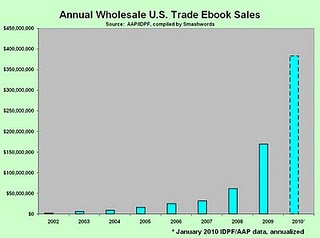
“According to the AAP (Association of American Publishers), in 2009 ebooks accounted for 3.31% of all trade book sales, up from only 1.19% in 2008. Even if sales stay flat from January onward in 2010, we’re looking at ebooks accounting for 6-8% of U.S. book sales in 2010. If sales accelerate further, a 10% monthly run rate is certainly likely by the end of this year. These numbers are dramatically higher than most reasonably-minded industry watchers predicted even a few months ago.…”

“In January, during Amazon’s quarterly earnings conference call, Jeff Bezos announced that for books it sells in both Kindle and print formats, ebooks were then accounting for 60% of unit sales.…”

“…the latest Book Industry Study Group survey.…BISG found that 47% of all ebook reading is happening not on these new-fangled devices, but on ordinary computer screens.”

https://blog.smashwords.com/2010/03/ebook-market-exploding-says-new-idpf.html

Post a comment

Why proofreading is no longer necessary

Can you raed this? Olny 55 plepoe out of 100 can. I cdnuolt blveiee that I cluod aulaclty uesdnatnrd what I was rdanieg. The phaonmneal pweor of the hmuan mnid. Aoccdrnig to rscheearch at Cmabrigde Uinervtisy, it dseno’t mtaetr in what oerdr the ltteres in a word are, the olny iproamtnt tihng is that the frsit and last ltteer be in the rghit pclae. The rset can be a taotl mses and you can still raed it whotuit a pboerlm. This is bcuseae the huamn mnid deos not raed ervey lteter by istlef, but the word as a wlohe. Azanmig huh? Yaeh and I awlyas tghuhot slpeling was ipmorantt! …

https://www.tumblr.com/tagged/huamn

-From Lew this morning. (Lew mines the webosphere daily.)

Post a comment (3 comments)

Exploded Bug poster by Peter Aschwanden

The Power of boingboing: we got over 6000 hits on our website for our septic systems book from this mention on boingboing by By Mark Frauenfelder on Feb. 23, 2010:

“The late Peter Aschwanden was best known for his extremely detailed and humorous illustrations for John Muir’s 1969 book, How to Keep Your Volkswagen Alive: A Manual of Step-by-Step Procedures for the Compleat Idiot. His cover illustration for The Septic System Owner’s Manual almost makes me wish I had a septic tank.”

At Peter’s website, you can order books, posters, and T-shirts. His “Exploded Bug” poster (above) is amazing! https://www.peteraschwanden.com

Post a comment

The revolution underway in publishing/article by Jason Epstein

Publishing: The Revolutionary Future by Jason Epstein, New York Review of Books, March 11, 2010

The publishing world is changing hugely, and fast. Strange, we don’t seem to be that affected (yet). Maybe because we do so few books and take lots of time to do each one; people are still buying them. It may also be that we’re small and can move fast, unconstrained by big corporate complexity. We’re adapting.

Charlotte Mayerson, my friend and former senior editor at Random House, sent me a link to this perceptive article by Jason Epstein, former editorial director (for 40 years) at Random House, and co-founder of The New York Review of Books, and it seems important enough to pass on. Here’s the lead paragraph:

“The transition within the book publishing industry from physical inventory stored in a warehouse and trucked to retailers to digital files stored in cyberspace and delivered almost anywhere on earth as quickly and cheaply as e-mail is now underway and irreversible. This historic shift will radically transform worldwide book publishing, the cultures it affects and on which it depends. Meanwhile, for quite different reasons, the genteel book business that I joined more than a half-century ago is already on edge, suffering from a gambler’s unbreakable addiction to risky, seasonal best sellers, many of which don’t recoup their costs, and the simultaneous deterioration of backlist, the vital annuity on which book publishers had in better days relied for year-to-year stability through bad times and good. The crisis of confidence reflects these intersecting shocks, an overspecialized marketplace dominated by high-risk ephemera and a technological shift orders of magnitude greater than the momentous evolution from monkish scriptoria to movable type launched in Gutenberg’s German city of Mainz six centuries ago.”

Full article here: https://www.nybooks.com/articles/23683

Post a comment (1 comment)

Tiny House Book Is Rolling

For the last year I’ve been saving URLs of websites, blogs, anything on the internet on the subject of tiny houses. I ended up with over 100 URLs and about a month ago I started going through them and printing out photos and text, which I then file in folders in a filing cabinet. I have maybe 70 file folders now. I have 2-3 weeks more of checking out the blogs and websites. Each reference I go to usually leads me to find other things on the web.

I have no idea right now what the book will look like. After I have all the files assembled, I’ll go through them and make notes and start figuring out the categories, and the flow of the book. Then I have to contact all the bloggers and photographers. I’ll then do non-electronic layouts, sizing photos on my 10-year-old HP color copy machine ($250 new). I’ll get Lew to look stuff over. It will then go to David for artistic tune-up, then to Rick for book construction.

I’ve got some wonderful material. There might just be a movement out there of people simplifying their lives, taking care of their own shelter needs with their own hands. Sort of looks like that to me. This is gonna be a great book! We’ll try to keep up our standards of 1000 photos per book. The vast amount of material we have in our books means that we can only pay a few major contributors. But we do offer blog and website publicity for all participants.

-Above photo from: https://www.betterbarns.com/. These guys are an example of what’s out there.

Post a comment (5 comments)