As I go though my digital photos (200,000+) — usually looking for something to do with the Rolling Homes book I’m working on — I run across photos and grab them to post here. As I said in an earlier post, this was on a trip to Vancouver Island in 2017.
On Thursday Louie and I, plus our friends Titsch and Pepe, drove up to the Noyo harbor just south of Ft. Bragg to have lunch at Silver’s At The Wharf, which is as good a seafood restaurant as there is anywhere. I not only recommend going there if you are ever in the vicinity of Fort Bragg, but also to check out the little harbor community of restaurants, fishing stores, trailer park, and other real life, non-tourist businesses at the harbor.
It’s a serious fishing port, with fairly hazardous channel lined by boulders out into the ocean. Fishermen along the coast have my utmost respect, especially if they have to get out into the ocean through the waves; not for the fainthearted, for sure. Same thing with farmers: they have to deal with the real world; so different from most other occupations.
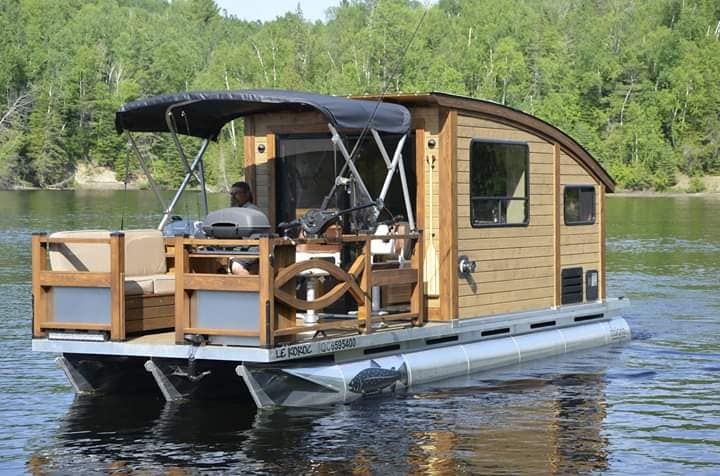
This boat caught my eye.
Statistics: Beam: 26.0 ft Tonnage: 143 GT / 97 NT Year of Build: 1982 Builder: Kelley Boat Works, Fort Bragg, CA
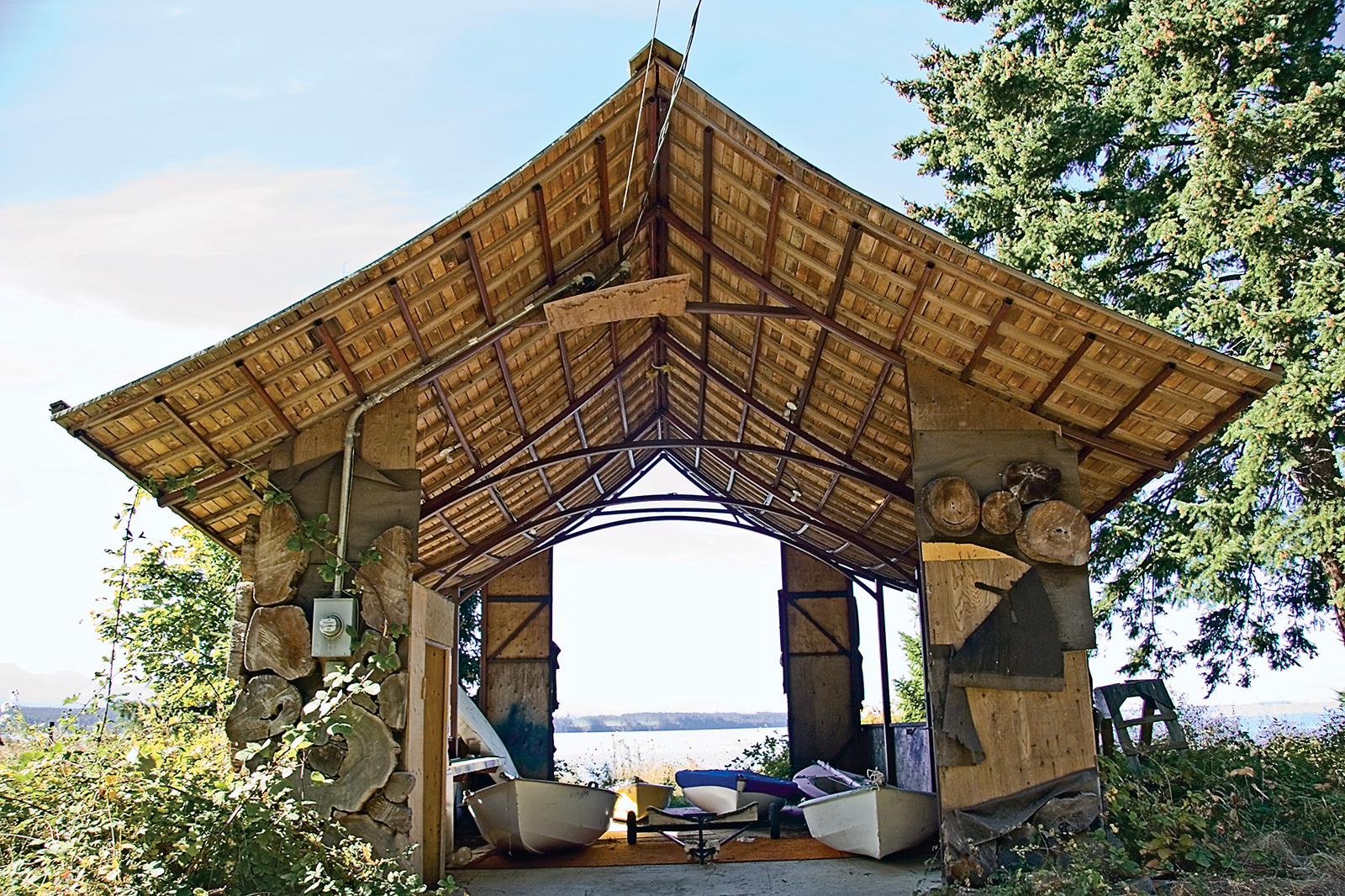
This gracefully curved little steel-frame boathouse was built by Dean Ellis on the beach of an island in the Strait of Georgia, BC. Posts are 4″–5″ steel, 8 feet on center. The curved steel purlins are 2½″ steel tubes, The curves formed on a break in a sheet metal shop. The 1″ by 6″ wood sheathing is welded to the steel purlins with nails.
The wood sheathing is connected to the steel purlins by driving nails through the roof sheathing alongside the steel purlins, then welding to the purlins with wire-fed welder.
Here is a 2020 update on Swedish world sailor Sven Yrvind, whose lifetime of solo sailing was documented in Tiny Homes on the Move (pp. 148-151). Here are a few glimpses of what we referred to as “Sven’s Next Boat” on p. 151, and a 15-minute interview.
“At sea, I can find my youth.”
Note: 30% discount on 2 or more of our books, plus free shipping and money-back-if-not-completely-satisfied (beats Amazon): www.shelterpub.com
A year or so ago, a large pine tree fell into one of the main channels of our lagoon, blocking boat access. The county finally decided to remove it. I thought they’d get a crane, but the tree company hit upon this ingenious low-tech solution: a two-canoe catamaran, decked with 2×4s and plywood, which they loaded up with chunks of the tree, then had their boat pulled with a rope to an access point, where they loaded the wood onto a truck.
Reminds me of the many ingenious low-tech workarounds I’ve seen in Mexico, like a crowbar made out of rebar, or fishermen whose gear amounts to a bottle wrapped with fishing line; they go to the beach with this in their pocket, then spool the line off the bottle twirl it around their head and cast into the surf.