I’ve admired this little floating building for years, on a local bay.
This design could be adapted to living quarters. Barbecue, beer and tables out on deck. Winch to haul boat out of water. No rent.
Brilliant design often happens in unexpected places. I find a lot of it with farm buildings.
Architecture without architects.
Tags: architecture, boats, design, DIY, fish, fishing, kayak, ocean, off-the-grid, tiny homes, tiny homes on the move, tiny houses
Treehouses in Japan built by Yuichi Takeuchi. Yuichi visited us here in 2015. He’s an artist, carpenter and treehouse builder. He said he’d been heavily inspired by our book Shelter. He was making a movie called Simplife and interviewed me.
Today I was working on a camper van he built for skiing in Japan for our forthcoming book Rolling Homes, and I came across his treehouses, which can be found at www.treeheads.com.


252285
Three side-by-side houses in SFO’s Sunset district last week.
One person commented that he had lived in one of these and that it had a 5′ by 5′ outdoor patio in the center of the house. Come to think if it, I remember such an inner patio in my friend Rod Lundquist’s mother’s house out in the avenues, it was like a light well with windows looking into it on all 4 sides. A pretty nice feature for houses that are built wall-to-wall.
The title popped into my mind and I just looked it up, nothing to do with houses, but a pretty nice opening stanza in this poem by Eugene Field, 1850-1895:
Wynken, Blynken, and Nod one night
Sailed off in a wooden shoe,
Sailed into a river of crystal light
Into a sea of dew.
“Where are you going, and what do you wish?”
The old moon asked the three.
“We have come to fish for the herring fish
That live in this beautiful sea;
Nets of silver and gold have we,”
Said Wynken, Blynken, and Nod

Michael McDonough
Rising Earth Natural Building
Troy, NY
www.risingearthbuilding.com

The works of our good friend Yogan have appeared in our last three building books. Right now I’m working on the story of his latest mobile home for our book Rolling Homes, and I ran across this photo of his present home in the woods.
This guy is prolific! See previous posts on his work, including his visit to California a few years back: www.lloydkahn.com/?s=yogan
His blog: yogan.over-blog.com

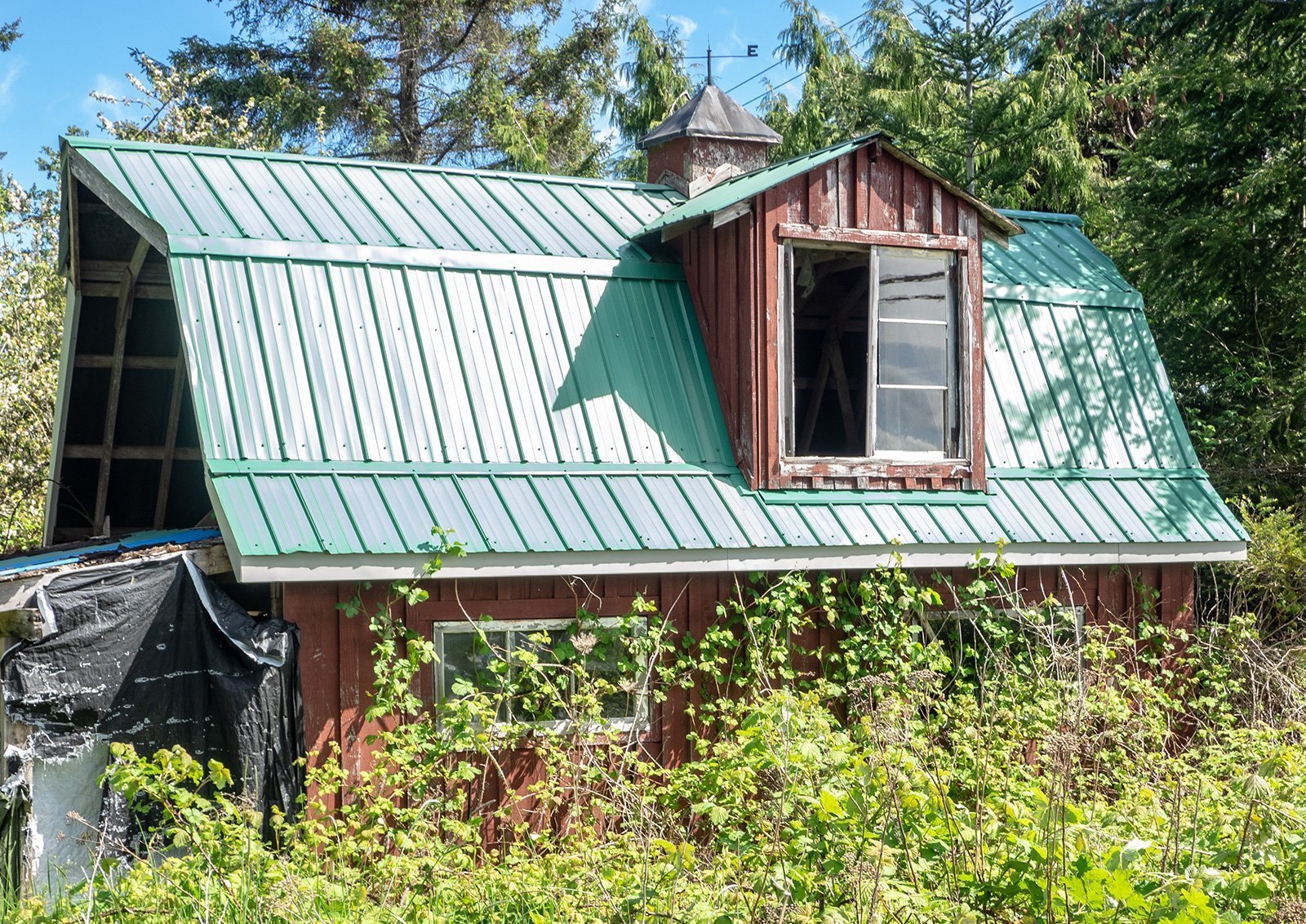
I really like the gambrel roof, where you take the gable shape, and push it up to get more headroom in the 2nd story. Big, spacious dormer nice for 2nd story.
Though it looks like it’s not being used (and there’s krappy shed attached on the left side), they’ve put a new roof on it.
Framing

There’s a lot to learn about building framing from farm buildings. Like the gussets here; attach them with construction screws and you’ve got simple, cheap connectors.

Shot on a trip in 2017, hanging out with Godfrey Stephens and Bruno Atkey…
I like a lot of things about this design, like the way the shingles flair out over the lower windows.
Too bad more people having homes built don’t just go with the thousands of well-worked-out designs like this, rather than hiring an architect, who will usually be trying to make a “statement.”
There are lots of of home-sweet-homes designs out there, worked out over centuries.