Bob Easton, who designed (and did all the hand-lettered headlines and drawings of small buildings) in Shelter with me in 1973, has been an architect ever since, and today sent me this note, along with this photo:
“…got busy this week, in the middle of renovating 120-year-old Episcopal church here in Montecito.”
The church was apparently designed by Arthur Benton in 1900.
I was a FLW fan in the early ’60s. We went to Taliesin West (on the same trip, hung out a bit with Paolo Soleri at his compound in Scottsdale, where he had just built this beautiful underground grotto/studio). Slept on the deck of a burned-down FLW house nearby. Visited the house (in Pasadena?) with imprinted concrete blocks and also got a tour of a home in Marin County by a guy named Berger who built it himself.
So FLW’s engineering sucked. He was an artist!
This was sent in by Ed today. For the thread that started the FLW conversation, see comments on this post: My Little Hut in the Woods

Just ran across this shot from a 2005 trip to Viet Nam. Sometimes a building is perfect without even knowing it.
 There are several additional accounts documenting this beautiful indigenous/vernacular style. These folks seem to be particularly organized and have published a book, that I hope can be sold here somehow or maybe even reprinted in an English language edition. Phenomenal tradition.
–Gazine Grenia
instagram.com/nalichniki

Witty redesign of quonset hut on Alameda Air Base. I think quonset huts are a much better simple design for conversion to homes than A-frames, which to me have a negative interior space.

Val is that unusual combination of creative architect and master builder. He can build what he designs!
I shot this picture of his home in 1973. There’s a long interview and about a dozen other pictures of his work in Shelter.

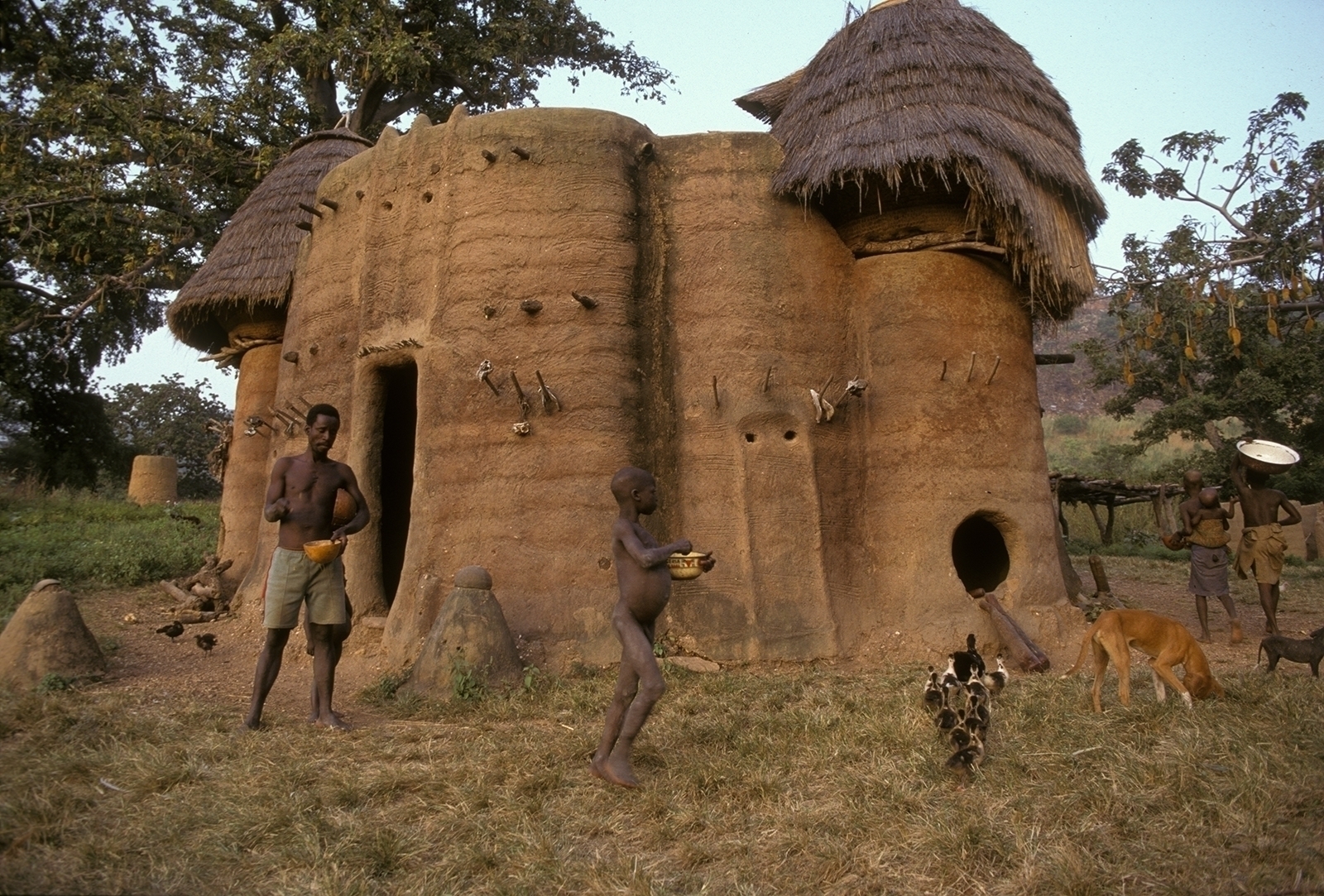
Photo by Yoshio Komatsu from his children’s book Wonderful Houses Around the World. This is next to a large baobab tree in the Tamberma region of Togo. The outside of the house is painted red with paint from the nut of the Karite tree. Bedrooms are on the second story, animals on first story. Note goose and goslings heading for their ramp on right side. Bones hanging on walls are to scare away evil spirits. Nine family members live here.

I remember seeing this cottage and reflecting on all the plastics and highly processed materials we had been using in dome construction. This was built of materials from the immediate environs and part of the land, both physically and visibly. It’s in Shelter.

Designed by my surfing friend John Stonum, who was in his final year of architecture at UC Berkeley. (I was his first client.) It had what we called a “sod roof” in those days (now called a “living roof”). I got a big load of merch-grade redwood 2×4’s at the closing out of the nearby Olema Lumber Yard for — get this — $35 per 1,000 board feet, and nailed them together on edge for the roof deck. I let them run wild on the right-hand side, so had to cut off about 14 feet of them. I started out with a hand saw, then went and rented a Skilsaw to finish the job.
I was working as an insurance broker in San Francisco and would rush home from work every night and as well, work on weekends. As the years went by, I started on a very ambitious remodeling of the old summer house on the property (in Mill Valley, Calif.), and what with the cultural revolution brewing (I was listening to Beatles records while working), my dislike of wearing a suit and increasing boredom with the business world AND a growing love of building and working with my hands, I quit my job in 1965 and went to work as a carpenter.
The roof had two layers of tar and gravel, then 2″ of coarse gravel and 4″ of earth. It was planted with chamomile and in the spring, it was covered with white blossoms.
 Dear Lloyd,
I enjoy your books and your blog very much! Thanks for that!
I just found the German book Kleinsthäuser, Ferienhäuser, Bungalows from 1959. I have never heard the term “Kleinsthäuser” which means tiny houses, so I was surprised to see that.
I attach a few pictures because I thought you might find it interesting. The first ones are showing a portable house and the second batch “Heidelberger Wochenendhaus,” i.e., Heidelberger weekend home, shows an interesting tiny house designed by two Germans.
The last picture shows two houses that were built according to a method developed in the USA in which the car is parked under the house, which is on stilts.
Kind regards,
Petra (Hegenbart)