Actually, it’s more like 120 alpacas here. I ran across this wonderful operation last week in the Willamette Valley south of Portland. For one thing, they grow barley sprouts to feed the animals—25 tons a year—something they tell me is being done on large scale by some dairies, especially in Europe. It’s not all the food for the animals (they also graze), but a significant amount—high in protein, produced on site, a win-winner. No fossil fuels used.
They were shearing the alpacas and I shot photos.
Wings and A Prayer, 18100 S. Hwy. 99W, Amity, OR 97101
“…This lion, after being imprisoned in a circus for 13 years in a tiny, fetid cage where he could barely move, had the opportunity to touch the earth and the grass for the first time when he arrived at the Ranch of the Gnomes. The video captures this first contact at the time of his release to his new home.…”
Guest editorial by Wayne Jacintho* posted in The Garden Island newspaper July 29, 2013:
Kauai’s chemical companies (seed farmers) like to tell us they’re feeding the world. Using poisons and genetic engineering, they’ve helped give us an Everest of cheap federally subsidized corn that is fed to cattle, which gives us cheap beef. Since looking into this feeding of grain to a grass-eater, I no longer eat cheap beef. I buy local, and I’d like to tell you why.
My story begins with Michael Pollan’s “The Omnivore’s Dilemma,” a book about three sources of meals: American Agribusiness, organic farms, and hunting/gathering. In chapter 4, “The Feedlot”, Pollan purchases an eight-month-old steer in South Dakota and follows his steer to a feedlot in Kansas where it will be fattened for slaughter. He smells the lot’s stench more than a mile before seeing: 37,000 cattle, a hundred or so per pen, standing or lying in a gray slurry of feces, urine and mud, as far as the eye can see.
His steer will exist briefly in this place so different from a farm or ranch that a new name had to be invented: Concentrated Animal Feeding Operation, or CAFO, which could not exist without corn that cost CAFOs less to buy than it does to grow, corn that has “found its way into the diet of [cattle] that never used to eat much of it … In their short history, CAFOs have produced more than their share … of polluted water and air, toxic wastes [and] novel and deadly pathogens” and a waste pollution problem “which seldom is remedied at all.”
Rain, rain, go away — just kidding — it’s wonderful. More rainfall as of this date (December 17th) than in the last 10 years. 20-1/2″ so far, and TOTAL rainfall for the past 3 years has been 23-24″ per year (June is end of season). California (at least coastal) is starting to pull through. The big boy, Shasta Lake (visible from Interstate 5) is 32% full as compared to normal of 52% this time of year; it’s a good start. Come on low pressure, stick around, keep on keepin the storm track open…
Last night I was driving home about 9:30 in the pitch-black rainy night along the coast, Billy Boy Arnold playing a blues song, when a coyote appeared, trotting along the left side of the road. I pulled alongside him, rolled the window down and turned up the music full blast. He ambled along, glancing over at me, seemingly unconcerned, for 20-30 seconds before veering off into the coyote (sic) brush. Wily, mos def…
Actually 2 days before the full moon, but it was bright last night. I headed out on my usual Tuesday night solo run—well, vigorous hike is more like it. Beach beautiful, with a 100-foot long glistening inland pond in moonlight, no one there, I had one of those almost chilling moments, surrounded by such beauty, alone, waves breaking, negative ions up the kazoo, super energizing of chi…
I started out in a down parka and gloves, brrrr…I don’t feel like going out into the cold night, but as always, the heart likes to pump, and pretty soon I take off the parka and gloves and climb the hills in a t-shirt. Circulation, circulation, circulation…
As I came back down into the valley, a coyote startled me. It was so close, and so beautiful. There were 2 of them close by and another at a distance. They were singing. Totally. One did a yodel, starting high, then breaking voice down to lower sustained note. Then a distant coyote would respond. Oh my!
I heard this about Australian aborigines: the smoke signals don’t contain the message. Rather, they’re a notice to a group maybe a few miles away to tune into psychic forces and get a telepathic message. Wow!
On the way home, moonlight streaming across the ocean, on Little Steven’s Underground Garage (Sirius): “Beautiful Delilah” by the Kinks, followed by Chuck Berry doing same (his) song. https://grooveshark.com/s/Beautiful+Delilah/2725La?src=5
“The skulls on display in the Academy’s 4,000-square-foot second-floor Forum Theater and Gallery range from an enormous African bull elephant to a tiny bat, from frogs and fish to giraffes and walruses. There are interactive displays that simulate the vision of predator and prey, and allow visitors to be hands-on with cast skulls. Another part of the exhibit shows live dermestid beetle larvae cleaning delicate bones (the larvae can scour the flesh of a small skull in three days). And there is an interactive 3-D display developed by Google that allows visitors to view skulls from various angles.
“A skull provides important information about a species’ evolution and reveals secrets about that individual animal’s life,” said Moe Flannery, collections manager of ornithology and mammalogy at the academy.
Walking through the exhibit, Flannery added, “By searching for clues written in the bone, we can follow the story of an animal’s life, from birth to old age. We can learn what the animal ate, how it defended itself, communicated, interacted with its environment, and often how it died – all by looking at its skull.…”
Intersections with the natural world the past few days: I studied water skeeters in a hill pond Tuesday; a brilliant design by mother nature. They float on 6 legs; 4 long ones for skittering and 2 short legs in front. They move mostly with breaststrokes of the 2 front legs and when startled just zoom. I was transfixed, watched them for 5 minutes or so, the fact they float on their legs…Doug saw a young mountain lion; we always look for the long tail to be sure it’s not a big bobcat…Yes, a long tail, he said, also that it appeared to be a young one, with spots on its skin…I saw a big healthy coyote crossing the road Tuesday night…Yesterday I paddled my kayak across the bay and dug clams…saw 4 of the huge American Pelicans; wingspan of 8-10 feet…harvested some seaweed — Macrocystis integrifolia, a smaller cousin of giant kelp; I’ve been bringing home all kinds of seaweed and this one appears promising. It’s flavorful, with salt crystals that sparkle when it’s dried. I’m grinding it and using it instead of salt on meat, vegetables. salad.
Maybe 15 years ago we had a fox that would appear when we were barbecuing. We’d give him little pieces of meat — not a lot, we didn’t want him to get dependent on humanoids. He was very cautious, always ready to flee. He was a joy to see, to get so close to an elegant wild creature. But there was a period where all the mid-sized critters — foxes, skunks, raccoons, possums — died off from distemper or something. Now they’re coming back.
This little guy has been skirting our half-acre the past few weeks — looks like a juvenile. A few days ago he was on my woodpile. I was about 20 feet away, standing stock still and we locked eyes. He craned his head in and out, I guess getting multiple takes on me.
Yesterday he nestled into a hollow spot on the (living) roof of the chicken coop.
Also on the wild creature front: in the last week I’ve caught 2 hummingbirds. They fly into the office kitchen and can’t get out. It’s easy to catch them. Once they’re in my cupped hands, they seem to relax. I’ll always find someone around to see when I release them. When I open my hands, they sit there a split second, green feathers shimmering in the sunlight. Then vooom! Off like a little helicopter.


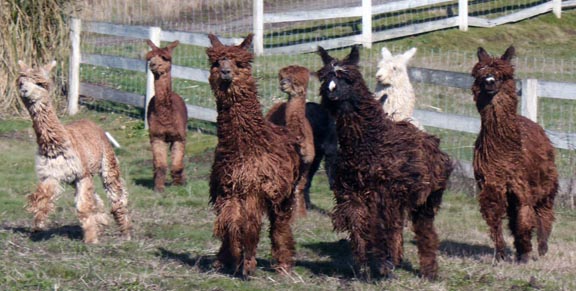 Actually, it’s more like 120 alpacas here. I ran across this wonderful operation last week in the Willamette Valley south of Portland. For one thing, they grow barley sprouts to feed the animals—25 tons a year—something they tell me is being done on large scale by some dairies, especially in Europe. It’s not all the food for the animals (they also graze), but a significant amount—high in protein, produced on site, a win-winner. No fossil fuels used.