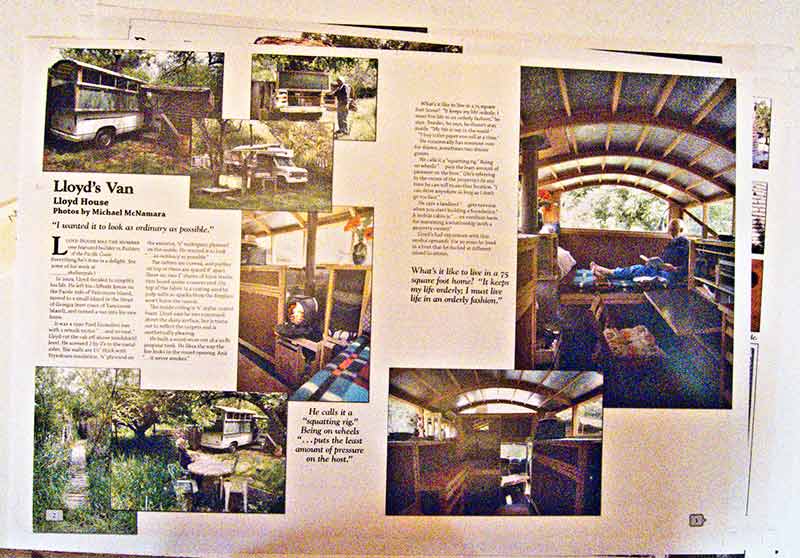
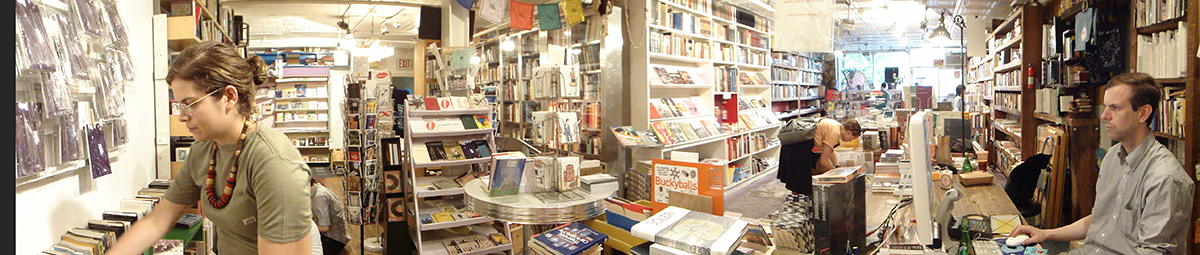
There are always going to be what are now called “print books.” Those you hold in your hand and don’t need electricity to read. There will always be independent bookstores, as I realized upon going into the Spoonbill & Sugartown bookstore on Bedford Avenue in Brooklyn last night. It felt so right. My type of books, my type of bookstore, obviously run by book lovers. A place I can spend a lot of happy time browsing. I was turned on to it by Bill Getz, the Publishers Group West sales rep for the NYC area, who said he loved the place.
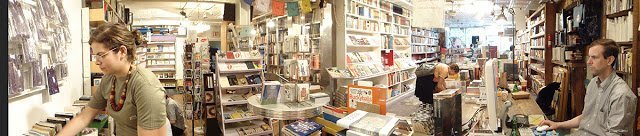 Sean and Janice knew who I was. Sean said be thought they had sold maybe 1000 copies of Shelter. He looked in his data base and said they’d sold 108 copies of Builders of the Pacific Coast and 70 copies of Home Work. Wow.
If we could only get more independent bookstores to display our books face-out like this. If people pick up our books, we’re off and running.
They have used as well as new books, and in the back room were original copies of Steve Baer’s Dome Cookbook ($165) and our Domebook One ($120). Extremely rare books. 218 Bedford Ave in Williamsburg (Brooklyn); take the L train from 14th street, get off at the 1st stop in Brooklyn and check out this hip neighborhood. It’s got a buzz.
 Several people told me that Brooklyn is the new Village, i.e. rents are so high in Manhattan that people have moved out. Several things led me out there last night: I’d heard that the Spoonbill & Sugartown bookstore was selling a ton of our books, Bedford Avenue sounded hip, and I wanted to hear The Baby Soda Jazz Band, playing that night at a brewpub in the hood.
For many years in my visits here I’d avoid subways, walking many miles and taking cabs. Intimidated by being underground, never sure which train to take. Several years ago I realized this was stupid, and got back into subway travel by going out to Coney Island (in the winter). That got me back into it.
The subway trip out to the Williamsburg area of Brooklyn is short and simple. I came up and walked to Bedford Ave. and felt immediately at home. It’s quiet. That is, compared to the laser intensity of Manhattan. Relaxed. A skateboarder whipped down the street. I saw a bunch of great stuff in what you might call an antique store, called Ugly Luggage. There was an old Underwood typewriter and boy was it fun to hit mechanical keys for a change. (I bet my writing would be better if I used a mechanical type writer — yeah, duh!) I liked just about everything in the store and ended up buying this little 1934 Boy Scout Diary, partly filled out way back when. (I was born in 1935.) It belonged to Victor Teinour of Slatedale, Pennsylvania There are pages of drawings of storm cloud formations, trees, plants, fish, music for bugle calls, etc. It’s about 2″ X 6.” Good vibes.

 Michael Moore showed up yesterday in cargo shorts and signed copies of his new book, Here Comes Trouble: Stories From My Life. He clearly enjoys people and posed for a photo with each person.
 “The Langston Hughes Library is a private non-circulating library designed by Maya Lin (most famous for her Vietnam Veteran’s Memorial in Washington DC), and located on the Haley Farm in Clinton, TN. It contains a 5,000-volume reference collection focusing on works by African-American authors and illustrator, and books focused on the Black experience.…
An 1860s refurbished barn and two corn cribs comprise the exterior skin of the building. The rustic exterior, which evokes the ‘architectural vernacular of 19th-century East Tennessee, a plain language of silvery, time-worn siding, rough logs, and minimal geometries,’ is melded with modern Shaker-like simplicity on the interior.
Maya Lin pointed out that the function of the exterior and that of the interior were different and thus she ‘wanted to make a real cut between outside and inside…there didn’t seem to be much point in preserving the rustic feel of the barn’s interior.’
…A striking aspect of the design (is) the glass-encased corn cribs that act as a base for the cantelievered barn that sits atop them. Margaret Butler of Martella Associates states that the glass between the logs ‘glows like a Chinese lantern’ at night…”
Abovehttps://en.wikipedia.org/wiki/Langston_Hughes_Library
Maya Lin’s website: https://www.mayalin.com/
 Our book Getting Back in Shape, by Bob Anderson (author of Stretching), and Bill Pearl (author of Getting Stronger), has just been translated into Lithuanian. Stretching has been translated into 23 languages, the latest a pocketbook edition by Random House in Germany.
You can see the listing of the 60+ foreign editions of our books at: https://is.gd/shfor, including Shelter and HomeWork in Japanese. Both these books, plus Builders of the Pacific Coast, are in Korean. HomeWork is also in French.
I will be going to the Frankfurt Book Fair this October, especially to sell rights to our book on tiny houses, which it appears, will be of interest all over the world.
It’s a great thing to connect with people in other countries. “California to Universe, do you read me?” (This morning we got an order from Austria to ship all 8 of our building books to an address in Brazil!)
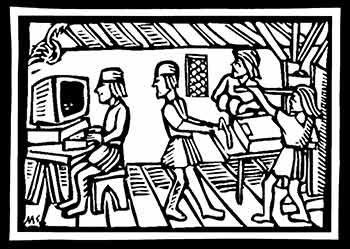
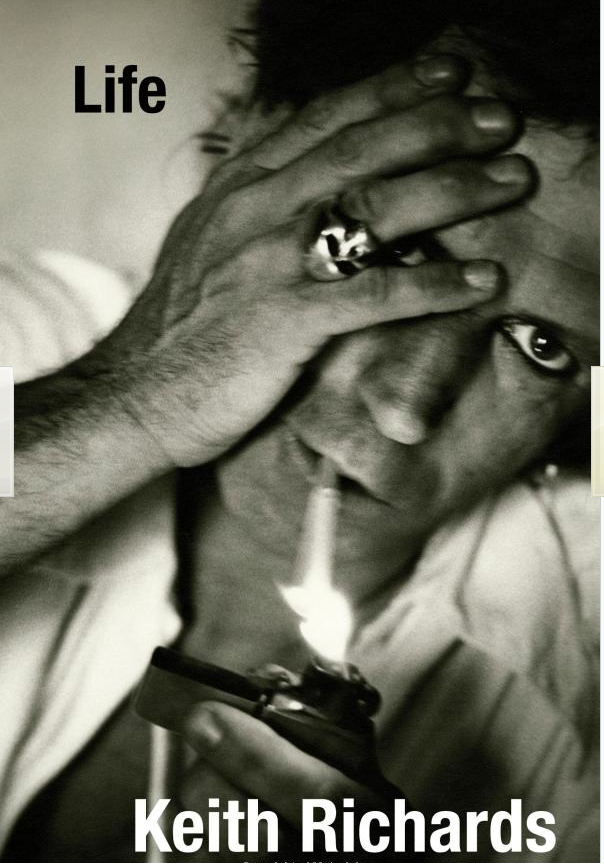
Because I’m such a modern guy, I downloaded Keith Richards” Life on my iPad, read it, and really liked it (see previous posting).
OK, the plot thickens: my son Will is a musician, living in Santa Cruz (Calif.) and is working with engineer Rich Williams of Paradise Recording studio on a recording device that, in Will’s words: “… (uses) analog tape to get a sound that feels good. Analog recording is like a hand built home, whereas digital recording is analogous to a prefab house. This way is old fashioned, imperfect, and feels better.”
If you read my previous post about what the Stones were doing 40+ years ago, it sounds a lot like what Paradise recordings’ hardware is doing in the 21st century. Why am I not surprised that deviating from the purely digital can up the soul factor?
Read More …
 Stones fans (and blues guitar players): You’re gonna love this book. What a surprise! It’s not perfect, but in parts is insightful, truthful, and informative. Way interesting background stuff on this phenomenal band.
I enjoyed it immensely. There was a fascinating part about Keith plying an acoustic guitar directly into a cassette recorder and distorting the sound to get the desired effect. They were getting electric guitar out of acoustic guitar in ways you can’t do with today’s digital recording apparatus. I remember listening to a Stones song back in the day as I was returning to reality from an, ahem, chemically-enhanced state of consciousness. What was this sound? It was as if they were distorting time, stretching it, and compressing it.
The book explains how the Keith and Mick couldn’t believe that Americans were so largely unaware of Mississippi/Texas.Chicago blues music, their tangled relationship, how they wrote songs together, Keith’s formidable heroin/cocaine habits… It’s startling in its honesty about a lot of stuff. (And it also led me indirectly to an epiphany about ebooks, which I’ll tackle in another post.)
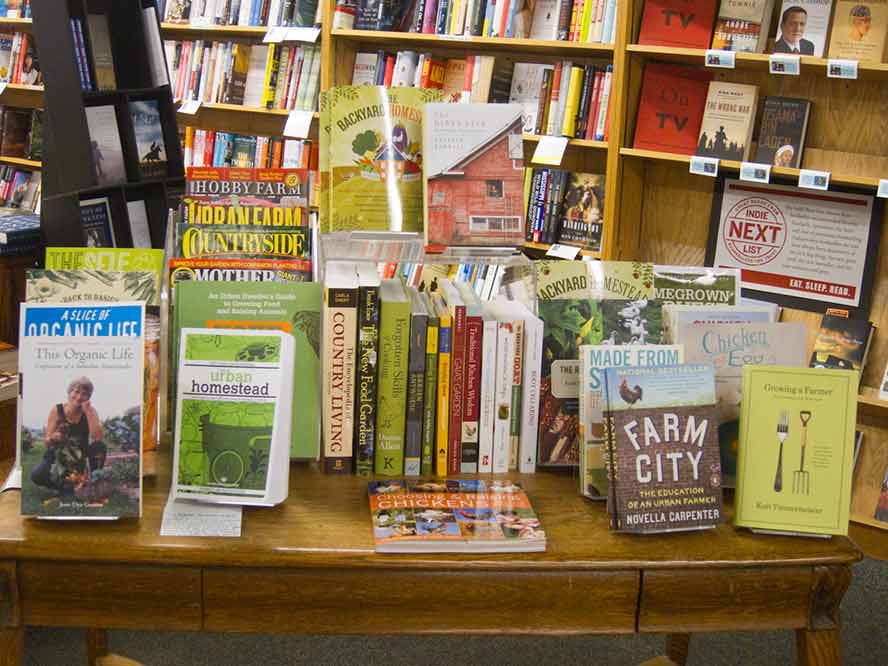
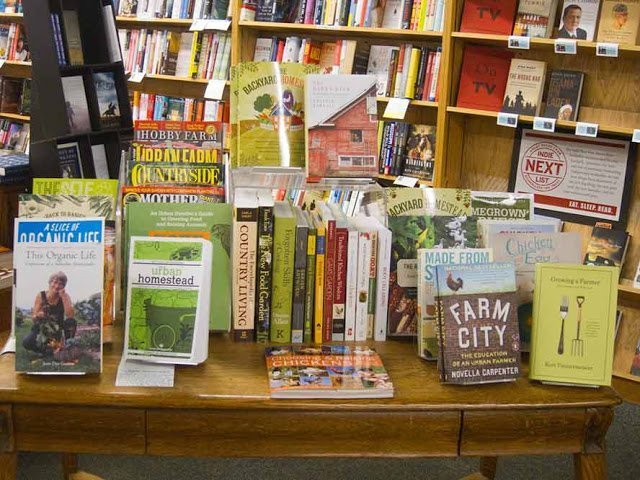 When in Santa Cruz last week we went to Bookshop Santa Cruz, a wonderful bookstore. It’s in the tradition of The Tattered Cover in Denver, with tons of books face-out, chairs and couches to sit in, helpful bibliophile staff, intelligent arrangement of titles. Here’s a table reflecting the recent upsurge of interest in growing (at least some of) your own food, whether you live in the city or country. The book at top right with the red barn is titled The Dirty Life: A Memoir of Farming, Food, and Love, by Kristin Kimball, which has got rave reviews. (I mention it here because you can’t read the title in the photo.) Another great bookstore I visited recently was Copperfield’s in Healdsburg, Calif. It seemed like most of the titles were on tables, face-out. For those of us who love books, there ain’t nothin like a real bookstore.
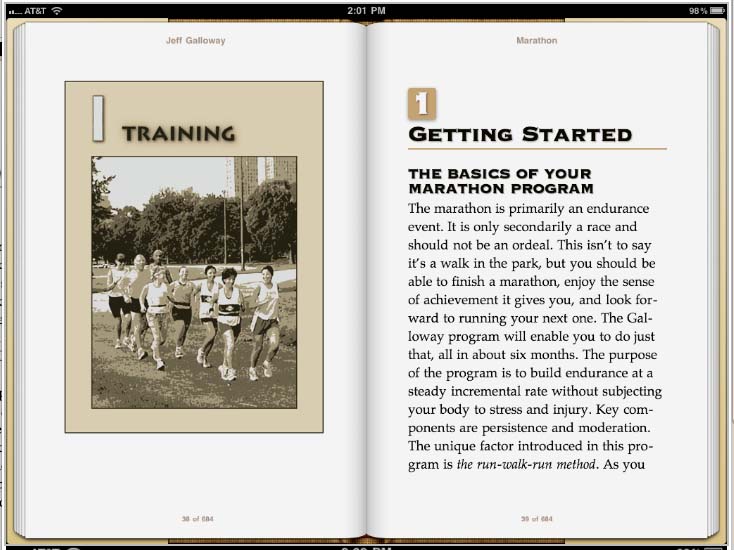
Of interest to marathoners (or those who want to run their first one): Shelter Mac wizard Rick Gordon has just finished preparing Jeff Galloway’s revolutionary marathon training book for both the iPad and the Kindle, and I kid you not, it really looks good. It makes the majority of iPad books look dowdy. The graphics, colors, and tables are elegant.
It also works on an iPhone: you can carry your training program in your pocket. Marathoners. click below for more info.
 Read More …
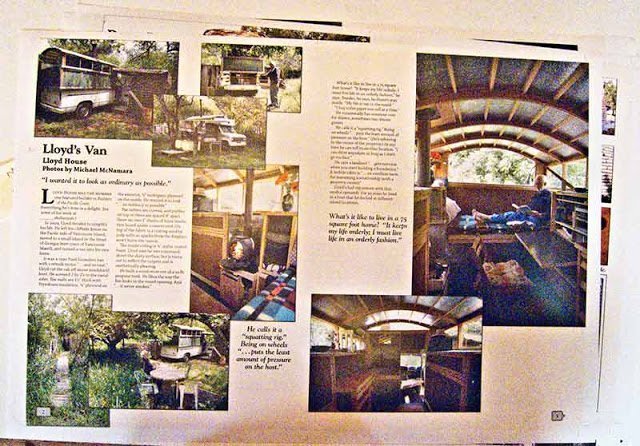 A few days ago I wrote about doing my original layout of books on paper, not on the computer. Owl posted this comment:
“One of the aspects I enjoy about the LK books I have is the ease of reading them. I find my eye travels quite naturally around the page and there is a flow to the whole book. It doesn’t surprise me that they are laid out on paper during the assembly/construction after all, if the intention is to produce a physical book I would have thought it is best to design the book as close to the finished piece as you can. In the same way if I was putting together an e-book I would want to design it on something that is going to give the feel of the reader most likely to be used.
While a computer is a powerful and useful tool I feel they can only simulate a physical medium and hint at the tactile qualities.”
(Above layout is very rough.)


 Sean and Janice knew who I was. Sean said be thought they had sold maybe 1000 copies of Shelter. He looked in his data base and said they’d sold 108 copies of Builders of the Pacific Coast and 70 copies of Home Work. Wow.