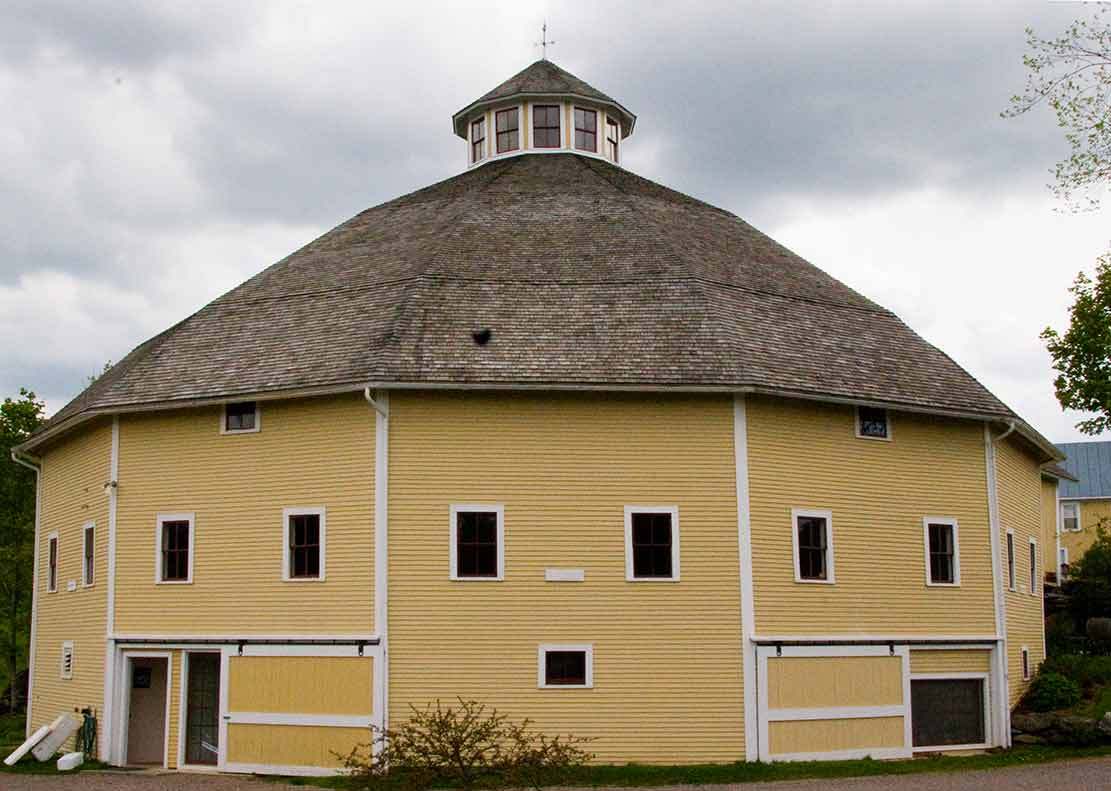
Too bad that the hundreds of houses at the coastal development Sea Ranch, which were supposed to be modeled on local farm buildings such as this one, turned out to be so sterile. The one part of Sea Ranch design that did work, was the landscaping by landscape designer Lawrence Halprin; he basically left the natural vegetation as is.


Ward Hensill builds these unique tiny buildings in Bodega, Calif. He uses 1⅛″ plywood, and it is screwed together — no nails. The pop-out windows give them a much bigger feel than you’d expect with only 120 sq. ft. of floor space.
More info: www.bodegaportablebuildings.com

These last 4 days, we had a visit from Steve Pezman, the co-creator and recently-retired editor of Surfer’s Journal, and his long-time surfing buddy, photographer Leo Hetzel. Steve interviewed me and Leo shot photos for an article in the magazine. We talked about the old days, among other things, and this was the cover of a scrapbook I made of a surfing trip to Costa Rica in 1990. It shows Kurt Van Dyke on the balcony of his hotel for surfers in Puerto Viejo, on the Caribbean coast southeast of Puerto Limón. When he saw me about to take a picture, Kurt said, “Classic, eh?”
(I have a long history with the Van Dyke family. Betty Van Dyke is one of my oldest and very best friends, and I hung out with Peter Van Dyke in the ’50s; Kurt is Betty’s son.)

Looks like it’s behind Seal Rocks.

They don’t have the noble head of a hawk or a falcon, but they are masters of flight — cruising the updrafts, looking for rotting meat.

It looks pretty sound. (I shot this a few years ago.) New roof. The eaves all look good, no sagging from a bad foundation. I like the funky colors. I bet it’s been fixed up by now. (It looks like it’s been prepped for paintng.)
 I hate to rain on anyone’s parade, what with all the recent euphoria over decriminalizing cannabis, but — having smoked pot for over 50 years — I offer herewith some first-hand experience:
I never considered myself a stoner. I wasn’t stoned all the time. Over that period of time I might have smoked the equivalent of a joint or two per week. I started when I was 28 years old, and it did indeed change my life. It got me on to the right side of my brain and gave me a new way to look at life. I quit my job as an insurance broker soon thereafter, and started exploring other worlds. Cannabis was a key element in the changes I went through in the ’60s,* and has enriched my life greatly overall. Credit where due.
HOWEVER:
- My lungs didn’t feel so good about 5 years ago and I started vaping. But even that proved irritating, so I’ve gone to using tinctures. I had my lungs checked and nothing turned up, but I know what I feel. “You don’t need a weatherman…” If you’ve used a bong, what about the tar that accumulated on the glass? When you’re smoking a joint — or a pipe — you’re pulling all this stuff through your lungs. When you use a Bic lighter with a pipe, what are you inhaling? Think about it.
- A lot of commercial pot has been chemically fertilized and when necessary, sprayed with toxic chemicals to combat pests. I saw a survey that tested many samples from a dispensary, and the vast majority contained traces of insecticides (i.e. Avid or Eagle 20).** An organic grower friend once said to me. “They’re smoking paraquat!” (Not really, but you get the idea.) If one of these big growers gets spider mites in his $20,000 crop, what do you think he’s going to do?
- KNOW YOUR GROWER. People buy only organic produce, yet smoke pot without any assurance that it’s pesticide-free. You should know how your pot was grown. Do you think hydroponic pot is the same as if grown in soil? Is it grown under lights, with fans, using lots of electricity to do something that the sun can do au naturel? Ask your grower where the water comes from, fertilizers used, what is done to combat critters like spider mites? Natural predators? And etc..
The psychoactive benefits are indeed wonderful, so I would look to other ways to imbibe. Vaping instead of smoking; it cuts down on a lot of particulates that you’d otherwise be pulling through your lungs. High-quality tinctures and edibles (and not over-consuming, as is so easy to do. “I ate the whole brownie and couldn’t find my way home”).
Just sayin’…
Note: I’m only talking about smoking here. Cannabis is a miracle plant for healing. Hemp (same family) is wonderful for food, fiber, insulation, construction…
*See my book-in-progress on the ’60s under the above button.
**Do Google search for Avid and Eagle 20…
PS Someone just came by, looked at all this, and said:”Well, duh…”

1960, me (at left) and my Stinson beach lifeguard friends in Mill Valley about to take off on a surfing trip to the Point Reyes Peninsula in my 1937 Chevy (with square-cut gears) truck. This was a few years before everything started to change.
Getting It Wrong…
In 2017, there was a media blitz on “The 50th Anniversary of the Summer of Love.” There were TV shows, magazine and online articles, and museum exhibits on what supposedly took place in San Francisco in the summer of 1967.
I read all these stories and articles, watched the films, went to the exhibits, and was puzzled. This wasn’t the way I saw it, and I was there. There were a bunch of things wrong with all this coverage:
What the ’60s Wasn’t
- The “summer of love” was a disaster. An estimated 100,000 kids trekked to San Francisco, most of them looking for drugs, sex, and rock and roll. A lot of them inspired by the lame song about wearing flowers in your hair if you came to San Francisco. The city wasn’t prepared for the inundation; the Haight-Ashbury neighborhood was overwhelmed. There wasn’t enough food, housing, or sanitation for the influx. Things deteriorated rapidly.
- Secondly, the Haight Ashbury district wasn’t the ’60s.
“The Haight-Ashbury was a neighborhood. The ’60s was a movement.”
–Ken Kesey
Kesey nails it here, as he did so often. The media has focused on the Haight-Ashbury, since it’s been so well documented, and it’s easy to interview people who were there.
But the ’60s was about much more than the Haight, it was about a lot more than rock and roll and smoking pot and living in old Victorians in San Francisco.
It was nationwide, arguably worldwide, and it encompassed a staggering variety of subjects and events and changes.
- Most of the books, films, articles, and exhibits about the ’60s are by people who weren’t there — second-hand accounts.
My first thoughts were that these versions didn’t reflect what really happened.
Read More …