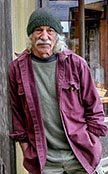
Ain't She Sweet, The Invisibility of Old Guys, Back from Canada, Working Out

My First Music Gig

(Well, the first in 50 years*)

My mom is 99 and is living in a rest home. She lives in a wing with ladies in their 80s and 90s, maybe 15 of them. As are many people of this age, they have varying degrees of forgetfulness or confusion. Yesterday I took over my ukulele and sang songs with them. My repertoire of uke songs consists mostly of old tunes from the ’20s and ’30s’ like of the flapper era. When I played the uke in high school, these were the type songs that had ukulele arrangements.

The ladies had been playing Bingo and were all sitting around a table, looking bored. Boredom is a big problem for people in retirement homes. I was a bit nervous, but Clara, one of the caregivers, urged me on. She said they’d love it. I took the uke out of the case – none of them knew what I was going to do – tuned it, then played and sang Five Foot Two.

Five foot two

Eyes of blue

But oh what those five feet can do,

Has anybody seen my gal

By god, they all sat up. Sparkles came into eyes.

Turned up nose,

Turned down hose,

Never had no other beaus,

Has anybody seen my gal

It was a hit! Some of them were bouncing to the music. Big smiles. One lady, sitting next to my mom, was singing along, as were maybe 6-7 of them, and she had a clear, lovely voice. I focused on her and we sang together. Her eyes were bright and shining. She could really sing. Another lady, who I’d seen before, and always looked pretty out of it, never smiling, was transformed. Her face lit up, and she sang along. One of the caregiver girls was dancing in the background.

Bye Bye Blackbird/Ja-Da/When You Wore a Tulip/Over the Rainbow/Toot Toot Tootsie/My Little Grass Shack/Coney Island Baby/Singin’ in the Rain/Ain’t Gonna Study War No More/Peg O’ My Heart. We must have sung 30 songs. I was sweating. It was fun!

They liked the peppy ones like Ain’t She Sweet, but they also seemed to love the sentimental ones, which I ended up singing to them, like I’m In the Mood For Love, or I’ll See You in My Dreams. They clapped after each song. It was a very forgiving audience

Music can transform people. It cuts through everything, direct to the heart. I realized that these were the songs that these ladies had danced to and listened to with their beaus in the 30’s, and they (the songs) are mostly forgotten now. They want a return engagement this Sunday. I’m starting to practice at night. A few of them wanted to pay me and one said she was going to give me $750. I told her cash, check or money order.

*In high school (Lowell High, San Francisco, class of ’52), we had a quartet called “The Uncalled Four” and sang at rallies and parties. I had a Martin ukulele and one guy played the washtub bass. (One of our members was Bill Bixby, who went on to fame and fortune (The Incredible Hulk, My Favorite Martian, etc.)

The Invisibility of Old Guys

Grey hair has meant I can walk down the street virtually unnoticed. There’s none of the former sparring around with alpha males. I’m not considered a threat. And women? I saw an old friend recently, a guy who was a dashing figure in his earlier days; girls always noticed him. He said, “I walk down the street now and women don’t even see me.” When I’m in my reporter’s mode it’s great to go unnoticed. At times I wish I could be invisible, so I could observe “purely,” as it were, without my presence (and camera) altering the people I’m observing. Maybe by the time I’m 80 I’ll be totally invisible.

Back from Canada

I got back about 10 days ago from a trip shooting photos of carpenters and their work in and around Vancouver island, B. C. It takes me about this long to decompress, to get back into home mode. I’m pretty whacked out when I travel. On the road I operate at about 50% of my normal energy. A different bed every night, long periods driving. But at the same time I love it. Going down a road I’ve never been down before. It’s hunting, except with a camera instead of gun. I love the Pacific Northwest and the people up there. It was a great trip in terms of gathering material and hanging out with new-found sympático friends. The worst thing was not working out for a month. Hard on the body. When I get back and start running or paddling again, I get such a rush of energy and good-feeling. It’s a very real addiction,

Working Out

Bob Anderson, the author of Stretching, says “You never hear anyone say, ‘I’m sorry I worked out.'” Often I’m just too lazy or comfortable to get out and run or surf, but every single time I do I feel great. It never fails. If I make myself jump in a cold creek, I end up feeling incredible. Gotta do stuff like that more often. Talking to myself here.

Post a comment (3 comments)

Blogging from Vancouver

This is my 28th day on the road and I’m in a light airy apartment of friends in Vancouver getting ready to head south and home. Yesterday I finished my final shoot in the rain (what else?) of a sculptural house on a small island off the coast of West Vancouver. Hey, that’s a wrap, I thought, feeling movie-director-like, and now I get to head on down the road to home sweet home.

I’ve been cold every day (off and on) for a month. Home-made muffler and Alpaca wool hat, 5 layers of clothing, gloves, rain boots, and still a shock each time I get out of my truck. Rain, snow, hail, wind, towering white clouds and fast-moving water-laden black clouds. One day of magical snow on Hornby Island. The trees grow like mad here in the Northwest. People living in the country have to beat back the ever-encroaching woods. I asked a guy in Tofino what the rainfall was and he said “Ten feet.” But the great thing about winter here is the lack of tourists. Tofino (“Tough Town”), the picturesque seaside town on the west coast of Vancouver Island, is a dream this time of year. Down to the locals, no strolling crowds, good vibes.

Here are a few things this San Francisco-based observer has observed up here, meaning Vancouver Island and vicinity:

  1. People are more competent. They have to cope with tough weather. Nature slaps you around. There are a lot of young people who can do real stuff: building, fishing, gardening, welding. People seem sincere, straightforward; it’s a relief to get out of California for a while.
  2. Native culture and art are still very powerful here. Most of the Northwest Indians may have been wiped out by Whitey, but a lot of the strong ones have survived. You see native people everywhere and the art (totems, masks, paintings) is vibrant and alive.
  3. This is sea-people country. It’s a water wonderland, with not only the ocean, but inlets, passageways, fijords, islands, thousands of miles of every conceivable type of waterway, and there are boats of every description everywhere.
  4. And finally, the carpentry: before I came up here for the first time last year, a friend said “You don’t have anything in Home Work like the buildings up north.” Lo and behold, he was right. This is my 3rd trip (out of 4) to Vancouver Island and vicinity shooting photos for a book, Builders of the Pacific Northwest Coast, and I’ve been constantly delighted by the creativity and craftsmanship of these carpenters.

Vancouver is a wonderful city. Clean, brght, on the sea. I just had the best meal of the trip (actually out of a lot of good meals) at Restaurante Baru Latino on Alma Street. The great feeling when you realize that every bit of food has been carefully and lovingly prepared. I started talking to the chef, who was a sympático soul, and asked him if there were any good blues clubs in Vancouver and he directed me to The Yale Hotel (at Granville and Drake) and it turned out to be a large rambling room with pool table, plenty of tables, bar and dance floor in a 170-year-old building, and talk about good vibes! The band was Texas Flood, so named after a Stevie Ray Vaughn Album, and sure enough they were channeling Stevie, down to the guitar player wearing a Stevie-type hat. Turns out to be a great venue. James Cotton had been there a few weeks back, the Reggae Cowboys the night before, Walter Trout the next week. There isn’t really a blues club like this in San Francisco.

Well, so much for my plans to blog frequently on my trip — just didn’t work out that way. I DID keep up with my email, but never seemed to have time to post anything. I’ll try to get some stuff up when I return home, after I get through the first week of decompressing and unloading info (2,500 photos among other data). Tomorrow I’m headin’ south!

Post a comment

On the Road Dispatch from Portland

I’m off on a month-long trip shooting photos for our next major book, Builders of the Northwest Coast. I’ve been on the road 5 days now and it’s been magical — sorry, no other word to describe what’s been happening. Driving over to a somewhat remote mountain hot springs center to talk to Sun Ray Kelley, things started getting good as I got into snow. When I got to the resort I found, to my complete surprise, an unbelievable masterpiece of a building. I spent 2 days photographing it and talking to Sun Ray, a most remarkable man.

Then I drove over to the Mendocino coast to hang out with my friend Louie for a few days. I lucked into some great music Saturday night at Bones Bar-B-Q & Blues club in Gualala. Four young locals from Ft. Bragg, blue grass and blues and it was one of those nights. Pretty soon every single person in the room (20-25 people maybe), including waitresses and burly bouncer, was dancing. Total band/audience rapport.

I took off yesterday, Monday, drove over to Clearlake where 1000s of seagulls were spectacularly present in the blue waters, then got on Highway 5 north. I went into the town of Mt. Shasta and lucked out in the body department. I took a sauna and then had some extraordinary bodywork done by Michael Bueno at the newly-opened Sacred Mountain Retreat. He unlocked all kinds of tensions and helped with my sports injuries. I’ve had tons of body work, and this was extraordinary. Is this guy good for athletes!

Sacred Mountain Spa, Mt. Shasta City, CA

Had a hamburger and vanilla malt at an all-night diner in Medford, Oregon around midnight. Good! Classic burger. Malt made with real ice cream, and a lot left in the stainless shake container placed on the counter. Good burger and shake: American masterpiece.

I slept in my truck (20 degrees), warm down bag, for 3-4 hours last night. Had great breakfast in Eugene at Zenon cafe. Fresh-made chicken-apple sausage.

I’m sitting in a very cool coffee shop, the Stumptown Roastery, in Portland. Is this a great town! I decided I’d try to drive into town and scope it out cold and it worked. Found a good street with bunch of cafes, asked someone and got directed to this very homey part of town. The neighborhood with cute charming frame houses, with big back yards, not all gussied up like in San Francisco. Nice people everywhere. I’m going to talk to a bunch of art students from Reed college tomorrow, then head up to Victoria.

Post a comment

Builders of the Northwest Coast, Mongolian Cloud Houses (Yurt Book), etc.

I guess these are hybrid blogs. I just can’t seem to get into daily or weekly or whatever regularity. Too much else to do. My last blog was 6 weeks ago. I’m leaving on a trip to Vancouver Island tomorrow, shooting photos for our next book Builders of the Northwest Coast. I’m excited about going back up there. I’m stopping off at Harbin Hot Springs (near Clear Lake, Calif.) on the way north to interview awesome builder Sun Ray Kelley, who’s building a temple at Harbin. I’ll of course jump into the hot springs, then head over to Pt. Arena, my favorite town on the Mendocino coast, where I’m looking for land. Then on up to Portland where I’ll talk to a bunch of art students about building and the ’60s, then on to Victoria, where I’ll stay on my friend Godfrey’s sailboat for a few days, then over to Tofino on the west side of the island. I’ll go north by boat to see builder Lloyd House, as well as a floating village in a secluded cove. From there back to Denman and Hornby islands on the east side of V.I., to work with architect Michael McNamara and shoot mucho pix. I’ll try to send off a blog or two from the road.

Yurt Book Finished

(Well, just about.) What started out to be a simple reprint of a charming ’70s book on how to build a 13′ yurt out of bamboo and canvas got more complex as we started in on it. We have a lot of building stuff on our website from Home Work and Shelter, and the number one subject in terms of hits is “yurts.” So with all this interest we teamed up with author-illustrator Dan Kuehn to update and improve the book. What drew us to the book in the first place were Dan’s 60s-style illustrations — charming and easy to follow. Like Peter Aschwanden’s drawings in Keeping Your VW Alive — The Idiots Guide.

What’s unique (and hardly cost-effective) in our book production modus operandi is that we start putting pages together way before we have a complete manuscript. Publishers reading this will recognize the high cost of operating this way. but what we get is if-you’ll-excuse-the-expression, an organic book, one that’s alive, being created on the spot. We’re writing text, doing drawings, gathering photos while the book is in production.

At the very last minute we got a bunch of photos of gers in Mongolia and Mongolian cowboys from Jim Macey. Jim has been to Mongolia numerous times in recent years on geological expeditions. He also brought four Mongolian cowboys to Elko, Nevada to show them American cowboys and their techniques and equipment.

The ger of a wealthy businessman set up on a grassy plain during the national horse races eight miles from Mongolia’s capital city of Ulaanbataar

While engaged in geologic field reconnaissance of an unmapped earth quake fault in north western Mongolia, Jim met a local family camped for the summer in their ger with their herds of sheep and goats.

Setting up a ger in northern Mongolia in 1994

The book has just been proofread and we expect it to be printed by April. We think it looks so great we’re going to send a copy to sales reps. This always seems to happen. We can never get material on a book together before we actually get the book done.

Black Chanterelle Mushrooms

They are hard to find, almost invisible in the woods — and delicious. My friend Louie and I found some while tramping around in the woods in Mendocino county, that night made bruschetta topped with sauteed chanterelles, along with Louie’s homemade zinfandel, while a storm raged outside Louie’s snug little house in the woods.

Post a comment

The House That Kahn Built

From:

Marin Independent Journal

02/19/2006

https://www.marinij.com/fastsearchresults/ci_3526323

The House That Kahn Built:

Back-to-the-land believer promotes doing it yourself

Rick Polito

LLOYD KAHN sits downstairs from the octagonal tower sheathed in the redwood shingles he harvested at low tide from the nearby Bolinas beaches, and he slaps a well-calloused palm on the polished wood table.

“This is built from old floor joists,” he declares, giving the table another solid knock.

In Kahn’s world, do-it-yourself is almost beside the point. For the 70-year-old publisher and unapologetic old hippie, the idea is really to do it for yourself. Thirty-three years after he published “Shelter,” a textbook and tour of hand-built architecture that crested a counterculture back-to-the-land movement, Kahn is back on subject.

Lloyd Kahn built his house in Bolinas. He says he worked with carpenters and taught himself the trade.

(IJ photo/Frankie Frost)

He’d spent decades publishing fitness books, including a best seller on stretching, but his newest book, “Home Work: Handbuilt Shelter,” is clearly a sequel to “Shelter.” It reads like an autobiography. Kahn has seen a lot and likes to talk about all of it. “It all came out of my own life,” he says. “You can ride shotgun with me.”

But mostly he wants people to think about where and how they live, and why shaping it, building it and making it theirs is so important. “It’s going to be a really difficult thing to do,” Kahn says of building a home. “Harder than anything else you’ll ever do.” And then he adds, “but it’s a wonderful process.”

“Shelter” wasn’t just a guide to that process; it was a guide to an era. Kahn is quick to defend 1960s – “You don’t hear the success stories of the ’60s,” he’ll say -“and many of the buildings in “Shelter,” and “Home Work” could be zoned as hippie houses. These are homes for people who wanted to “create their own life,” and alternative building in the ’60s and early ’70s was an expression of that.

“Building your own house was just part of everything else,” he says.

It certainly was for Kahn. A native San Franciscan, Kahn was older than the baby boomers who launched those multiple revolutions, but he recognized the movement when it happened and left a job in insurance in 1965 for a “one of those ‘On the Road’ trips,” hitchhiking across the country.

“I decided there were other things I could do with my life than making a lot of money.”

When he got back, he started building. He worked with carpenters, taught himself the trade and started thinking about different ways of building, erecting a home in Marin from recycled lumber. “I was using used railroad ties things like that.”

He took a detour into geodesic domes “after hearing Bucky (Buckminster) Fuller talk” and became a “counterculture spokesman for dome building.” “I was Mr. Dome in those years,” he says. But when he grew disillusioned with domes – they leak and the floor plans are hard to define – he came back to simple homes. They were buildings anybody could build, and they did, lots of them.

“It was this little blip of history,” Kahn says.

The little where “Shelter” came from.

In the ’60s and early ’70s, a back-to-the-land ethic made living simply, and escaping the materialistic mainstream, a definable social statement. Back-to-the-landers fled to areas where building codes did not penetrate. “People were jumping suburbia,” recalls Peter Warshall, a former editor of the Whole Earth Magazine, and a contributor to “Shelter.” In the country, people were free to define their own lives and the structures in which they lived those lives. “No one was out there looking at building codes,” Warshall recalls.

When Kahn bought his Bolinas lot, “a building permit was $200 and you could draw your own plans.”

It was happening in lots of places. People used local materials and sometimes whimsical shapes. Ilka Hartmann, another Bolinas dweller who contributed photographs to “Shelter,” recalls it as an era of “voluntary simplicity.”

“People were very consciously rejecting the ’50s and the sterility of the ’50s,” Hartmann says.

There was a pride in living and building outside the commercial whirl. Hartmann remembers salvaging lumber from a decommissioned Fort Baker in Sausalito. “I spent a whole day just pulling nails for the floor,” she says. “Shelter” captured that.

“It’s an expression of that time.”

But times change.

Warshall would say that the homesteaders were too successful for their own good. The appeal of rural life became popular. Second homes drove up prices. Suburbia caught up.

And speculation crept in. Warshall believes homes stopped being statements — “We all thought of our houses as living organisms at that time” — and started being investments.

Homes became grander. The counters went granite and the spa tub was trimmed in marble for the master bath, not planked together out of redwood next to the organic garden.

“People got into thinking of houses as turnover houses,” Warshall says.

Whatever happened, Kahn isn’t happy about it. People are living in houses that are too big, too expensive and ill-tuned to their surroundings.

“Things got more expensive, and building something got much, much more expensive,” he says.

All that deprives people of an essential experience.

Kahn is still living in a house that will “never” be finished. He attributes a favorite proverb to Arab origin; “When a man finishes building his house, he’s dead.” Kahn says he works on his house “one day a week” and assumes many of the readers who wore through multiple copies of Shelter are doing the same.

Louie Frazier is one of them.

Frazier lives on the Garcia River in Mendocino County near Point Arena, weaving furniture from willow branches and living in the house he built with inspiration from “Shelter.”

Frazier met Kahn when the Bolinas publisher was working on “Home Work” and was able to show him how the book became a house. He took Kahn on a tour, pointing out features he’d borrowed from “Shelter.”

“I held up the book and I said, ‘See this?'”

Frazier was part of Kahn’s “little blip of history.” He got to his land before the building codes caught up.

“It’s pretty natural to build a nest,” Fraizier says. “It’s only the building codes that make you think you don’t know what you’re doing.”

Kahn would say everybody can know what they are doing. “If you don’t know how to do something,” he says. “Start doing it and you’ll figure it out as you go along.”

He senses that more people are ready to do just that. The free form expression of “Shelter” has given away to a green building environmental ethic with do-it-yourselfers experimenting with straw bale homes, “papercrete,” “rasta” blocks made out of recycling plastic and other energy efficient building styles.

“I was at a solar energy conference in Hopland and it was just like the ’60s,” he says, beaming.

What he hopes is that people learn that rethinking their homes doesn’t begin and end at Home Depot. It starts somewhere inside. By building their own home, or just changing it, people might better understand what they really need and not just what they saw in a magazine, or in their neighbor’s kitchen.

It’s just not do-it-yourself, he would say.

It’s do-it-for-yourself.

Post a comment

Get on the YouTube!

It’s early Thursday morning and I’ve just left on a month-long photo shoot for my next book, Builders of the Northwest Coast. I’m sitting in Cafe Roma in San Francisco, earphone plugged into my Mac laptop, watching film clips of Otis Redding, Muddy Waters, Bob Dylan, and Hank Williams.

YouTube.com (www.youtube.com) is the most fabulous website I’ve discovered in years. Film clips of all manner of things and I haven’t even got past the music stuff. (And there aren’t just oldies.) Lord this is so brilliant. You not only hear the music, but see the artists performing.

Otis dancing in a park with about 15 little kids, maybe 6 years old. His version of “Satisfaction.” Is this good! He must have lip-synched to the music and he starts dancing for the kids and they all start dancing with him and then more kids run up and dance. Spontaneous and genuine. Rare and unique.

https://www.youtube.com/?v=E3SYkdDYr_U

Otis doing “Try A Little Tenderness” backed by the Bar-Kays band in orange jumpsuits. It’s wonderful to see him in person — he must be the most beautiful man I’ve ever seen.

https://www.youtube.com/?v=qxgBxZPuYh4

You knew Otis (not Aretha) wrote “Respect,” right? Here he does it with the Bar-Kays. You just can’t hold still when he gets into “Got-to/got-to/have it·”

https://www.youtube.com/?v=91c-XwWqihk

Hank Williams and Anita Carter singing a beautiful duet of “I Can’t Help It (if I’m in so love with you).” Intro by June Carter:

https://www.youtube.com/?v=kXvpqDjVjKA

Bob Dylan in strong voice at Frank Sinatra benefit 1995 backed by full orchestra:

https://www.youtube.com/?v=6Dm_QVu7Ey8/

1983 duet by Frank Sinatra and Bono (yes!) of “I’ve Got You Under My Skin”:

https://www.youtube.com/?v=Z_XnENZrino

When you find some songs you like you can bring up all the songs posted by whoever put those songs on the site. For example, James Carr has 142 songs posted.

****

I’ll probably be doing more newsletters and blogs in the next month, when I’m nomadic and free of office biz.

Lloyd

P.S.: Every time I set out on a trip these days I think of my friend Godfrey writing me once: “May your trip be fraught with adventure.” May it.

Post a comment (1 comment)

Return to Baja: A Love Affair Rekindled

For about 12 years (1989-2001) I’d go to Baja California every chance I got. 3-4 times a year, for stays of 4 days to 3 weeks. I fell in love with the place as soon as I got out into the blue Sea of Cortez on a ferry headed for La Paz one fine Spring day. Desert, beach, waves, plants, birds, stars at night, warm water, blue blue skies. I drove from La Paz through Todos Santos, Cabo San Lucas, and to San José del Cabo, old Spanish-style town on the southern tip of Baja.

One day I walked into a small gift shop and met 26-year old Isidro (Chílón) Amora, a native of Mexico City. We hit it off immediately. He was another explorer, he searched out fossil sites, cave paintings, remote beaches, waterfalls in magic canyons, and knew the history of the Los Cabos area, its discovery by the Spanish in the 1500s, the English pirate ships terrorizing Spanish galleons, the original inhabitants — the strong and beautiful Pericua tribe.

Over the years Chílón and I criss-crossed Baja, either in my desert converted VW Baja bug, or his rail (dune buggy). We camped on beaches and in arroyos, visited remote ranchos, old missions, found hot springs, ate in a hundred taco stands. We’d go to places where I was the only gringo. I loved that! I got inside the culture. Chílón knew the cool local restaurants, bars, taco stands, nightclubs, art galleries – places I’d never have found on my own.

It also helped that he was a local celebrity due to his 2-hour children’s talk/music show on Sundays. He played “Periquín,” a parrot with a kind of high, birdlike voice and talked to the kids. His trademark was a trill, like when you flutter your tongue against the rood of your mouth, Rrrrrrrrr. All Los Cabos kids listened to him. He played rock and roll and reggae, told the kids to respect their parents, kids got to talk on the air. As we’d walk down the streets, people would go Rrrrrrrrrr in passing. There was a wave of good will wherever he went, and I coasted along in his wake. I got to see Baja from a Mexican point of view, far different from the standard gringo/Baja wavelength — at their most receptive and revealing.

We launched a newspaper, El Correcaminos, that turned out great, but never got past its first issue Always in the back of my mind was a book on Baja. I shot thousands of pictures over the years, made notes, accumulated over 50 books on Baja. I was into it!

My love affair with Baja didn’t end, but the exigencies of my publishing business and the need to get some books (including Homework) done, intervened, and I quit going down there about 4 years ago.

Last week I went down for 5 days, to hang out with Chílón, to witness the profound developmental changes in Los Cabos, to take another look. In my next posting I’ll add a few photos and comments. On this trip I realized that, with the unique perspective I’ve had through Chílón, as well as my other Mexican friends Fino (local surfer dude), and Yuca (“pocho” hotelier, deal-maker), I had (have) a ton of unique material for a book. Suddenly, the Baja book, which had been on the back burner has taken on a reality. Maybe 2007. This project now makes sense, especially with the large numbers of people going to the region, there’s an audience not only among North Americans, but with travelers from other countries. I’m working on my Builders of the Northwest Coast now, but this looks like the next major book. Hey it’s so great to get excited about something, to have a book hove into view like this. This just clicked.

La Paz is a great town right now. It’s a lot more real than Cabo San Lucas or San José del Cabo (or Todos Santos.) Sure gringos are there in force, but it’s still a Mexican town.

German motorcyclist on the Baja tour on his BMW in the courtyard of El Azul Angel, great little hotel in La Paz.

Chilón

Mexican wit and ingenuity. Hamburgers cooking on pickup truck converted-to-grill on the Malecón in La Paz.

Old adobe building in El Triunfo, former copper mining town 30 miles south of La Paz

Chilón and I stayed up all Saturday night, then went out to Coyote Beach at dawn on Sunday (east of Tecolote) to watch the sunrise, which was pink due to cloud cover. I jumped in the 70-degree water for a sunrise swim. On the way back to town we came upon these turkey buzzards drying their wings on cardon cacti.

Chair made of palm frond stems by Chilón’s friend Alfredo. These stems are actually scrap from palm leaf palapa roofs.

Sale y vale,*

Lloyd

*Mexican slang for “goodbye,” pronounced sah-lay vah-lay. Try it next time you’re saying goodbye to a Mexican, instead of “adios.” It always gets a great reaction.

Post a comment (1 comment)

California Stormin'/Lesley’s Quilts/Firewood/Running/Wetsuits/Life Perking Up

Hello from the new Year in drenched/flooded/muddy Northern California. It’s been a couple weeks of pouring rain, huge surf, power outages, road closures, businesses ruined (our friend and associate Stuart Kenter had 5 feet of water in his office in nearby San Anselmo on New Year’s eve. (A house had floated into the creekbed and dammed it up so that all the town’s businesses were pretty well totalled.) We ran the office (and freezer) on a low-noise Honday generator on and off for two days. Cooking and eating by candlelight was like going back to the middle ages. Silence. Not even what my friend Paul Wingate used to refer to as ”the 60-cycle hum” (that’s there even when appliances are off, such as when you escape to an isolated cabin in the woods). People all over Marin County were out in mud-spattered boots with shovels, hoses, and sandbags. Spontaneous neighbor-organized volunteer work, clearing roads, unclogging culverts, cleaning up inundated houses and stores. Nice to see. People knew what to do. No ”officials” necessary.

Yesterday it cleared, skies were blue. A wonderful thing about California, blue skies the norm, unlike say Europe or the midwest where it’ll be grey and overcast all winter. So things are, in this endless cycle of life on the Pacific Coast, perking up right now.

Here is something I’ve been meaning to do for some time: show people my wife Lesley’s quilts. Lesley has been making quilts for some 20 years. I’ve watched in wonder and delight as she’s created them slowly, one after the other. What I love about them, in addition to the colors and patterns (which you can see here) and the hand-stitched texture (which you can’t see here), is the informality within the formality. Within an overall geometric pattern, there’s a randomness that’s — well, look at the first quilt below.

We (us guys in the office) are helping her launch a website, to be called LesleysQuilts.com. Within a month or two she’ll have greeting cards made from the 6 quilts shown here. Eventually she’ll have her jewelry and other occasional creations on the site. (Lately she’s been spinning and dying fine wool and making scarves, shawls, and hats — right now I’m wearing a black Merino wool watch cap that’s warm and soft).

Lesley’s Quilts

Copyright © 2006 by Lesley Creed

Copyright © 2006 by Lesley Creed

Copyright © 2006 by Lesley Creed

Copyright © 2006 by Lesley Creed

Copyright © 2006 by Lesley Creed

Copyright © 2006 by Lesley Creed

Back to Biz

We’re working on the yurt book, I’ve just built a new layout table where I can spread a lot of stuff out and am starting to put together some preliminary material for what will be next summer’s production of BUILDERS OF THE NORTHWEST COAST. I’m going back to Vancouver island in late February, to shoot more photos of the area’s unique builders.

Other Fragments

I just got my chain saw tuned up and am going out to cart home some oak firewood from trees that have conveniently fallen on roadsides. Am also going to start training for this year’s Dipsea race with the help of running guru Jeff Galloway (I just had to look up this fact to make sure it was true: Jeff ran a 2:16 marathon at age 35!) I have run very little in the last 3-4 weeks, so pretty much have to start over,

My son Will just scored me a new O’Neill (6/4) wetsuit with hood and new stretchy (no stitching) seams. The worst part of surfing in cold water is the struggle in and out of a suit, and these new suits seem like a big improvement (if the seams hold up).

NY, NY

I just ran across this in a detective novel:

“The size and quickness of New York always excited me. It always made me think of the way Lewis Mumford defined a city, something like ‘the most options in the least space.’”

Melancholy Baby

–Robert Parker

Cheers from beaten and battered California (OK, so we’re fair weather wimps!). Right now it feels like life rejuvenating. Days getting slightly longer. Seems like a lot of options in a lot of places here right now. I’m goin’ out in the woods this afternoon to take a run and look for chantrelles…

Post a comment

Eye of the Storm

Tuesday night at 6 I met my running friends at Muir Beach. It was pitch black, windy, spiting bits of rain. I knew where I wanted to go, so slipped away from the boyz and headed out to the beach. I ran down the creekside road and it was totally flooded in spots. I jumped right in. (Once you get your feet and legs wet, you’re relaxed and not struggling to keep dry.) I splashed through the puddles with a kind of glee — away from the grown-ups. I ran to the beach/pounding waves/not a soul/then up along cliffs on trails and road to my destination, a finger of land 2 miles down the coast that juts out into the ocean, maybe 500′ above the water. I walked down the narrow trail to the farthest-out point, turned my light off and faced the ocean. El Pacífico!

Wind howling

breathing deeply

pumping chi.

It must have been 50-60 mph. When there was a gust I’d lean into it and it would hold me up for a minute. It would have ripped an umbrella out of yr. hands. We’re talkin power! Every cell in my body felt alive.

On the way back to the pub I jumped in the creek, tights, shoes and all, with my headlight hanging from a bush, illuminating the water. O what a night! Charged up for days…

Post a comment (2 comments)

Cameras, Cannabis, TiVo, Glucosamine, Music, Surfboards, Skateboards

This is a motley collection of stuff, a bunch of things I’ve run across, inspired by Kevin Kelly’s CoolTools (https://www.kk.org/cooltools)

Olympus Stylus 800

My pocket camera, the alternative to my heavy artillery Canon 20-D, is a little gem. 8 megapixels, huge screen, shoots extremely well in poor light. It’s more laid back, so small that people are at their ease around it.

Canon 20D

This is my heavy and serious camera and it’s awesome. I have three lenses, from wide angle to (motion stabilized) telephoto. It takes my not-always-gentle handling — dust, salt air, bumping it around, continually changing lenses. It’s a dream of a camera. I now delete as I shoot. Shoot one, look at it, then go back and alter exposure or cropping until I get it right. Intelligently designed and the settings are pretty intuitive.

Marijuana Vaporizers

You volatize the cannabinoids, and don’t smoke all the leaf, so it’s way better for your lungs. The taste is of sweet flowers, not smoke. The high end is a beautifully designed and produced unit from Germany called the Volcano. And yes, it’s $500, but how much are your lungs worth? (https://www.vaporwarehouse.com). On the other hand, there is a $55 unit called the Vapor Genie (https://www.vaporgenie.com) that is good for travel (the Volcano is not). It’s an ingenious little wooden pipe with a ceramic filter that reduces the heat of a lighter flame.

Canadian Weed

These strong sweet-smelling buds have probably been grown hydroponically (like feeding humans intravenously, no soil, no natural sunshine, just lonely weird plants being fed chemicals), and in many cases sprayed with insecticides. Organic growers ought to use labels. Grown in soil and sunshine outdoors, creek water, organically fed, never sprayed, no fossil fuels burned to generate electricity for artificial lights. Buyer beware, know your source. I confirmed the spraying bit with a couple of knowledgeable people in British Columbia. If a grower has a large hydroponic crop in all its monoculture glory, and a couple of bugs (say spider mites) get in there and reproduce, is he going to risk losing his entire crop or is he going to spray? If what he sprays kills bugs, what does it do to your lungs?

iPod vs. Walkman

I got an iPod. I loaded a bunch of my CDs on it and by gosh, I could play Al Green or Patti Smith or The White Stripes anywhere at any time. Tres cool, right? Well, know what? I don’t use it. I’ve found a Walkman works a lot better for me. I like to listen to albums as I get them and I don’t want to have to load it into the Ipod via my computer. So simple to stick a CD in the Walkman, a good little player is the SonyPsyc Atrac 3 Plus with MP3.

Magical Musical Night — Stephen Bruton

Friday I was heading home from a day of running around in SF and the East Bay and stopped by my favorite nightclub, the Sweetwater in Mill Valley. Two bands from Austin were playing. I went in and man, was it an excellent evening of music. Opening act, Danny Click, was fabulous. Then out came Stephen Bruton. I can’t figure out why he isn’t famous. A gunslinger guitar player, great voice, writes beautiful songs. Just 3 guys, sounded like a much bigger band. In his 50s, been around a while, it’s blues-based rock and roll, just an elegant musician. I totally recommend the album I’m listening to now: From the Five, Stephen Bruton. (https://www.stephernbruton.com)

HBO/TiVo

I’ve seen the light! I guess everyone knew this but me, but when we finally sprung for the full satellite package, including HBO, Sundance, Showtime, etc. it was a whole different world. There’s actually good stuff on TV. Plus the TiVo recorder is brilliant. I stretch and do various exercises while watching.

Glucosamine Powder

A friend of mine uses glucosamine hydrochloride powder, taking it twice daily, says in a few months it completely cleared up his arthritis. He buys it in a pet store, says it’s the same stuff. I got mine online, human variety, $13 for 6 ounces from https://www.iherb.com/health.html. I take half a tsp twice daily in fruit juice, it’s a lot better than those horse pills.

Baking Soda In the Kitchen

We buy it in ten pound boxes and put it in sprinkler. We use it on glasses (makes them glisten), washing out sink, cleaning anything. It cuts grease.

Surftek Surfboards

These are a real departure from the standard fiberglassed polyurethane foam boards. At the core is very lightweight styrofoam, glassed with resin, then a thin layer of hi-density styrofoam again covered with resin. Then the board is vacuum formed with epoxy, making it light and strong. I have a 10 footer, it paddles like a dream, and has me making more waves than I ever did before. They’re expensive, maybe $800. If you’re in Northern California, Doug Haut of Santa Cruz is a legendary shaper and master craftsman and has a shop on Swift Street in SC.

The Purple Skunk Skateboard Shop in SF

This place is unique. They have all the standard boards for ramps and street skating, but they also have maybe the biggest collection of longboards anywhere AND you can take any of them out for a spin around the block. The guys who work there are always innovating, with boards, trucks, and wheels. If you skated once and gave it up, please know that there are new materials and designs now, especially for downhillers (as opposed to street skaters and the airborne), where you want to cruise, carve, ride as long a distance as possible downhill.

Office Workout Equipment

Here’s what I have in the office: chin-up bars to hang from or do chin-ups; bungie-cord-type straps for arm exercises; set of 20 lb dumbells, weird spring-loaded exercise tool I got for $5 in a Mexican flea market; and a Back Revolution, wonderful inversion device for one’s spine and lower back. It’s ingeniously-designed so you hang from your hips and it stretches out your spine gently. AND just 1-1/2 minutes is all that’s necessary at a time. I’ve got two of them, I try to remember to hang before going to bed at night, and in the office once in a while. I found out about them from fitness guru, Bob Anderson

Bodylastics Workout Bands, 1 Kit, $40.00

https://www.bodybuilding.com/store/body/body.html

Back Revolution, $400,

https://stretching.com/products/backrev.asp

Post a comment (1 comment)