How I got into building

When I was 12, I helped my Dad build a house on the outskirts of Colusa, Calif. It was a concrete block house on 440 acres he had bought and turned into a rice farm. Also, he was a serious duck hunter and it served the dual purpose of farm and duck club.

We’d leave San Francisco early Friday afternoons and work long hours Saturday and Sunday. My job was shoveling sand, gravel, and cement into a concrete mixer (which I still have, still working, 63 years later). We’d usally pick up a laborer early in the morning on the streets in Colusa, then drive the 8 miles out to the ranch. I found I could work harder than the guys we picked up; they’d usually been drinking heavily the night before. I liked the work. I got some rare praise from my Dad for working hard. I still like shoveling, although I always tried to hide this skill on construction jobs so I wouldn’t end up on shovel detail.

As much as I liked shoveling, it was nothing compared to hammering. One of those memorable moments in my life: the concrete slab was finished, the block walls built (by travelling masons), grout poured in the blocks, and the walls and roof framed by Pinky Smith, a cigar-chomping carpenter who was also the leader of my Cub Scout troop. I was allowed up on the roof with a hammer and canvas apron to nail down the roof sheathing. I still remember that morning, sun shining, smell of the wood, the satisfaction of hammering nails (acuracy wasn’t that important here), the thrill of creating a surface, and then walking on it. I was hooked.

My next carpentry experience was in college (’53-’54) when I got a job working summers for a shipwright on the docks in San Francisco (which used to be an actual working port instead of a tourist destination). When ships came in and the holds were loaded, we’d go in and shore up the cargo with wooden bracing so it wouldn’t shift around out at sea. I got $2.50 an hour and double-time for overtime, a fortune in those days. Some times we’d work 24 straight hours and I’d get close to $100 for the day. In down time, when no ships we’re in, we’d build pallets at the shipwright’s yard at the foot of Hyde Street, right down from the Buena Vista bar. The Ghirardelli chocolate factory was a few blocks away and when they were cooking, the smell of chocolate filled the air. Most of the other carpenters were from Oklahoma and all of them were older than me, and I loved learning the basic carpentry skills and the camaraderie.

When it came to building my own house in the early ’60s in Mill Valley, I had the basics of crude carpentry down. I never got any good at finish work, but I’ve alwyas loved working up to the time a building is framed and sheathed. To this day I love to shift gears and do something with wood. Making tables, fixing chairs, shaking a roof, the smell of wood, the satisfaction of creating something out of raw materials. You know, with all the changes going on in the world now, the art of building a home isn’t that much different. Computers can’t pour a foundation or frame a wall, or lay a floor. It’s still human hands holding the tools and making the connections to provide the roof overhead.

Post a comment (4 comments)

San Francisco with Jack on a sunny Friday afternoon

My good friend Jack Fulton is a photographer who paints with a camera. We’ve taken a lot of road trips together, including a 2-week sojourn to New Mexico in 1972 shooting a lot of the photos that appeared in Shelter. Wherever we go, we’re both out shooting photos. Jack is constantly scanning the world. It’s inspiring for me.

Friday we went into San Francisco early and wandered around in the late-afternoon sun-drenched beach neighborhood around the 4000 block of Judah. This small village includes Mollusk Surf Shop at 4500 Irving, Outerlands restaurant (fresh-baked bread, hip-beach-driftwood atmosphere, open for lunch and dinner), a block over on Irving, and Trouble Coffee a few doors down, my dream coffee shop, small, cozy, healthy vibes.

Photo by Jack Fulton of Julia and me in Trouble Coffee

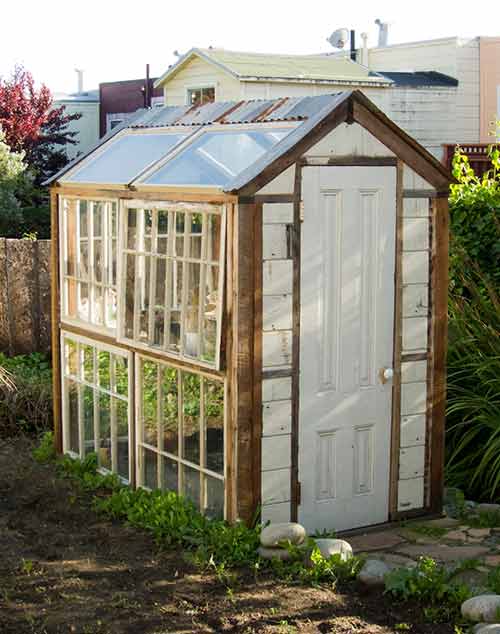
Next door, the newly-opened General Store, where, in the back yard, was this perfect little greenhouse (below).  I fall in love with a building now and then, and this was one of those. Proportion, placement, used materials, it all comes together. Built by Jesse Schlesinger.

Post a comment (1 comment)

Get Low with Robert Duvall — Fantastic new film

My roommate and best friend for a couple of years at Stanford was Dick Zanuck, now the über-successful film producer (Driving Miss Daisy, Butch Cassidy, and more recently the Tim Burton/Johnny Depp collaborative mega-filns. We’ve kept in touch over the years and he knows I like the film work of his son Dean (who produced Road to Perdition in 2002), so last week he sent me two tickets to an advance screening of Dean’s latest movie, Get Low with Robert Duvall, Bill Murray, and Sissy Spacek. (I mean, how could you go wrong?) My friend Jack Fulton and I went. It was at the grand old Castro Theater in San Francisco. Before the screening, Duvall answered questions for maybe 45 minutes. His favorite role of all time was in the TV series Lonesome Dove; he said he walked into the makeup room on the Lonesome Dove set and said, “Boys, we’re making the Godfather of westerns,” He considers the first two Godfathers masterpieces. Asked how do you get into all these different roles, he said, you have to know yourself.

Photo: Director Aaron Schneider, producer Dean Zanuck and actor/producer Robert Duvall

He must know himself pretty well, because he gives a brilliant performance in this wonderful movie. It opens July 30 and you can see a trailer at: https://is.gd/bRlaz

It’s a great script, wonderful acting, set in 1930s Tennessee. Duvall’s log cabin is a beauty, with a stone fireplace; inside wide horizontal planks, orange glow from kerosene lanterns and flickering fireplace flames. Just lovely throughout. Bill and Sissy are perfect. Duvall’ is a 100% Academy Award performance, powerful, nuanced, and I hope the fact that this is a low-budget film without big-bucks backing doesn’t stop him from being nominated.

Here’s to guys who make movies from the heart.

Post a comment (3 comments)

Great blog from British Columbia

“In the US these houses are sometimes referred to as “Big Sur vernacular,” but usually here on the west coast of Canada we just call them handmade or handbuilt houses, vernacular architecture, or hippie houses. They’re pretty common in British Columbia, most famously on the Gulf Islands between mainland Vancouver and Vancouver Island, but they exist everywhere. This particular house was built by hand in sections beginning in the late 60s, on a dry granite hill just above a lake. The piece of land was cheap at the time, and the house was built for almost nothing. The owners were artists at the time and had virtually no budget, so most of the materials were salvaged or bartered, and since the place was built with the help of friends there were almost no labour costs.…

One of the best things about the house is its smell. The milled cedar boards that clad almost all of the walls give off a kind of perfume. I’ve never been in a city house that smells that way, though I guess it’s possible.…”

Blogger Lindsay asks that no one re-posts this photo or any from her blog, due to the privacy desires of the owner/builders. (She gave us special permission.)

https://blog.ounodesign.com/

Post a comment (1 comment)

Just cain't do it like I did it…

My training for the Dipsea race in June got rudely interrupted when I stumbled and injured some hamstring muscles out on the trail last Saturday. 6 weeks until the race and now I’m waiting and watching (feeling) for muscles to heal so I can get back to training before it’s too late.  For competitive runners,  ’twas ever thus…

Coincidentally Lesley gave me a CD yesterday of fiddler Johnny Kimble (recently interviewed by Terry Gross on NPR) and one of the songs has these witty lyrics:

What do you do

when you just cain’t do

what you did

when you did

what you did?

When you opened your eyes

and finally realized

you ain’t no longer a kid.

Sigh…

Post a comment (4 comments)

Stewart Brand on Nils Gilman and "Deviant Globalization"

From Stewart Brand, https://longnow.org/:

“Growing twice as fast as the global legitimate economy is the global hidden economy of trade in drugs, weapons, laundered money, sex workers, illegal immigrants, hostages, human organs, pirated intellectual property, looted archeological artifacts, stolen art, endangered species, illegal waste, and massively sophisticated computer hacking. In some parts of the world, with the decline of state sovereignty and growth of grassroots communication technology, outlaw organizations are taking over statelike duties.

Historian Nils Gilman, a consultant at Global Business Network/Monitor, is co-author of a forthcoming book on the subject.

(Talk next week:) ‘Deviant Globalization,’ Nils Gilman, Cowell Theater, Fort Mason Center, San Francisco, 7pm, Monday, May 3.”

Post a comment

Phoebe Babo on the piano/Dancing in a wheelchair

A few weeks ago I stopped by my mom’s rest home. About 15 elderly ladies were sitting around listening to another elderly lady play the piano. She was terrific. Five Foot two, Ain’t She Sweet, Bye-bye Blues — the ’20s and ’30s songs we used to play in high school, accompanied by ukulele and washtub bass.

I called Phoebe and asked her if she’d be interested in having me and my box bass and my brother Bob and his banjo sit in with her. Sure, she said. Well, yesterday Bob and I showed up and I gotta say we clicked. Everybody was happy. My mom was moving her hands and feet in rhythm to the music. One of the ladies, Jane, knows the words to just about every song, and she sang along with me. I ended up with a blister on my string-plucking finger. Towards the end of the session, Bob got his banjo going, and the joint was rockin’. Two of the caregivers were dancing. At the end of the song, Phoebe said, “One more time, boys!” It was so much fun!

Phoebe is 91 years old, born in 1918. She has 18 gigs a month at a rest home-type places, and since she no longer drives, she takes whistle-stop wheels buses to get around the county. We’re going to play with her again in a couple of weeks and we’ll shoot a video.

Five foot two,
eyes of blue,
but oh what those 5 foot can do,
has anybody seen my gal?

Post a comment (3 comments)

Moon Raindrops Waves Low Tide Rocks Pelicans Buzzards Seals Cormorants This Morning

Today’s my birthday, also a full moon (whoo-whoo!). I was going to skate on the mountain at sunrise, but it was cloudy, so I decided to go to a rocky grotto on a nearby beach. I got up at 4:15, made my way down the “not-for-the-faint-hearted” trail, real steep in spots, It’d been raining and I soon learned that Vibram soles are slippery on wet rocks. Got down to the grotto as the full moon was going down on the western horizon. Rain drops falling. A swell had come up overnight and the waves were powerful and crashing. Vortex of energy! I hung out for maybe 20 minutes, then started back up the cliff. Partway up, I looked down at the beach in time to see a big flock of pelicans fly inches above a breaking wave. They use the wave’s updraft and hardly flap their wings. From my vantage point I could see them doing this beautiful dance, skimming above one wave, then when it broke, switching to a new, yet unbroken wave.

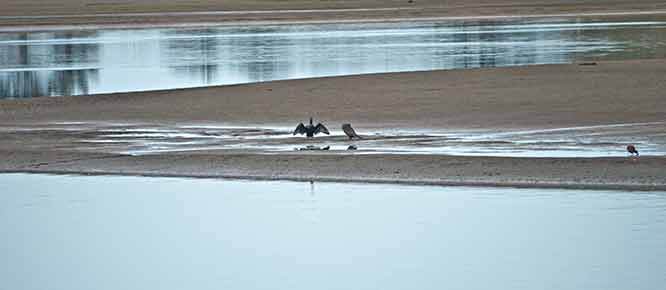
This was on the way home, a few hours ago. Low tide in the lagoon.

Post a comment (3 comments)

Free Sears tool catalog

Per a posting today from Cooltools, you can get a Sears tool catalog for free:

“On a recent trip to Sears, I was happily surprised to see a thick catalog near the checkout. I hadn’t realized the Sears Tool Catalog is still in print, still available for free, and just about as big as the old Radio Shack catalogs I used to get.

It’s not just Craftsman tools in here. They have all of your professional brands inside, and some wicked tools you can’t find at a brick-and-mortar Sears. Woodworking tools are well-represented. Mechanics tools are, too, as you’d expect, including SK tools and some small specialty brands; also shop equipment, even some boots and clothing. Sears has also recently made major upgrades to what it’s calling its interactive catalog.

— Christopher Wanko”

Post a comment (1 comment)