 Note: 1/4″ wire mesh is placed on the ground, from edge to edge, and under the blocks before filling with soil. I suggest letting the wire extend at least an inch beyond the edges of the blocks. Gopher-proof.


Note: 1/4″ wire mesh is placed on the ground, from edge to edge, and under the blocks before filling with soil. I suggest letting the wire extend at least an inch beyond the edges of the blocks. Gopher-proof.
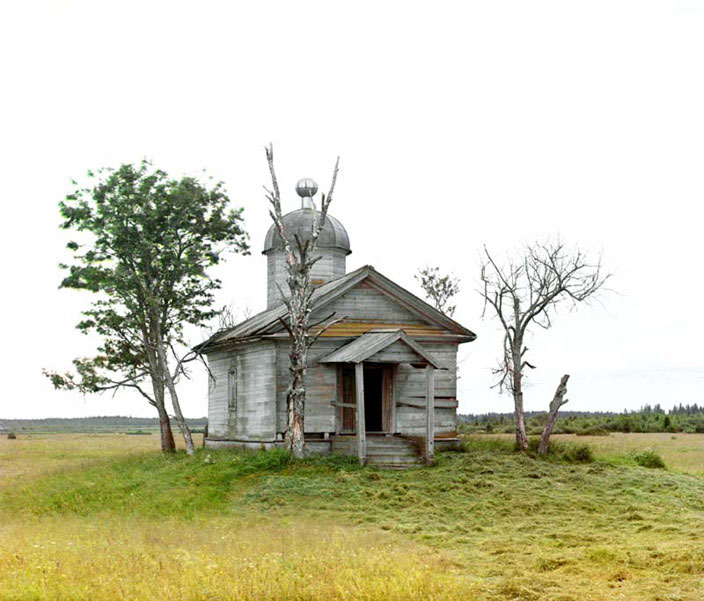 Wooden Chapel on the Site of Old Belozersk. First mentioned in Russian chronicles for the year 862 A.D., the town of Belozersk or “White Lake” was abandoned and relocated several times. The original settlement, commemorated here by a small nineteenth-century wooden chapel, was on the north side of the White Lake in north central European Russia.
Sergei Mikhailovich Prokudin-Gorskii.
A Chapel on the Site Where the Old City of Belozersk Stood, 1909.
Digital color rendering
This is from: https://www.loc.gov/exhibits/empire/architecture.html.
The whole digitized collection of thousands of photos can be found at https://www.loc.gov/exhibits/empire
Sent us by Kevin Kelly
 This beautiful old Graham was parked in the garage at the Oakland Museum last Friday night. It looks so stylish.
From Boing Boing, posted by Cory Doctorow yesterday (Perfect timing for me, since I’m taking off this weekend for the Book Expo America convention and a week in NYC, one of my great loves.)
 “How To Be a Retronaut has a large gallery of images from Store Front: The Disappearing Face of New York, a new book by James and Karla Murray that documents the vanishing golden-age shop signs of New York City, including interviews with the shop owners. The Associated Press review says, ‘They tell the story of the 20th century in New York, with wisps of the 19th and hints of the 21st. If you want to understand the aesthetics of the country’s most famous city at street level, this is the best way to do it short of actually going there.’
“During the eight years it took James and Karla Murray to complete this project, one third of the stores they featured have closed”
– Newsweek
https://www.howtobearetronaut.com/2011/05/the-disappearing-face-of-new-york/
 I’m doing a sneak preview (slide presentation) of pages from the tiny homes book this Saturday at the Maker Faire in San Mateo, Calif. It’s billed as the “World’s Largest DIY Fest-ival,” created by Make Magazine to “celebrate arts, crafts, engineering, science projects and the Do-It-Yourself (DIY) mindset.”
It’s a pretty huge event, I think something like 100,000 visitors. It’s mostly tech stuff, but there’s a corner called Homegrown Village where I’ll be.
Tip: get there early because traffic at this event is a bear.
(The robots walking around the fairgrounds are spectacular.)
It’s Saturday, May 21st at 11:30 AM, at “Homegrown Village.” Fair opens at 10 AM. More info: https://makerfaire.com/pub/e/6148
 I just got one of these sails and tried it out for the first time skating late yesterday afternoon. It’s mainly used to slow down when skateboarding downhill. Fun! I’m still getting the hang of it, but I was able to go down some hills where I’d normally get going too fast and have to jump off.
Two women came around the corner when I had the sail deployed and one said, “Oooh that looks like fun!”
I also tried it out last week on my paddleboard, sailing with the wind.
Good way to start the week, early this Monday morning, sent by Lew Lewandowski:
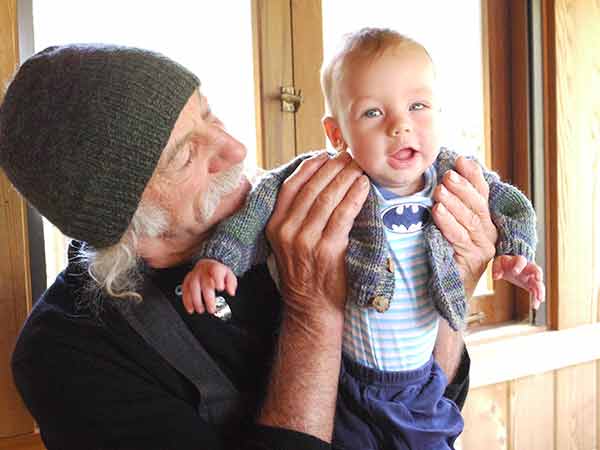 My good friend from Baja, Chilon, told me that Mexican slang for the grandpa of a boy, is “Abuelito de Batman.” Well, all right!
Here’s me a few hours ago with Batman. I’m awed by babies. The perfect little hands with grasping fingers, the smooth skin, the smiles, and the deep look into your eyes that infants practice before they learn not too. I love the feeling of thus little guy on my shoulder. I took him out to watch the chickens. I watched his eyes as he scanned the scene. Seeing things for the first time. He’s 4 months old.
I took off early Friday for Oakland, to do my talk on “The Whole Earth Catalog and Alternative Structures” at the Oakland Museum. I went across the Richmond bridge, but when I got out to Hwy. 80, it was so jammed up (late Friday afternoon) that I cut up Gilman and then went along San Pablo all the way into downtown Oakland.
Oakland is always a relief from the preciousness of Marin County and the slightly jaded beauty of San Francisco. The people, the buildings, the civic projects — they got soul. I love the visuals (I Am A Camera). The Hotsy-Totsy Club with its confederate-looking flag logo, the motorcycle shops, the ribs and burger joints, the 1000s of great buildings. Oakland is like the younger sister of a great beauty (SF), more fun to hang out with, more laid-back, not so pretentious.
About 40 people came to my talk, it was a great crowd. I showed them two collectors’ copies, the first Whole Earth Catalog (1968) and The Dome Cookbook ($1, 1967) by Steve Baer and described how the WEC became a pre-computer network for the counter-culture. Plus how it transformed the West Coast publishing scene; by the time it sold 100,000 copies, it got the attention of New York. Random House took over distribution and this led the way to a bunch of West Coast books getting major muscle NY distribution, including Domebook 2, The Tassajara Bread Book, Anybody’s Bike Book, The Massage Book, and in 1973, our book Shelter.
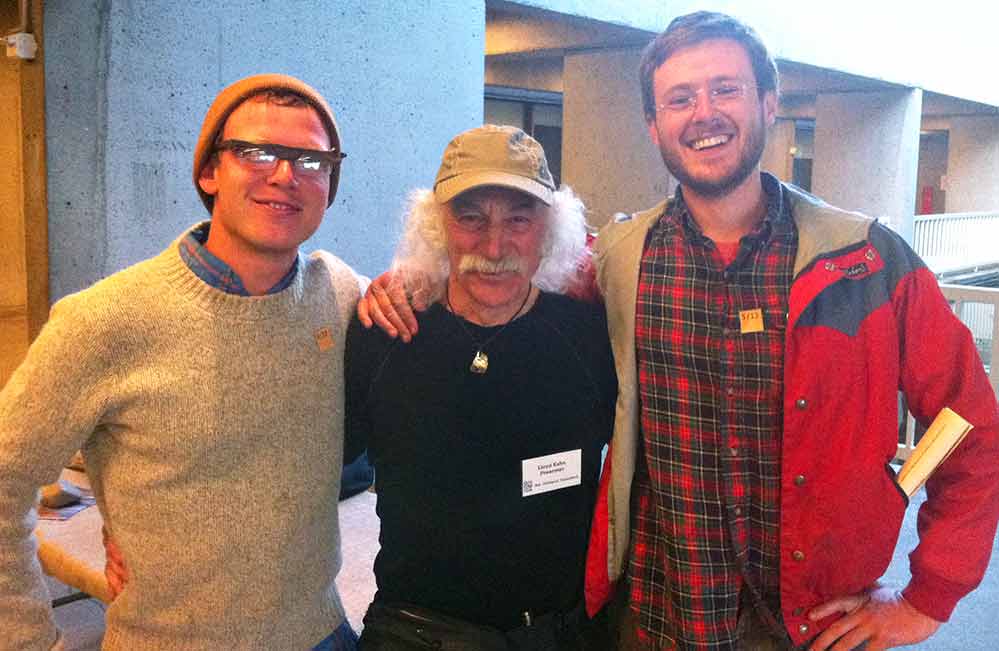
Here’s a photo shot by Zach Klein on his iPhone, of me with Isaiah and Sean, who are living on a piece of land in Aptos, and building tiny houses: