solar (25)

Half-Acre Homestead in Boise, Idaho

Hi Lloyd,

I’ve attached a few pics of our half-acre homestead project here in Boise, Idaho. My wife and I bought a .42-acre lot with a fixer-upper house in the heart of town 5 years ago. We also added two beautiful girls, Willow (6) and Zoe (7 mos).

We focused on the house first, with a goal of having a net-zero house … and we are pretty close thanks to it after gutting and replacing all the plumbing, electrical and mechanical systems. This includes a bad-ass Mitsubishi heat pump, solar array that is net metered, heat pump water heater, all LED lighting, induction range, and lots of insulation.

My family deserves a lot of credit living thru the remodel process (is it ever really done?) and dealing with their carpenter dad that has big ideas sometimes.

The gas company came to replace our old meter and I just told them to pull it, we don’t need it anymore. That felt good.

The last 2 years we have focused a lot on the food production side, building up soil. We build a hugelkultur bed out of some trees we took down, and this has become a great spot for annuals, zucchini, squash and particularly melons … they love it. It also has a lot of mushrooms that fruit from the rotting wood below when the weather is right.

We get lots of water from our irrigation ditch as this area was all orchards before WW2, and Boise has an elaborate system of irrigation ditches all over town.

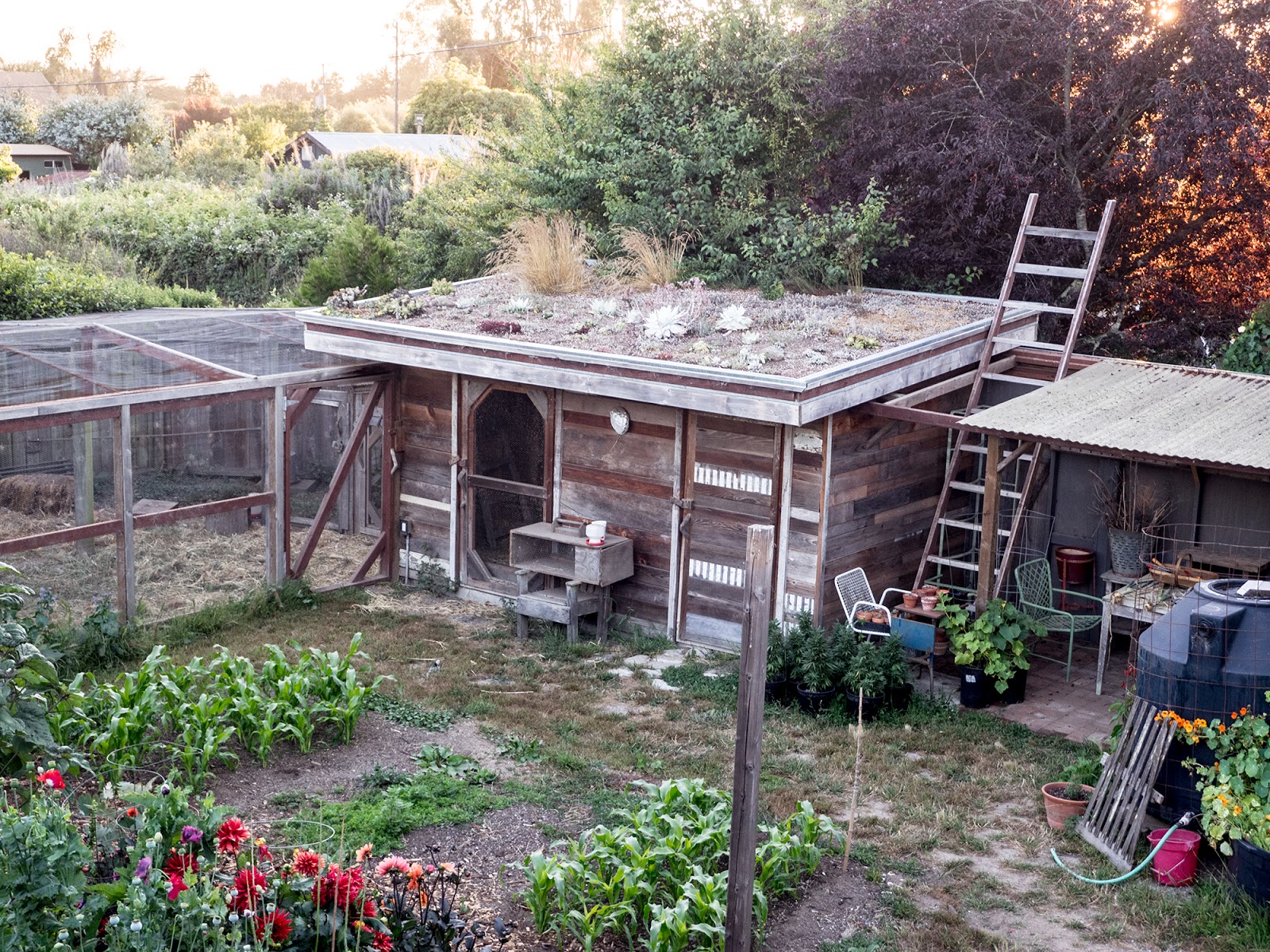
After reading The Half-Acre Homestead, I built up a compost area out of job site scraps and just poured piers for our chicken coop/garden storage area. The piers are big because I plan on adding a green roof like your coop.

I could go on and on, but I want you to know that books like yours have been a real lifeline for a builder like me, especially out here in Idaho. Folks like yourself, and Foster, Bruno, et al have been a great inspiration, and I will be forever grateful. Thank you for sharing with all of us.

Take care and come visit sometime,
T.J., Missy, Willow, and Zoe Sayles

Post a comment

Casting Call: DIY Network Looking for Off-Grid Home Builder

We just received this email.

Greetings,

My name is Gwendolyn Nix and I’m a casting producer with Warm Springs Productions (www.warmsprings.tv) and the DIY network. I’m currently casting the third season of DIY’s show “Building Off the Grid.” I’m reaching out to you to see if you or anyone you know would be interested in this opportunity.

We’re looking throughout the United States for folks who will soon be building an off-grid dwelling (i.e. starting within in the next few months). We cannot consider homes that are already underway.

All types of structures can be considered i.e. straw bale, earthship, tiny homes, yurts, container homes, earth-sheltered, log, stick-built, or whatever else your imagination comes up with! If you’re chosen for this project there is generous pay involved.

If you’re interested, please reach me at the contact information that follows my signature via either email or phone.

Please note, in order to be considered for the show, the home must be built on the land where it will ultimately exist (as opposed to being built in a warehouse and then transported to the land).

Here is a sneak peek link to the show: https://www.diynetwork.com/shows/building-off-the-grid

Thank you and I look forward to hearing from you.

Sincerely,

Gwendolyn Nix
Casting Producer & Social Media Manager
Warm Springs Productions
Cell: 406-214-6405
Email: gnnix@warmsprings.tv
Available 9am-5pm Mountain Standard Time

Post a comment (2 comments)

Handmade/Homemade: The Half Acre Homestead

When I start working on a book, it’s like setting out on an ocean voyage without a map. I get a theme, an idea, some kind of coherence on a subject,* then start.

When I built my first house in Mill Valley in the early ’60s, my friend Bob Whiteley and I laid out the foundation lines in chalk on the ground. “What do we do now, Bob,” I asked.

Bob said “This,” and took pick and shovel and started digging the foundation trench.

It’s been my M.O. all my life. When I don’t know what to do, I start. Things (usually) sort themselves out in the process. (I know, I know, I’ve said all this before…)

This book is about the tools and techniques Lesley and I have evolved in building a home and growing food (and creating a bunch of things) on a small piece of land over a 40+-year period.

I started by writing it in chapters: The House / The Kitchen / Kitchen Tools / The Garden / Garden Tools / Chickens / Food / Foraging/ /Fishing / The Shop / Shop / Shop Tools / Roadkill / Critters…What we’ve learned; what’s worked, what hasn’t…

Then I went through some 50,000 digital pictures and picked out 7-800 photos, printed them out contact sheets (12-up) and started organizing them under the above categories.

Next step: starting to put pages together; I am totally excited. I have (kind of unknowingly) been gathering material for this book for decades.

Now I gotta get out of here. Not only is it a gorgeous fresh spring day, but it’s my time of the year. Tauruses are feelin good…

Post a comment (10 comments)

Wind and Solar Power Could Meet Four-Fifths of U.S. Electricity Demand, Study Finds

Solar panels cover the roof of UCI’s Student Center Parking Structure. A new study co-authored by Steven Davis, associate professor of Earth system science, shows that the U.S. can meet 80 percent of its electricity demand with renewable solar and wind resources. Steve Zylius / UCI

Irvine, Calif., Feb. 27, 2018 – The United States could reliably meet about 80 percent of its electricity demand with solar and wind power generation, according to scientists at the University of California, Irvine; the California Institute of Technology; and the Carnegie Institution for Science.

However, meeting 100 percent of electricity demand with only solar and wind energy would require storing several weeks’ worth of electricity to compensate for the natural variability of these two resources, the researchers said.

“The sun sets, and the wind doesn’t always blow,” noted Steven Davis, UCI associate professor of Earth system science and co-author of a renewable energy study published today in the journal Energy & Environmental Science. “If we want a reliable power system based on these resources, how do we deal with their daily and seasonal changes?”

The team analyzed 36 years of hourly U.S. weather data (1980 to 2015) to understand the fundamental geophysical barriers to supplying electricity with only solar and wind energy.
Read More …

Post a comment (1 comment)

Randy’s Road Rig

Hi Lloyd,

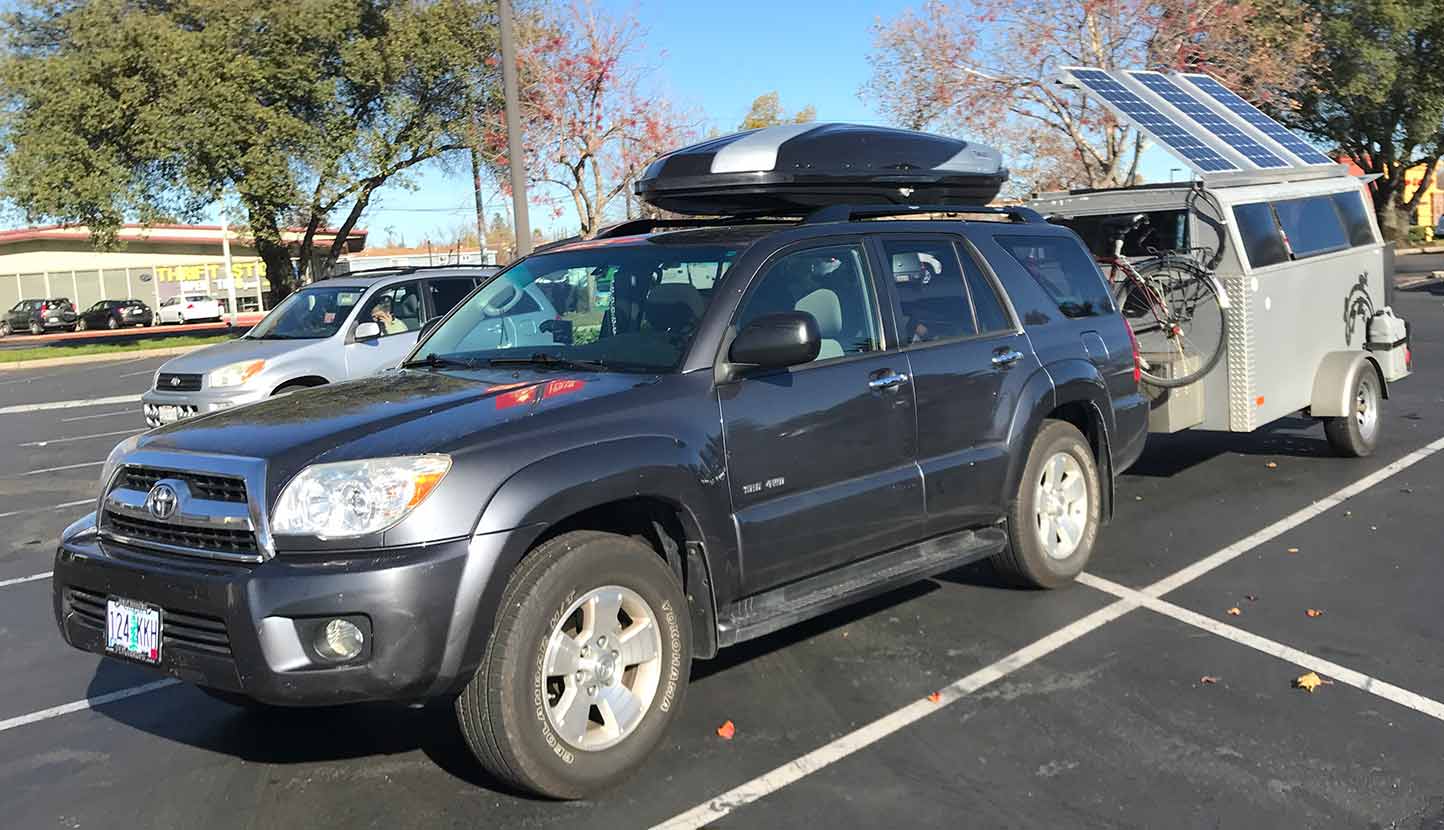
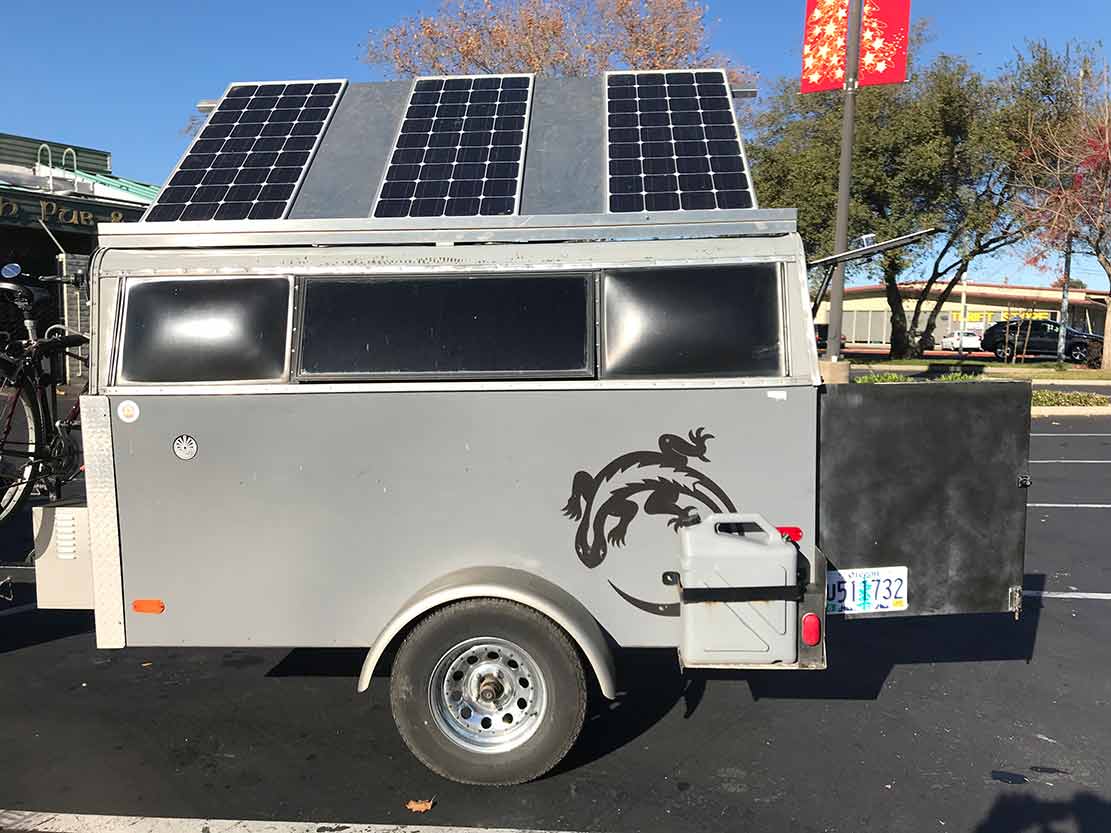
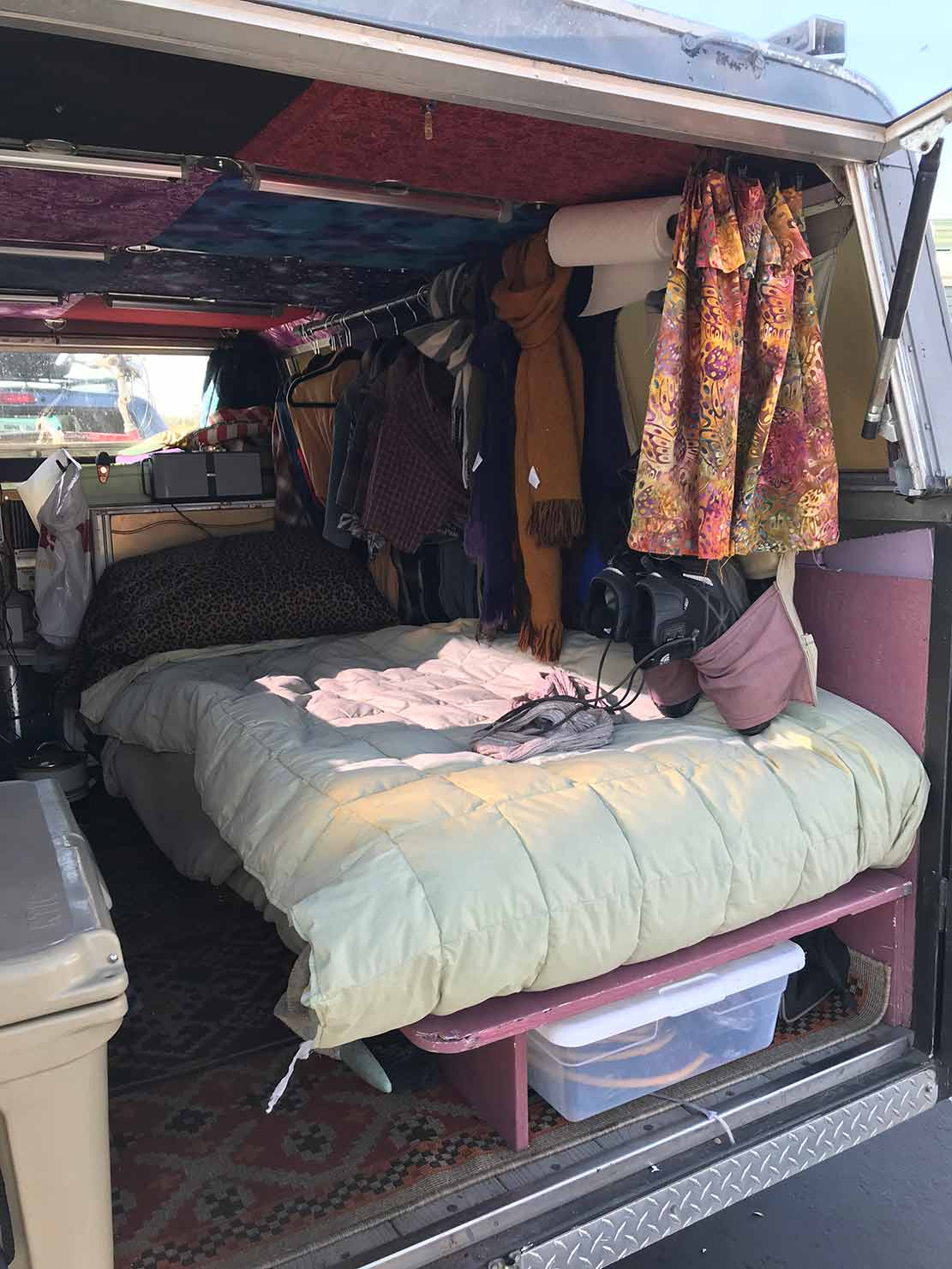
I ran into Randy in Folsom, CA.  I figured for sure he’d heard of Shelter and Tiny Homes on The Move, but he had not. Randy’s in his late 50’s and found himself in the middle of a late in life divorce and didn’t want tot have to work to own a house.  He’s a metal worker by trade and modified an old utility trailer with the camper shell from his old Dodge pick up into his new home.  It’s pretty cool.  I shared with him your website information too.

Dan Varvais

Post a comment

Advice to Californians Building New Homes After The Fires

I’d like to get this out to as many people as possible. Please send it to anyone you think might appreciate it.

       -LK

Poster from 1885, designed to encourage people to move westward

I would like to offer some suggestions to people whose homes were destroyed by the California fires of 2017. I have built three homes of my own and, as well, been publishing books on building for some 45 years now. From this experience I’ve come to some conclusions about practical, sensible building.

Much of the emphasis in our books has been on owner-building, and if you will be doing design and construction yourself, these are things for you to consider. If not, these are ideas you can discuss with architects and/or builders you may be working with — the principles are the same. 

Much has been learned about building homes in the last two or three decades. You may be able to take advantage of building materials and techniques that weren’t available when these homes were built. Here is a chance to do things better, to learn from experience, to create a home built from sustainable materials that will save energy, that will be better for you and the planet.

Please note: These are just random ideas for your consideration. This isn’t a check list, where you try to incorporate each suggestion in your plans. The purpose here is to stimulate thinking. Maybe you’ll find two or three ideas that will work for you.

Read More …

Post a comment (9 comments)

The Shelter Blog (theshelterblog.com) is Alive!

Rick Gordon has built it and we’ve been tinkering with it for a few months, and finally it feels ready to go. Whereas my blog is all over the place, The Shelter Blog will focus on homes, building, carpentry, gardening, farming, foraging, fishing, homesteading and the home arts. Check it out here:

https://www.theshelterblog.com

Note: it’s theshelterblog.com, not shelterblog.com. You need the article the.

I’m really excited by this. It’s as important — maybe in the long run more so — than one of our books. We have no competition here, since we have feedback from our 40 years publishing books on the subject of shelter. Plus we can share brand-new incoming photos and stories rather than wait years to get same into a book. It’ll be complimentary to our books.

We guarantee at least one new post per day, hope to get multiple posts daily as we get rolling.

Post a comment (3 comments)