cities (237)

Tiny Apartments and Punishing Work Hours: The Economic Roots of Hong Kong’s Protests

Excerpts from article by Alexandra Stevenson and Jin Wu, July 22, 2019, New York Times:

“HONG KONG — Rents higher than New York, London or San Francisco for apartments half the size. Nearly one in five people living in poverty. A minimum wage of $4.82 an hour.

Hong Kong, a semiautonomous Chinese city of 7.4 million people shaken this summer by huge protests, may be the world’s most unequal place to live. Anger over the growing power of mainland China in everyday life has fueled the protests, as has the desire of residents to choose their own leaders. But beneath that political anger lurks an undercurrent of deep anxiety over their own economic fortunes — and fears that it will only get worse.

“We thought maybe if you get a better education, you can have a better income,” said Kenneth Leung, a 55-year-old college-educated protester. “But in Hong Kong, over the last two decades, people may be able to get a college education, but they are not making more money.”

Mr. Leung joined the protests over Hong Kong’s plan to allow extraditions of criminal suspects to mainland China, where the Communist Party controls the courts and forced confessions are common. But he is also angry about his own situation: He works 12 hours a day, six days a week as a security guard, making $5.75 an hour.

He is one of 210,000 Hong Kong residents who live in one of the city’s thousands of illegally subdivided apartments. Some are so small they are called cages and coffins.
Read More …

Post a comment (1 comment)

Shelter in The City

In Berkeley Tuesday. It’s so heartbreaking to see what’s going on in the cities these days, a result of the great transfer of wealth to the upper 10%.

The name of our company is Shelter. When we started in the early ’70s, it was a positive thing to build your own house or somehow create your own shelter. Don’t pay rent; don’t get locked into a bank with a mortgage. Because I’ve built my own home(s), I’ve never paid rent or had mortgage payments — think what that’s meant over a 50 year period!  These days, things are desperate. You see it everywhere, but especially in housing, as the politicians in charge of the US government continue to skew things in favor of the rich at the expense of the poor and middle class.

The principles, as shown amply in our 7 building books, are still the same these days:
1. Keep it small. The heart of our book Shelter, published 45 years ago, was a section with plans for 5 small homes. Shelter II has plans for another 5 homes.
2. Look around in cities and towns for small fixer-uppers.
3. Do as much for yourself as possible, with your own hands. You don’t have to do it all. Do what you can — it’ll pay off in increased independence and savings (and satisfaction).

Shameless Commerce Dept.: Shelter is 30% off for the rest of September, with free shipping. Two or more books are 30% off at any time. We encourage you to buy books from independent booksellers, but IF you buy books online, buying them from us is cheaper than Amazon.

Post a comment (2 comments)

Beautiful Home in San Francisco

This beauty is in the Seacliiff district. Its view is of the blue waters of the bay and ocean and the Marin Headlands. I always check it out when I drive from Marin County in to the ocean beach area. Just stunning.

You turn right just after crossing through the Golden Gate Bridge toll booths and head out towards the Palace of the Legion of Honor; this is on one of the streets on your right along that route.

Note: This is a nice way to enter the city, skirting along the ocean out to the Cliff House and Ocean Beach (and to Outerlands restaurant, Trouble Coffee, Mollusk Surf Shop, and Hook Fish).

Post a comment

What the ’60s Wasn’t

1960, me (at left) and my Stinson beach lifeguard friends in Mill Valley about to take off on a surfing trip to the Point Reyes Peninsula in my 1937 Chevy (with square-cut gears) truck. This was a few years before everything started to change.

Getting It Wrong…

In 2017, there was a media blitz on “The 50th Anniversary of the Summer of Love.” There were TV shows, magazine and online articles, and museum exhibits on what supposedly took place in San Francisco in the summer of 1967.

I read all these stories and articles, watched the films, went to the exhibits, and was puzzled. This wasn’t the way I saw it, and I was there. There were a bunch of things wrong with all this coverage:

What the ’60s Wasn’t

  • The “summer of love” was a disaster. An estimated 100,000 kids trekked to San Francisco, most of them looking for drugs, sex, and rock and roll. A lot of them inspired by the lame song about wearing flowers in your hair if you came to San Francisco. The city wasn’t prepared for the inundation; the Haight-Ashbury neighborhood was overwhelmed. There wasn’t enough food, housing, or sanitation for the influx. Things deteriorated rapidly.
  • Secondly, the Haight Ashbury district wasn’t the ’60s.

    “The Haight-Ashbury was a neighborhood. The ’60s was a movement.”
    –Ken Kesey

    Kesey nails it here, as he did so often. The media has focused on the Haight-Ashbury, since it’s been so well documented, and it’s easy to interview people who were there.

    But the ’60s was about much more than the Haight, it was about a lot more than rock and roll and smoking pot and living in old Victorians in San Francisco.

    It was nationwide, arguably worldwide, and it encompassed a staggering variety of subjects and events and changes.

  • Most of the books, films, articles, and exhibits about the ’60s are by people who weren’t there — second-hand accounts.

My first thoughts were that these versions didn’t reflect what really happened.
Read More …

Post a comment (9 comments)

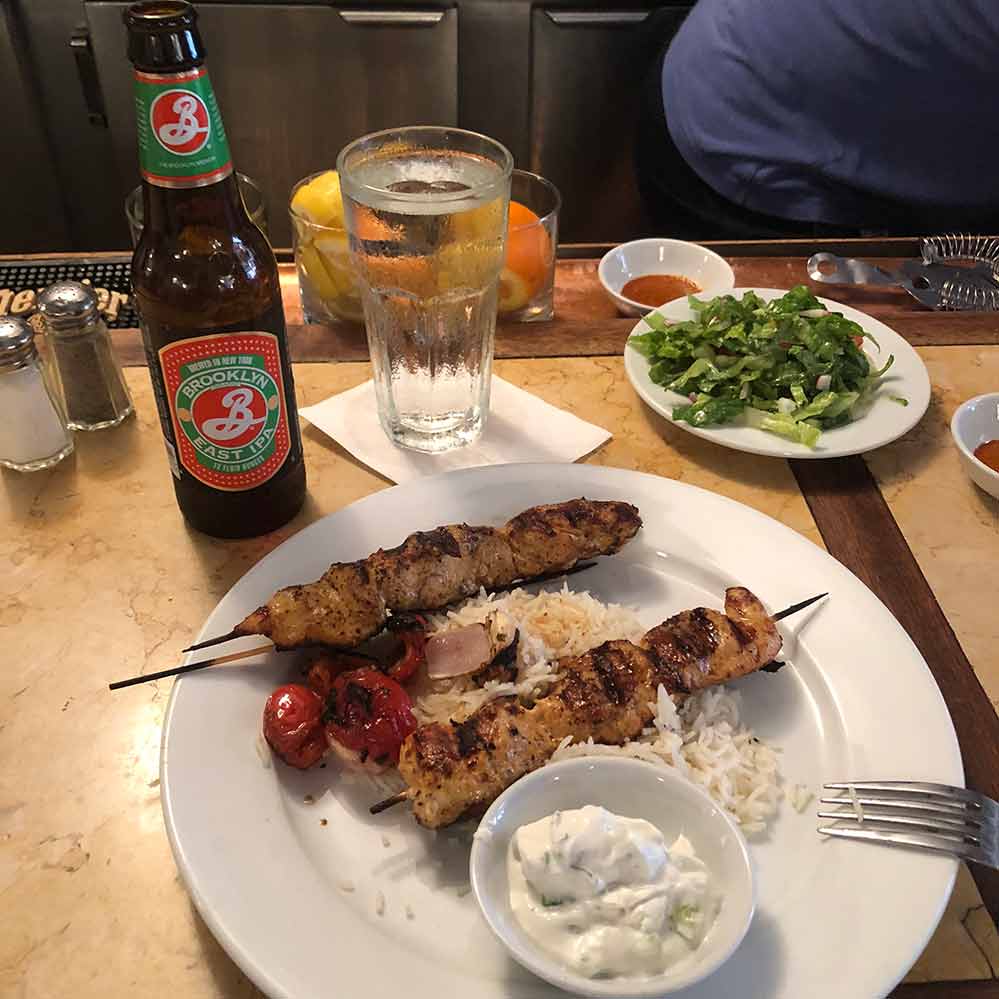
Coffee, Food, Pubs in NYC

Coffee

-Cafe Reggio on Bleeker

-Stumptown Roasters: 30 West 8th (2 blocks from Washington Sq.), and in the lobby of the Ace Hotel at 18, W. 29th (which looks like maybe a good place to stay)

-Blue Bottle: 450 W. 15th, 54 W. 40th

-Abraco, 81 E. 7th Street. All time great place. https://www.abraconyc.com/

Restaurants

-Saigon Kitchen, 114 McDougal Street

-Snack Taverna (Greek), 63 Bedford at 7th Ave.

-Periyali (which means “seashore” in Greek), 35 W. 20th  between 5th and 6th. https://www.periyali.com/

-Rosemary’s, 18 Greenwich Ave. https://www.rosemarysnyc.com/

-Blue Ribbon Sushi, 119 Sullivan St.

-EAK Ramen, 469 6th Ave.

-Cafe Mogador, 101 St. Marks Place. https://www.cafemogador.com/

-An Nam, 234 W. 48th, Times Sq. district. Japanese, Vietnamese, Chinese food. Normally this combination would make me suspicious, but this place, in an area I wouldn’t normally eat in, was really good — and inexpensive. I had a big plate of duck on brown rice, nicely cooked vegetables on a lunch special for $9.50. Plus delcious spring rolls.

Pubs

St. Dymphna’s, 118 St. Marks Place

The Blind Tiger Ale House, 281 Bleeker

Post a comment (1 comment)

NYC Greenery

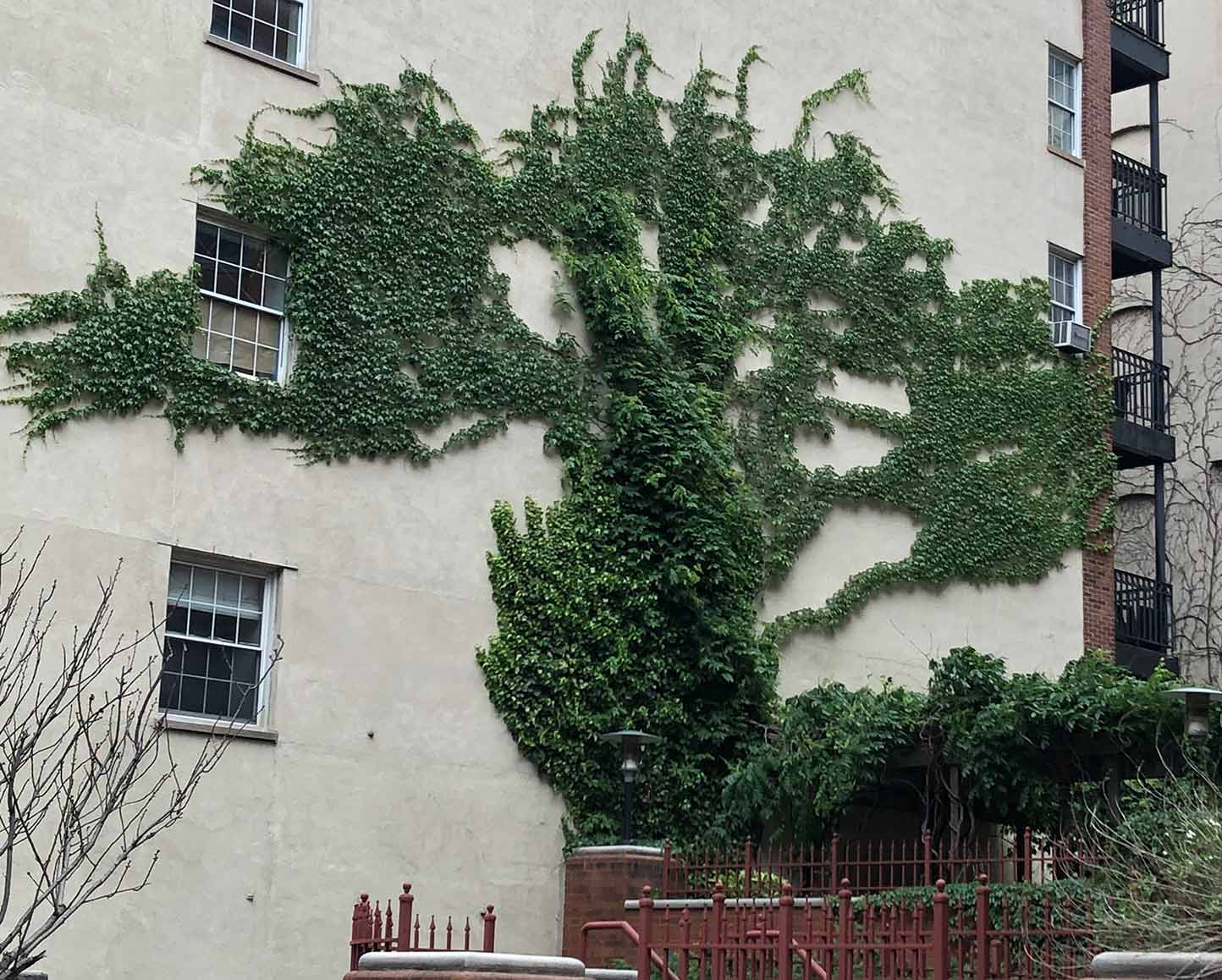
Ivy on side of building adjacent to the Jane Hotel, NYC. I wonder if it naturally shaped itself like the silhouette of a tree or if it’s a landscape designer at work.

Post a comment (1 comment)

The Eyes Have It

There are a lot of street artists in the Times Square area and Central Park that do sketches with charcoal. They look like mostly Vietnamese artists, and it’s amazing to watch them create these portraits with a bit of charcoal.

Post a comment