
“Tyringham’s Gingerbread House located on the Santarella Estate in the Berkshires, Western Massachusetts…”
Sent us by Jack at Full Circle Farm


“Tyringham’s Gingerbread House located on the Santarella Estate in the Berkshires, Western Massachusetts…”
Sent us by Jack at Full Circle Farm
From our good friend yogan, a highly skilled and innovative carpenter in France:
Our last job!
A big tower in colombage (Middle Ages technique of half-timber framing).
We sawed the wood with a mobile horizontal bandsaw, then drew an outline of the entire tower on the floor of our workshop; we then laid the wood on the markings to draw the assemblage.
Only tenons and mortises! No nails or bolts.
It’s a 4.5 × 4.5 × 12 meter (15 by 15 by 40 feet) tower (without the rock foundation).
8.7m3 (94 sq. ft.) of oak and chestnut was used. Almost 18m3 (194 sq. ft.) of uncut logs.
The roof and the walls will be finished this year!
www.cabanophiles.com
yogan.over-blog.com
facebook.com/mryogan
instagram.com/yogancarpenter


I’m going to put on a new roof soon, working by myself. Hardest part is getting the shingles up on the roof. I’m building a gable patio roof at the same time so I don’t want to rent a lift several times to load different roof areas as it progresses. While doing a search for info I came across this:
–Lew Lewandowski
A little blurry, but you get the idea. I’ve asked Lew to send us a video of his version.
Bundles of asphalt shingles are heavy!
Under the gaze of southern Arizona’s cinnamon-hued Canelo Hills, a mother shares ancient building traditions with her three sons. In Puebloan creation stories, adobe structures, like people, emerge from the earth and return to the earth. For Athena Steen, it’s the family memories, skills, knowledge, love, laughter — and the clay itself — that endure.
All clay, rock, and standing dead timber harvests in this film conducted in accordance with the rules of local jurisdictions.
Also, see: www.caneloproject.com/photos
From the multi-talented Steen family.
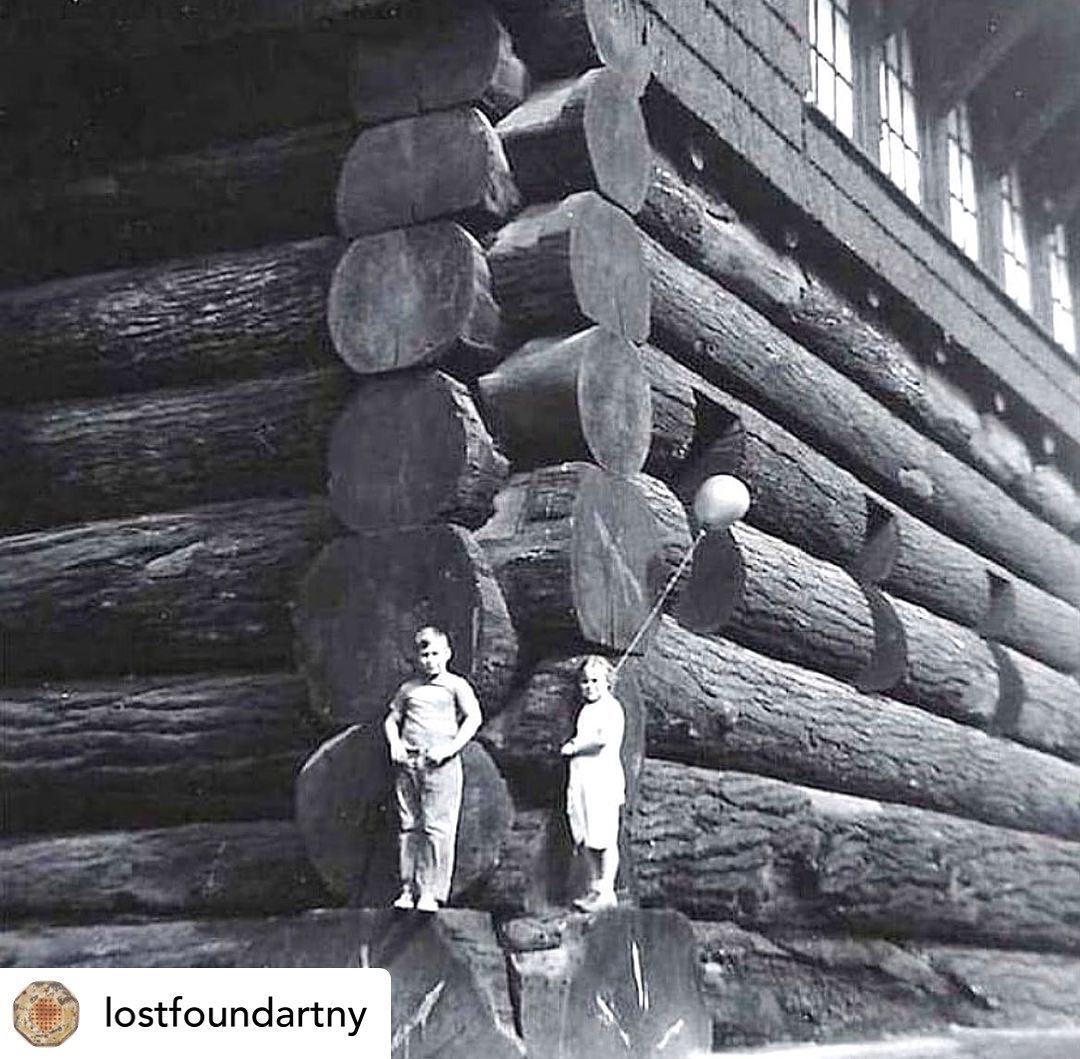
World’s largest log cabin, the Forestry Building in Portland, Oregon. Built in 1905, burned down in 1964.
@lostfoundartny
Full details (from Shari Dell): rarehistoricalphotos.com/
Hub is Ford truck wheel.

I don’t think the previous post showing a section of this magnificent building does it justice, so I used the Photoshop “merge” command to paste together 4 shots. Not entirely satisfactory either, as there are some weirdnesses in the stitching together, like the truck that passed by during the 4th shot.
The problem is with photographing buildings when you can’t get far enough back to get proper perspective. I used to solve this somewhat with a parallax distortion lens on my old Nikons, but iPhones have no such options.
Anyway, you get the idea (if imperfect) here.
The building, along with Gioto’s bell tower, is just staggering, as you can see, and this angle doesn’t even include Brunelleschi’s dome (at rear).


One of the moments that makes all the stress of travel worthwhile.
Waiting for the ferry to Sicily, this guy in a kind of beat up car in front of me was repacking his stuff, and pulled this out.
I went over and we were able to converse in Spanish. I told him how great they were and gave him one of our mini books.
He had driven to Barcelona with a bunch of these little constructions to sell, but hadn’t sold any. Price, about 50 Euros (cheap!).
Native Siciliano, Marco Paderni, from Catania.
Then he took out a 2nd smaller one (second pic), pointed to it and said “Regalo” — gift. I thanked him, but demurred, referring to air travel.
What generosity! Isn’t it strange how people with the least resources are the most generous?
To anyone receiving this for the first time, I send these newsletters out every few months. They’re different from social media — old school in a way — in that they go to a select audience (over 5,000 people now), rather than blasting out into the internetosphere.
If you’re not signed up on the list to receive it, you can sign up for email delivery of the Gimme Shelter newsletter here.
This is my first newsletter in 6 months, no less. Boy, how time has flown. So I’m afraid it’s gonna be a long one.
Rick and I have been working on this book for maybe 4 months. Our modus operandi: I write (or edit) text, print out photos, use a color copy machine (a workhorse Brother MFC-371DCW) to resize photos, then paste down text and photos with removable Scotch Tape. These then go to Rick, who uses Photoshop and InDesign to prepare files for printers. As we go along, he makes PDFs so I can print out pages to see how they look. An analog/digital process. We’ve got about 150 (out of 256) pages done.

I never know what a book will be like until we are well underway in production. We start with a theme — here, homes on wheels — and put it together 2 pages at a time, and the book reveals itself as we proceed.
And this one — good golly Miss Molly! — is turning out to be amazing. I’m sure you’re aware of the explosion of nomadic vehicles in recent years. Our book is composed of primarily do-it-yourselfers — the theme running through all our building books — and the designs, ingenuity, and craftsmanship are stunning.


One thing I just realized: there are a lot of surfers in this book — female and male. Below is Yasha Hetzel, who went 120,000 miles in Australia in a Citroën Berlingo van, here surfing at South Point:

BTW, we don’t seem to have any of the so-called “vanlife” rigs here — the young attractive couples with photos of sunsets and the minutiae of their daily lives. It wasn’t a conscious decision; it’s just is turning out that our rigs and people are more real, more hands-on than the “influencers.”
This is the big news around here right now. According to Wikipedia, the Biennale Architettura is “…an International exhibition held every other year in Venice, Italy, in which architecture from nations around the world is presented.”
The two architects responsible for the exhibit, Leopold Banchini and Lukas Feireiss, visited here last year, interviewed me, shot photos, and in conjunction with the exhibit, produced a book titled Shelter Cookbook. They have arranged for my flights to and from Venice, and a place to stay there, and after three flight cancellations and rescheduling and Covid preparations, I’m set to leave here on October 6th. I am excited!
The Shelter part of the exhibit consists of three of our books: Domebook One, Domebook 2, and Shelter, which are on display, as well as stick models of buildings shown in these books.


Stick models of buildings in Shelter and Domebook 2. A lot of work went into making these!


The exhibit is in the Arsenale di Venezia, a huge complex of shipyards and buildings built in the 1100s and used for building Venice’s ships.
I’ll be in Venice October 9–11; and on the 13th, I’ll be doing a slide presentation called “60 Years of Natural Building” at the Accademia di Architettura di Mendrisio, a school of architecture in Italian-speaking Switzerland. Then to Florence, then (maybe train ride) to Sicily where I’ll spend a week exploring (and swimming). Back home and back to book production end of October.
I’m really excited to be going back to Italy (and seeing Venice and Sicily for the first time). I love the people, the sea, the countryside, the food, the gardens — the Italian way of life — my cup of tea — er, espresso.
I’m going as lightweight as possible this trip, with a Cotopaxi Allpa 35 travel pack with compression bags (fits easily into overhead bin) and my regular daily Dakine backpack for MacBook Air, glasses, pens, etc. Trying something new this trip: the only camera — my iPhone 11 Pro Max. Not taking my Olympus OM-D EM-1 camera and lenses saves a lot of weight, and the iPhone is pretty darn capable.
Read More …