SunRay Kelley: “Take a Walk in Nature”
Post a comment (2 comments)


I apologize for the paucity of posts, but working on our next book, Rolling Homes, has been taking all my time.
I’ve avoided posting any of the material from the book because it won’t be available until June or July, but here’s an exception.

Serendipity materializes at the last moment!
We’ve been working on this book for about a year and half now and were down to one remaining page to fill.
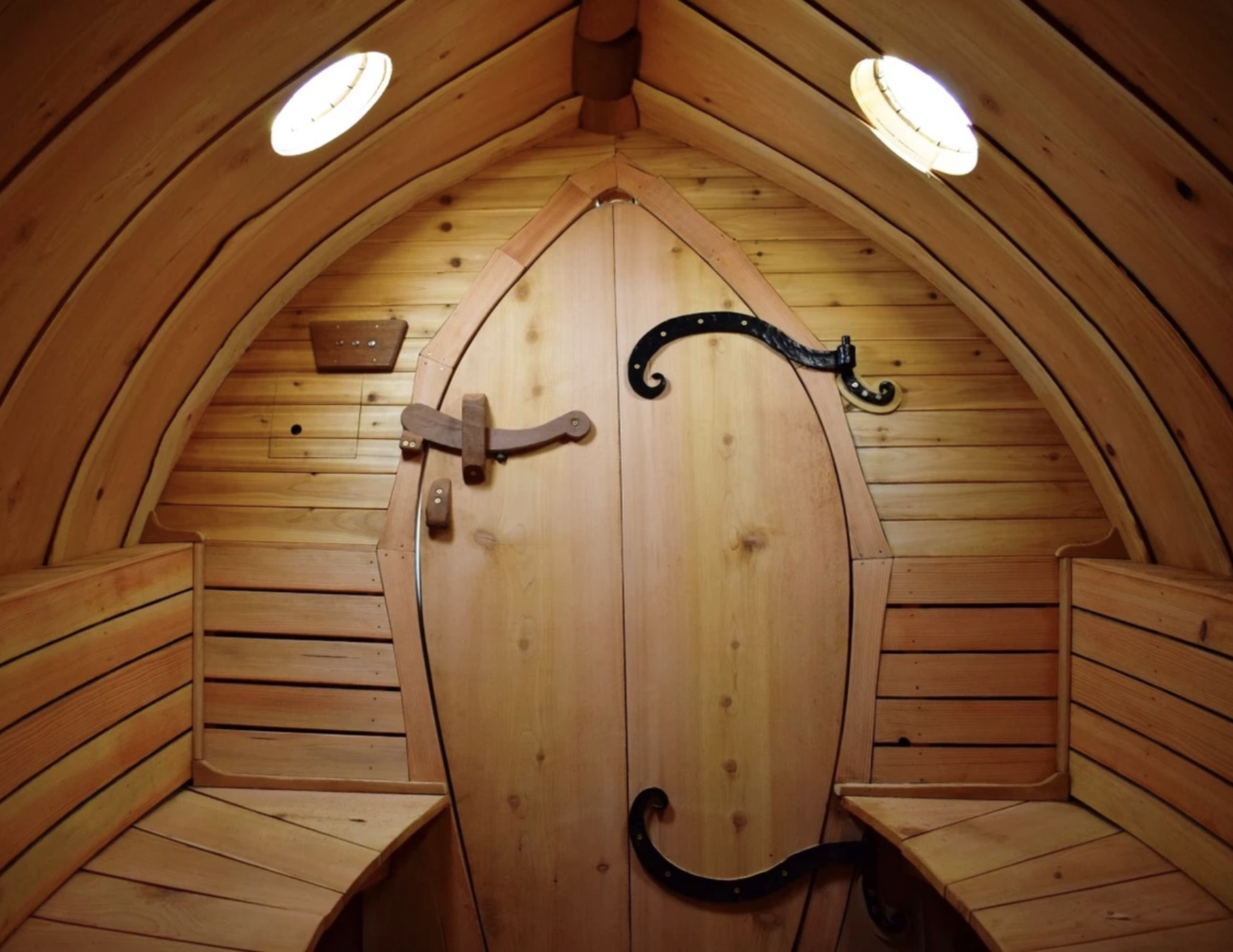
Flash back to 2016 when someone (anonymously) sent us a photograph of this perfect little vardo — one of those rare little structures where everything is perfect. It’s a delight. Like the creations of Lloyd House or Louie Frazier, all the elements are working, and I’ll say to myself, “Oh yeah!”
I posted it on my blog, asking if anyone knew where it was or who built it. No response.
Two days ago (six years later), I get an email from Bulgaria and Cen tells me that he is a mystery builder. Voila!
Here are the details from my new friend and kindred spirit in Bulgaria.
–LK
Originally built as a play space for my daughter and as a guest house, my camping karutsa design has a long heritage and has taken both me and my family on a wonderful journey.
Karutsas, pulled by horses or donkeys, were part of a way of life now disappearing in Bulgaria.
This one was built from recycled materials, and sleeps 1-3 people with comfort and style. A twist on its larger gypsy cousins, its distilled and refined design is a pure joy to be in. Once you enter, you don’t want to leave.
Insulated and weather proof, you can relax comfortably inside, you can view nature, read a book, or just be.
Deceptive from the outside, the inside space is light and airy. The step-up, step-in, sit-down porch, shelves, hooks, and storage compartment provide a nautical style living system. The outside kitchen and bathroom with tarp increase its overall usability.
This prototype has been just that. Its latest incarnation is evolving into what I hope will become a true relative of its Bulgarian cousins. A true modern hybrid, yet sympathetic to its origins and ethos.
They say form follows function — these wagons are like the Canadian canoe: just about impossible to improve upon, yet the design can be tweaked.
As we move into this new sustainable era, I hope to see my new lightweight designs again traveling the Balkans. A rolling, tiny home, fit for purpose, fit for use.
I owe a great deal to you, your work, and passions, Lloyd, and may it long continue — your books now give just as much pleasure to my children as they still do to me. I can’t count the number of people I have lent them to here in Bulgaria — a constant volley of wow and wowwwwww every time.
Thanks again, Lloyd — the biggest hugs from us all in Bulgaria. You are welcome here any time.
–Cen


Photo by Jon Kalish
Handmade living structure built from invasive grass by Daren Rabinovitch on the Aptos, California homestead known as Trout Gulch, created by members of the animation company Encyclopedia Pictura.
Note: Sean Hellfritsch, who lived at Trout Farm for a while, commented that they could not keep the woodrats out of the building. (Makes sense, it looks like a giant woodrat nest.)
Link to the NPR story Jon did about the place:
www.npr.org/2011/07/17/137680605/making-cutting-edge-animation-on-a-diy-homestead
https://www.youtube.com/watch?v=hda3vvmqQHQ
From Maui Surfer
At the Maritime Museum at Aquatic Park in San Francisco:


View of Maitavie Bay, Tahiti; painting by William Hodges (1776)
…Although the details of Tupaia’s knowledge may be lost to history, Pacific people continue to voyage in his wake. To mark the 250-year anniversary of Tupaia’s voyage, in 2019 Galenon and Teipoarii navigated the ship by the moon and stars from Tahiti to Aotearoa. They are part of a Pacific-wide movement of modern wayfinders who hope to restore inter-island networks disrupted by colonization and to build regional unity around shared challenges like climate change.
Like Tupaia, they exchanged oral traditions with people they met along the voyage. ‘Our ancestors would navigate to maintain relationships,’ says Galenon. ‘The canoe was the link.’
Above painting is Tahiti.
knowablemagazine.org/article/society/2021/reading-pacific-navigators-mysterious-map
Also, Polynesian Navigation on Wiki: wikipedia.org/wiki/Polynesian_navigation
From Dan Dwyer

 Travis Skinner, whose 400-square-foot small home was featured in our book Small Homes (pp. 52–53), has written a book about his unique wood-fired sauna on wheels. The book is called AnglerFish Sauna: Material Based Design & Deep-Sea Sculpture, and is available at:
In his introduction, Travis says: “What inspired us to make a 17-foot model of a female Anglerfish that is a wood-fired sauna on wheels? These pages will lead you on a multimedia journey through the conceptual design, the process of construction, and meaning within the sculpture.”
The sauna is beautiful, exceptional, and I’ve never seen anything quite like it. It’s also built with meticulous craftsmanship.


The mighty and ever-beautiful Golden Gate Bridge. I’ve been to the top (of the south tower), as well as underneath it in a kayak journey from my home beach into San Francisco.
Plus my dad went out on a plank walkway to the south tower when it was being built in 1933.
I got a connection with this bridge!
P.S.: The true designer of the bridge was Charles Alton Ellis, not Joseph Strauss. See John Van der Zee’s book, The Gate, on the true story of this elegant design.


A month or so ago, I saw a unique elliptical wooden teardrop trailer in the surfers’ parking lot at Salmon Creek (Sonoma County). Inside was Mira Nussbaum, who was painting on a silk scarf. The trailer will be one of the units covered in our forthcoming book (publication date May-June, 2022), Rolling Homes. Mira told me she and her husband lived in a tiny home, and she sent these photos. A link to her art work is at www.silkstorymaps.com.
Our tiny house, Tree Song, was inspired by three years of visioning and design for a better way of life. We built this sanctuary so that we could take a step towards living our own beliefs and values in our day-to-day choices. Tree Song was built in 2010 from locally harvested and produced material sourced from local businesses who care about their ecological impact, furthering our intention to live a simple life connected to the land. Tree Song was built on a 22′ × 8′ trailer and is 13′ tall. This amazing home has been at two retreat centers on the East Coast, made an arduous cross-country journey, and now resides in Northern California where we have called it our home since 2017.
–Mira and Alex