When I start a project, I’m never quite sure where it will go. I started working on a book on the ’60s last year, and found myself laying a lot of groundwork on my earlier years (1935-1960), so that the reader would know my background. I ended up with a sort of autobiography for almost half the book.
So when you click on “The ’60s” button in the blog header, there’ll be a lot of autobiographical stuff until I get to the ’60s.
Hitching Streetcar Rides
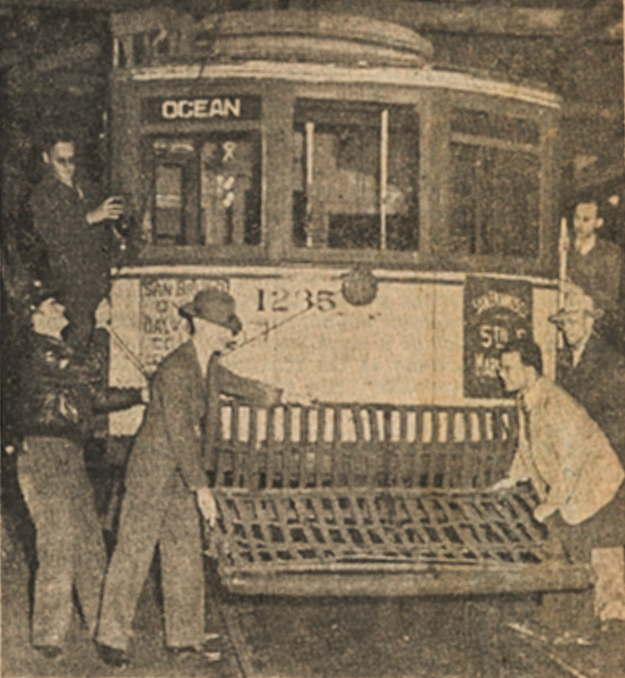
 The “L,” “M.” and “K” (my initials) streetcars ran through the Twin Peaks Tunnel, which went from the West Portal district to the Castro district. The mid-tunnel stop was about a mile walk from our house.
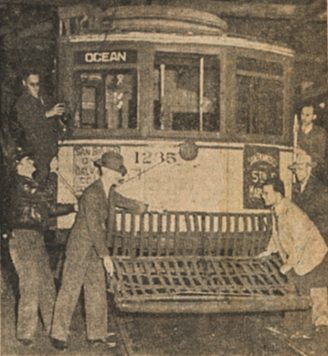
This rare photo shows one of the old-style streetcars from the ’40s. The cowcatcher is being lowered here. When the direction of the car was reversed at the end of the line, the cowcatcher would be tied up on the back end via a cable through that round fitting in the center. Throughout the city, us kids would creep up behind a slowly moving car (crouching so the conductor, who was in the back, wouldn’t see us), then run up and jump on the cowcatcher.
We rode all over the city. The big deal was to ride through the 2-mile long tunnel — sparks flying overhead from the electric trolleys — whoo! Lots of alcoves where someone who somehow ended up on foot in the tunnel could jump when trains came by. The trains probably went 20-30 mph, rocking through the darkness, to emerge into the dazzling daylight at Market and Castro.
San Francisco Was a Port

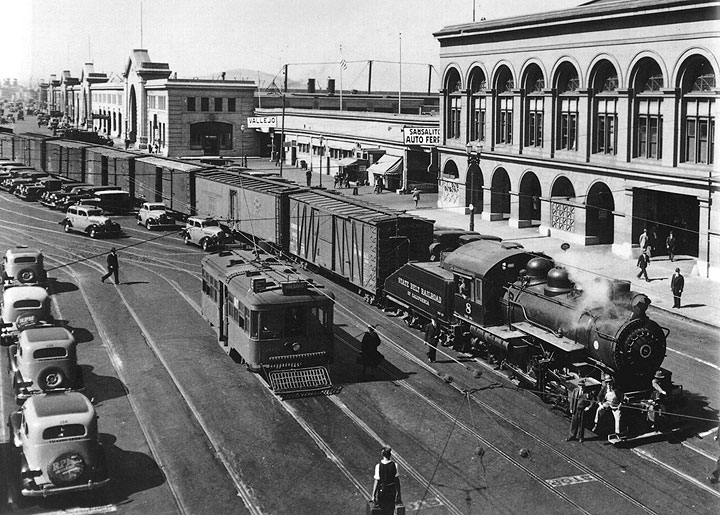
San Francisco Beltline Railroad. In this photo taken July 6, 1938, the E-Embarcadero streetcar line is running alongside the state-owned freight line. Photo: San Francisco History Center, San Francisco Public Library
Until the ’60s, the city, surrounded on three sides by water, was a shipping center. The waterfront was a deep water port, dating back to the clipper ships, with a series of piers. It was (is) called The Embarcadero, and when we were kids, it was a city within the city, with its own hotels, bars, and restaurants. Loading and unloading of ships was controlled by the Longshoreman’s Union. The streets were filled with cargo and busy with forklifts.
Fisherman’s Wharf, now a tourist mecca, was at one time the fishing center of the west coast, with its 16′ Monterey Clipper fishing boats modeled on the felluca sailing fishing boats of Genoa.
I mention this because this was the city of our childhood and one would never guess this by looking at the tourist-oriented, sanitized, palm-tree-lined waterfront of today.
Fishing in the City
Around the turn of the century, my grandfather had a bait and tackle shop at the foot of Hyde Street (in later years, it became Muni Bait), and that’s how my dad got started fishing; he and his friends went fishing in the ocean and also fished for trout in lakes in the Sierras.
My grandfather used to import hexagonal bamboo rods from China and tie on the casting guides with red and gold silk thread. It’s a craft he taught my dad, and my dad taught me.
My brother and I had our city version of fishing, which didn’t require any parental transportation or guidance. We would walk down to the tunnel, carrying fishing rods and a crab trap, and take a streetcar to Van Ness, where we’d take the H streetcar down to Muni Pier.
We’d catch crabs and use the orange part of the innards as bait to catch perch. We’d go back home on public transit and our mom would cook a fish dinner.
Read More …