On Saturday, I got up early and went to Palo Alto prior to going to the Maker Faire. The reason: going to Keeble & Schuchat Photography to check out the new Olympus OM-D E-M5 16MP 4/3, which my friend Bill Steen had just got and was raving about. Since I could use all the lenses I currently have for my Panasonic Lumix G1, I was interested in the much less shutter lag of the Olympus.
I’ve been dealing with Gary at K&S for years, and he bas guided me in pretty much all the cameras I’ve been using of late. During the course of our conversation, I took out my Canon Powershot S110, with which I shoot most of my pictures, and asked if there was (yet) any camera in this class. Yes, there was, and I ended up getting the new Sony Cyber-shot DSC-RX100, a powerful and innovative little camera, about the size of the Powershot, but with significant advantages: a Leica lens, a sensor that is 4 times that of the Powershot, a great panorama function, and other features.
This will be, as was the Powershot, the camera I have on me in a fanny pack most of the time.
I’m willing to pay a little more at a “bricks and mortar” store as opposed to Amazon. Here, I would never have known about this camera by rooting around on Amazon. It’s worth something.
Most of my photos that will appear here in the future (starting next week) will have been shot with this camera.
“In Luke Clark Tyler’s last New York City apartment, his shoes had some unusual companions in the closet. The shoes sat, in neat pairs, on a rack, directly below his dishes and right next to the microwave. A few inches away, a hip-high refrigerator lived beneath his desk. And the apartment was so narrow that Mr. Tyler could sit on a sofa pushed against one wall with his feet propped up on the opposite wall.
This was because Mr. Tyler’s entire home was only 78 square feet. And while his “Midtown mansion,” as he called it, was a far cry from the lavish town homes and shimmering penthouses that have spawned a thousand lustful television shows, a video tour posted on YouTube of Mr. Tyler’s little room has been viewed nearly 1.7 million times over the past year and a half. A similar video, about a 90-square-foot apartment on the Upper West Side, has been viewed even more times.…”
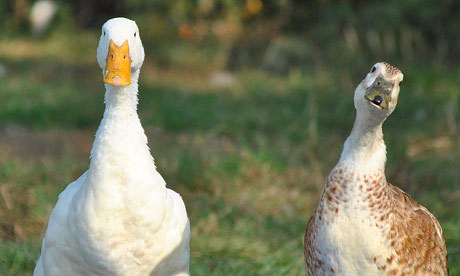
“When folks think of home-produced eggs, they tend to think of chickens: after all, it is chicken eggs we usually see for sale in the shops. Yet ducks have undergone much the same selection and breeding processes as chickens over the centuries to create domestic waterfowl that fulfil the same objectives of providing a source of meat and eggs.
Sure, there are the fancy fowl within the duck group (just as there are with chickens) where looks are the endgame, but there are also breeds of domestic waterfowl that can and do exceed the capabilities of chickens in terms of working livestock.
Campbells and Indian runner ducks are a case in point. Over the years they have been used as the primary laying breed within waterfowl and they are incredibly productive, producing 250-300 eggs in a season, which outstrips some of the best layer breeds of chicken. …”
When I was hitchhiking in France (in 1957), a truck driver that had given us a ride stopped, got out of his truck, walked over to a fence by the side of the road, and took a piss. So simple; why not? He was facing away from traffic, unit not visible. In this country (or the UK), it’s not de rigueur for some reason. The French don’t seem to have that Puritan body-as-shameful attitude.
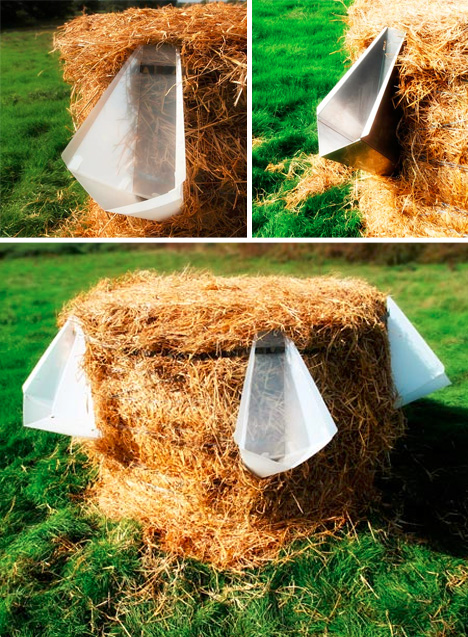
Here, from Mike W., is a great alternative to toxic chemical toilets for males (at least for urine) at outdoor events. Totally makes sense. Save that nitrogen!
“It is inefficient and unsustainable to haul human waste back in from remote festivals and other places typically populated with port-a-potties. So why not use on-hand materials to make something simple and green?
Thus L’Uritonnoir by Faltazi which turns an everyday farm item into a urinal by means of simple funnels attached on various sides and connected via a loop running around the perimeter. The composted results can be recycled right back into the local land. …”
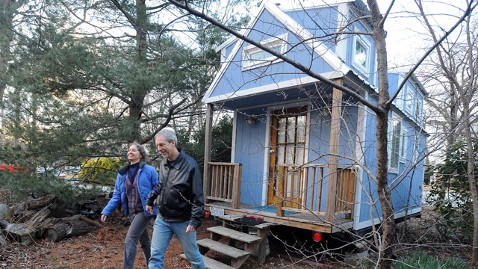
“When Greg Cantori and his wife, Renee, are ready to retire, they will not only have to pack up their respective offices, but also downsize their home, in a big way.
The Cantoris of Pasadena, Md., plan to retire in a 238-square-foot house on wheels they purchased two years ago for $19,000.
The couple lives with one of their two grown daughters in a 1,400-square-foot, three-bedroom, two-bath home on the same lot where their future retirement home waits on wheels. ‘We don’t know how many years it will be but we’re getting there,’ said Cantori, the president of Maryland Nonprofits.
…”
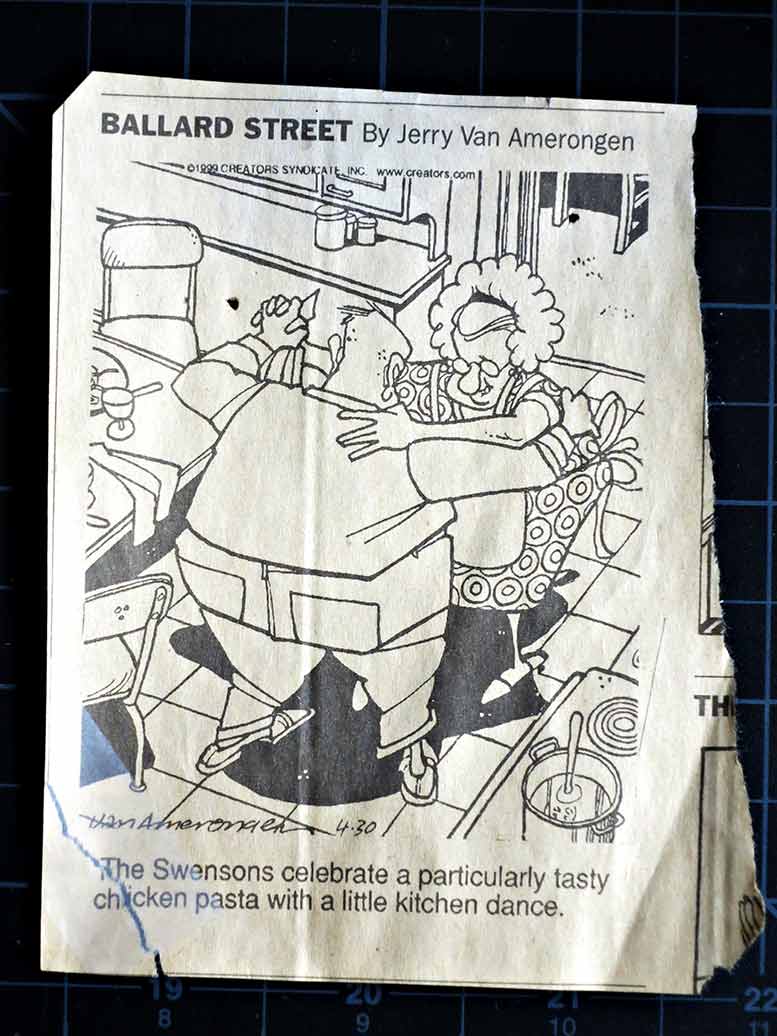
“I am writing this while walking on a treadmill. And now you know the biggest problem with working at a treadmill desk: the compulsion to announce constantly that you are working at a treadmill desk. It’s a lot like the early days of cell-phone calls, when the simple fact that you were doing what you were doing seemed so amazing that most conversations consisted largely of exclamations about the amazingness of the call. …
“…people don’t run at treadmill desks. They walk at one or two miles per hour, which is slow enough so that it doesn’t interfere with typing or talking or reading. …”
-Susan Orlean in the May 20, v2013 issue of TheNew Yorker here.
What a brilliant idea. I’m looking on Craig’s List for a treadmill.
What I Love About My Small Home: The most powerful feeling that I have about my small home will always be the love I feel while nestled inside it. It’s cozy and comfortable, a great space to do my creative art, while also serving as my perfect retreat. I love everything about it!
Biggest Challenge of Living in a Small Space with two people and two cats: finding your own place. My house is only 170 square feet, and in a space that small, it’s important that you feel you can go to your own place and do your own thing. It’s amazing that we are able to work on our own projects while in the company of the other. My husband will be working on his photography on the computer while I’m up in the loft diving into a good book. The house was designed for us, and that’s what makes it work.
Two years ago I did a “1/4 acre homestead” talk at the Maker Faire at the San Mateo County (Calif.) Event Center). This time around, I have a lot more material, plus URLs on all the tools I’m going to show. I’ll be doing a presentation on the Maker Faire Stage, at 2 PM on Saturday, May 18th, and at 2 PM Sunday, May 19th. Information on the Faire: https://makerfaire.com/. Reviews of the Faire: https://www.yelp.com/biz/maker-faire-san-mateo.
I’ll be showing slides of our homestead, and the various tools we use around here in the kitchen, garden, and shop — from 40+ years’ experience. I’ve picked the tools I think are unique and maybe not so well known, and left off all the ones that I think people may already know about. We’ve posted the URLs on our website here: https://www.shelterpub.com/_homestead/tools.html and I’ll be passing out cards with a QR code so people in the audience so they can check out any of these tools when they get home. I’ll also have copies of our Tiny Homes mini book (2″ x 2″) to give out.
Lew and Evan will be manning a booth (#4925) in the Expo Hall. This is the largest hall, and our booth is at the back. We’ll be showing the process we use in producing books, including the first draft layout pages done with scissors and scotch tape. We’ll also be selling copies of our building books, and giving away mini books.
Photo: draining dish rack in our kitchen built (20 years ago) by Lew Lewandowski
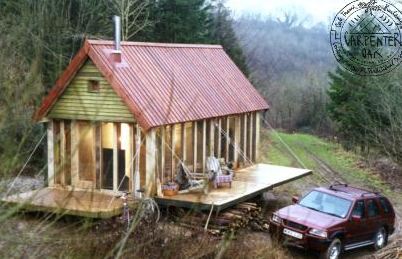
“Now here’s a tiny cabin with a twist that I wanted to show you.
It’s best built on stilts so you can make the best of use of the fold out porch area.
The tiny home is named The Forrester’s Cabin. It was built in 1996 and has a 24′x12′ footprint.
Once it’s closed up it looks just like a shed. But once the porch platforms are dropped it reveals the beautiful home inside.
It has a double bed alcove inside with a kitchen, bathroom, and more.…”


 On Saturday, I got up early and went to Palo Alto prior to going to the Maker Faire. The reason: going to Keeble & Schuchat Photography to check out the new Olympus OM-D E-M5 16MP 4/3, which my friend Bill Steen had just got and was raving about. Since I could use all the lenses I currently have for my Panasonic Lumix G1, I was interested in the much less shutter lag of the Olympus.