gardening (218)

Smoking Cannabis Is Bad for Your Health

I hate to rain on anyone’s parade, what with all the recent euphoria over decriminalizing cannabis, but — having smoked pot for over 50 years — I offer herewith some first-hand experience:

I never considered myself a stoner. I wasn’t stoned all the time. Over that period of time I might have smoked the equivalent of a joint or two per week. I started when I was 28 years old, and it did indeed change my life. It got me on to the right side of my brain and gave me a new way to look at life. I quit my job as an insurance broker soon thereafter, and started exploring other worlds. Cannabis was a key element in the changes I went through in the ’60s,* and has enriched my life greatly overall. Credit where due.

HOWEVER:

  1. My lungs didn’t feel so good about 5 years ago and I started vaping. But even that proved irritating, so I’ve gone to using tinctures. I had my lungs checked and nothing turned up, but I know what I feel. “You don’t need a weatherman…” If you’ve used a bong, what about the tar that accumulated on the glass? When you’re smoking a joint — or a pipe —  you’re pulling all this stuff through your lungs. When you use a Bic lighter with a pipe, what are you inhaling? Think about it.
  2. A lot of commercial pot has been chemically fertilized and when necessary, sprayed with toxic chemicals to combat pests. I saw a survey that tested many samples from a dispensary, and the vast majority contained traces of insecticides (i.e. Avid or Eagle 20).** An organic grower friend once said to me. “They’re smoking paraquat!” (Not really, but you get the idea.) If one of these big growers gets spider mites in his $20,000 crop, what do you think he’s going to do?
  3. KNOW YOUR GROWER. People  buy only organic produce, yet smoke pot without any assurance that it’s pesticide-free. You should know how your pot was grown. Do you think hydroponic pot is the same as if grown in soil? Is it grown under lights, with fans, using lots of electricity to do something that the sun can do au naturel? Ask your grower where the water comes from, fertilizers used, what is done to combat critters like spider mites? Natural predators? And etc..

The psychoactive benefits are indeed wonderful, so I would look to other ways to imbibe. Vaping instead of smoking; it cuts down on a lot of particulates that you’d otherwise be pulling through your lungs. High-quality tinctures and  edibles (and not over-consuming, as is so easy to do. “I ate the whole brownie and couldn’t find my way home”).

Just sayin’…

Note: I’m only talking about smoking here. Cannabis is a miracle plant for healing. Hemp (same family) is wonderful for food, fiber, insulation, construction…

*See my book-in-progress on the ’60s under the above button.

**Do Google search for Avid and Eagle 20

PS Someone just came by, looked at all this, and said:”Well, duh…”
 

Post a comment (2 comments)

The Japanese Mini Truck Garden Contest is a Whole New Genre in Landscaping

“The Kei Truck, or kei-tora for short, is a tiny but practical vehicle that originated in Japan. Although these days it’s widely used throughout Asia and other parts of the world, in Japan you’ll often see them used in the construction and agriculture industries as they can maneuver through small side streets and easily park.

And in a more recent turn of events, apparently they’re also used as a canvas for gardening contests.

The Kei Truck Garden Contest is an annual event…Numerous landscaping contractors from around Japan participate by arriving on site with their mini trucks and then spending several hours transforming the cargo bed into a garden.…”

Photos at: www.spoon-tamago.com/…

From Kevin Kelly

Post a comment

Handmade/Homemade: The Half Acre Homestead

When I start working on a book, it’s like setting out on an ocean voyage without a map. I get a theme, an idea, some kind of coherence on a subject,* then start.

When I built my first house in Mill Valley in the early ’60s, my friend Bob Whiteley and I laid out the foundation lines in chalk on the ground. “What do we do now, Bob,” I asked.

Bob said “This,” and took pick and shovel and started digging the foundation trench.

It’s been my M.O. all my life. When I don’t know what to do, I start. Things (usually) sort themselves out in the process. (I know, I know, I’ve said all this before…)

This book is about the tools and techniques Lesley and I have evolved in building a home and growing food (and creating a bunch of things) on a small piece of land over a 40+-year period.

I started by writing it in chapters: The House / The Kitchen / Kitchen Tools / The Garden / Garden Tools / Chickens / Food / Foraging/ /Fishing / The Shop / Shop / Shop Tools / Roadkill / Critters…What we’ve learned; what’s worked, what hasn’t…

Then I went through some 50,000 digital pictures and picked out 7-800 photos, printed them out contact sheets (12-up) and started organizing them under the above categories.

Next step: starting to put pages together; I am totally excited. I have (kind of unknowingly) been gathering material for this book for decades.

Now I gotta get out of here. Not only is it a gorgeous fresh spring day, but it’s my time of the year. Tauruses are feelin good…

Post a comment (10 comments)

Two Great Home/Garden Catalogs

Two great catalogs just arrived: www.lehmans.com and www.mcmurrayhatchery.com. The former: do-it-yrslf tools for home, kitchen, garden; the latter for chicks by mail — which we’ve been doing for over 30 years.We’ve got about 25 baby chicks coming in March. It’s great: we get a call from the post office: “We’ve got a box for you that’s chirping!” We pick them up and put them under an infrared light until they feather out. This year mostly Rhode Island Reds and Auracanas.

Post a comment (2 comments)

A Book For San Francisco Bay Area and Coastal California Gardeners

Lesley’s been gardening on our piece of Northern California coastal land for over 40 years. For vegetables, she’s come to rely on the book Golden Gate Gardening by Pam Pierce.

• Foggy climate charts

• What to plant when

• Encourages year-round vegetable growing.

• For the the San Francisco Bay Area and coastal California.


Over the years, we’ve given copies to our boys, as well as friends who are starting out to grow vegetables in the area.

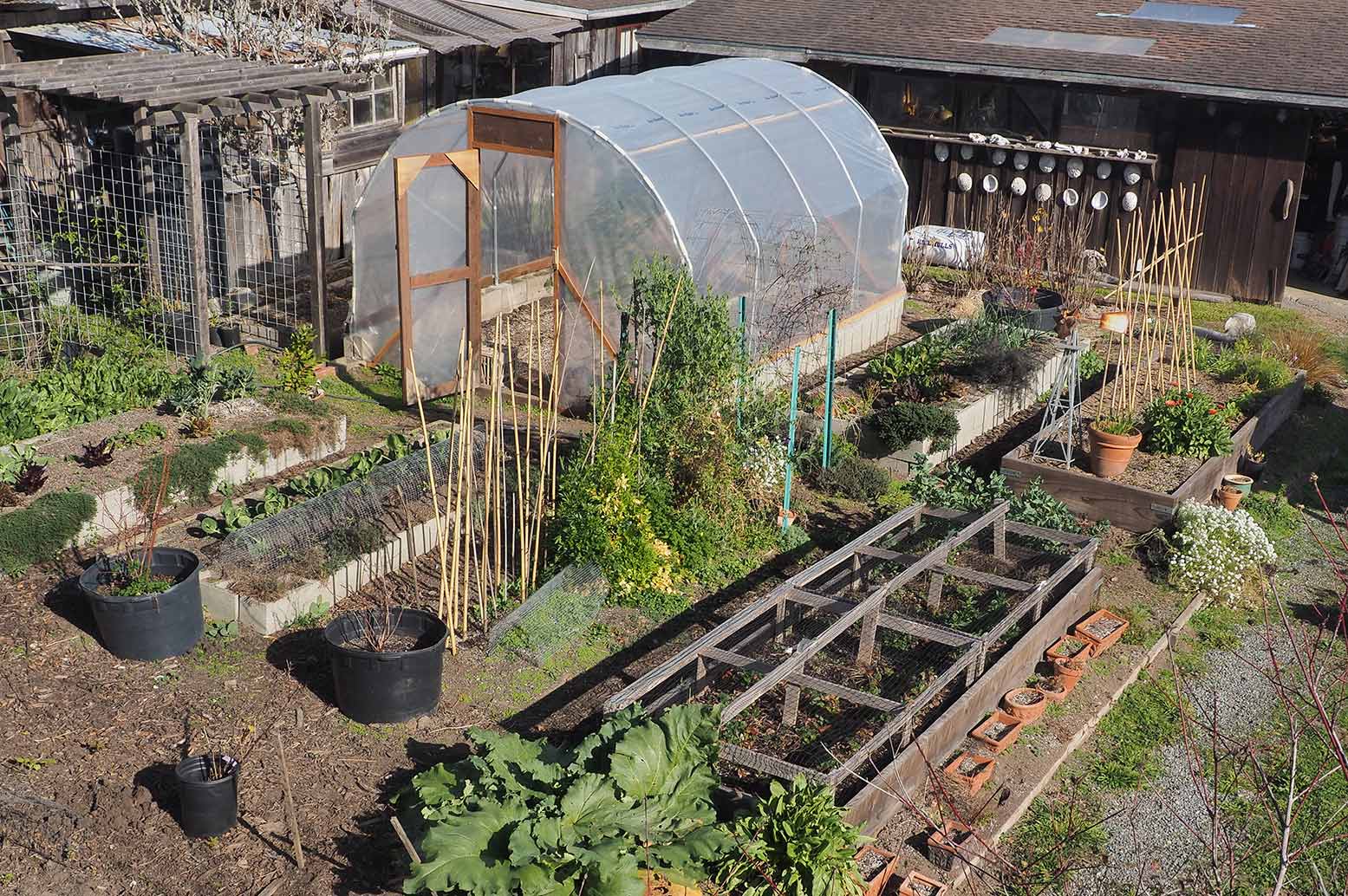
Below: garden at its most barren right now. New hoop greenhouse from Farmtek, a great source of greenhouse supplies and all kinds of agricultural products. We just added walls, 2 concrete blocks high, to get more height. Doors by Billy Cummings. Foreground: raised beds of redwood 2×12’s, 1/4″ wire on bottom for gophers. Lightweight lift-off  covers with netting to protect strawberries from birds

Post a comment (1 comment)