Running a USAF Newspaper in Germany, 1958-1960 — Part 3

Click on “The ’60s, above, to see preceding posts on the ’60s.

The Man with the Castle

Part of my job as the information services officer was to run the base photo lab and edit the base newspaper. I was also in charge of public relations and dealing with the press.

There was a German photographer, Helmut Haak, who photographed troops on American air bases. He was a big, hearty, outgoing man. He contacted me about setting up photo shoots.

I would line up a fighter plane down on our airstrip, and benches for the military personnel, arranged by unit. There might be 30-40 men and women in each photo.

Helmut made a ton of money selling the color photos. Practically everyone bought one. He drove a big Mercedes and lived in a small castle overlooking the Mosel River. One night he invited us, along with my secretary Inge, over for a light supper.

He served food and white and pink champagne in bottles with his own label. He took us up into a small turret at the top of the castle and as we looked down at the river in the mist, he showed us an exquisite little music box with a moving mechanical bird.

Helmut had a 4-seat Cessna airplane, and he made friends with our base commander, Colonel Simeral (a pilot) by taking him flying. It was a spiffy little plane, and the colonel loved flying it.

F-86 Sabre Dog Interceptor

One day at the base, Helmut took me up. We took off, and were still in the flight pattern when we heard on the radio: “F-86 dogs scrambling,” which meant that at least two of the base’s fighter pilots were taking off in a hurry. Shit!

Helmut was sweating. I was worried. The F-86’s were like rockets with cockpits on top — fast and powerful. Pretty soon, the planes roared past us—phew! — and we came back in.

Helmut told me that one time, when his girlfriend was sailing back to America from Southhampton, he swooped down when the ship was leaving port and dropped a bouquet of flowers for her with a note on the deck. Romantisch!

Before I left Germany, I got word that he had crashed and died in the French Alps, not seeing Mont Blanc in the fog. The report said that he missed the top of the mountain by 3-4 meters.

Post a comment (3 comments)

Sculptural Sauna by Travis Skinner

Hey Lloyd, We just finished this sauna, we wanted to share it with ya.

–Travis Skinner

“The Anglerfish Sauna is a wood-fired sauna on wheels! It was built by the Hundred Handed Ones architectural collective that I started in collaboration with Travis Conn.

We use sculptural forms in architectural works. The Anglerfish Sauna showcases these principles in an experience. We ask the audience to step into the work and experience natural forms inspired by life.”

Check out the details here: the fins over the tires, the spine, the light, the teeth…

Travis built a unique tiny home on wheels that was featured in our book Small Homes.

Check out his very creative and highly-crafted designs at pairoducks.blogspot.com.

Post a comment (1 comment)

Shit in the Air! / Causes of Fires / Native California Land Management / Forest Management

Talking to Louie on the phone just now about the smoky air of the last week, he said, “That isn’t just wood smoke: It’s plastics, building materials, exploded gasoline, burned-up houses and cars…”

Shit, I hadn’t thought of that this last week. I wasn’t out running, but did take a few walks.

I shouda stayed inside a lot more.

We went on to talk about causes of these fires. He said that a lot of the problem is the type of logging that does not deal with the “understory” — all the saplings and plants that spring up afterwards. If they keep growing unchecked, they produce ever more fuel for fire. It makes sense to burn the understory (at its right phase of growth) on a windless day in wet or moist weather.

When foresters are involved in a cut, they will set a limit on the height of the understory, so loggers have to cut slash up into smaller pieces; this is managing the forest. However a lot of logging is interested in profit, not land management, and they leave behind conditions ripe for fire.

He then segued into how the Pomo of the Pt. Arena / Manchester area managed the land. In addition to hunting, fishing, and  harvesting, they used fire to clear selected areas of land, making it easier to move around, making hunting easier, producing green young growth.

I told him about this great book, Tending the Wild, by M. Kat Andersen; about “…indigenous land management practices …in… California when first encountered by Europeans and detailed explication of the care of, harvesting of, and use of California’s native plants.”

You can get it at Larner Seeds: www.shltr.net/tend

The cycle of life…

Post a comment (3 comments)

Big Surf at Makaha, Circa 1953

Jim Fisher, a powerful swimmer, was on the Lowell High School (San Francisco) swim team in the early 1950s. The first time I ever went swimming in the ocean was when Jim and I went across the Great Highway from Fleishhacker Pool after a swimming meet, and went body surfing. It changed my life — the blue sky, the blue water, the waves…

After graduation, Jim went to Hawaii and, along with other haole California surfers, surfed the biggest waves they could find. I realize that this photo is blurred and scratchy, but It’s one of my favorite surf shots. There’s just something about it that grabs you. Jim said he almost drowned on the wipeout that ensued.

Post a comment (6 comments)

Running a USAF Newspaper in Germany, 1958-1960 — Part 2

Click on “The ’60s, above, to see preceding posts on the ’60s.

Old-School Typesetting

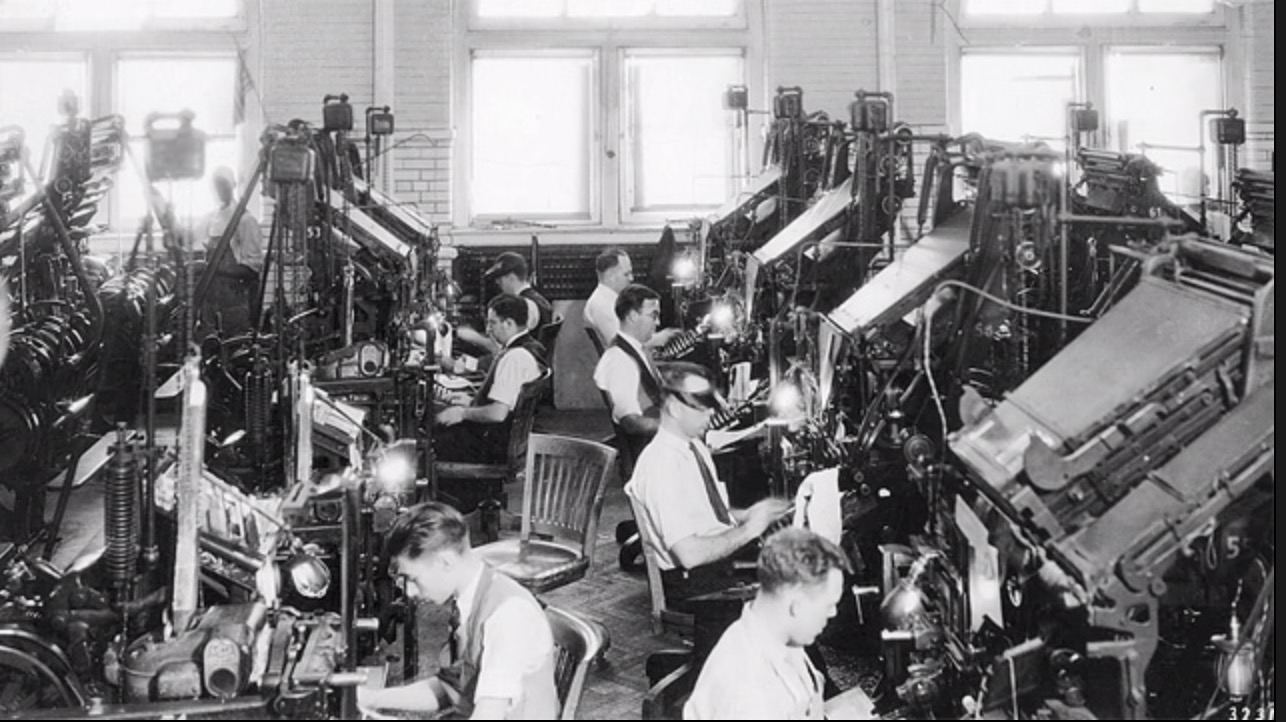
We went into town (Kauserslautern) twice a month to deliver typed-up text and photos to the printer. Printing was by the “linotype” process, where the words were produced on lead “slugs.” The typesetters were guys with green eyeshade visors, working on mechanical-looking keyboards.

They input the text, and slugs were created from a hot pot of lead. The whole process seemed medieval. (This was the stage of newspaper/magazine printing before the IBM Composer and later the Macintosh.) The slugs were then lined up in “galley” trays (hence the term “galley” used in later methods of printing), which were used to stamp the words onto paper.

The secret service on the base had a spare 35mm fixed-lens Leica that they let me use. I started developing and printing in the photo lab, learning from the sergeants and airmen who ran the lab, It was the beginning of my lifelong passion for photography.

Journalism

After I’d been on the job for about a year, I went to Wiesbaden for a week to work on the news desk of The Stars and Stripes, the big military newspaper for troops throughout Europe. This was an exercise that was available to information services officers. I loved the newsroom — my heart was (is still) in journalism — but I just couldn’t write copy fast enough. There went any career in journalism.

However, to my surprise, we were given an award for the best newspaper in the USAF in 1959. I sent the notice of the award to our base commander, who had been on my case for running an “alternative” newspaper — with a note saying, “It’s interesting that we got this award at the time we were being criticized by some base personnel for the quality of the newspaper.”

Germany was still in a semi bombed-out state in 1958. There were neighborhoods in Wiesbaden and Frankfurt that were still rubble. Living was cheap for Americans with the almighty dollar.The base had its own supermarket (commissary), chain store (BX), bowling alley, gym, officers’ and enlisted personnel clubs, and housing. If you stayed on the base, it was like being in a small American town, not in the middle of Western Europe. A lot of Air Force personnel never left the base.

Post a comment (2 comments)

Progress on Tiny Room

I picked up these used French doors at Urban Ore in Berkeley. They have brass door hardware and wavy glass. Installed by Billy Cummings. The exterior is pretty close to being finished. The plan is to have the bed on wheels so I can roll it out onto the deck to sleep out under the stars on dry nights.

Post a comment

Crab Season Opens November 15th

Our neighbor Todd Beeson getting ready for opening day. His truck is unique: a 1957 Chevy 2-ton Apache that he completely rebuilt. It’s got a chain-driven winch that operates off the boom. It looks like it might be a good crab (Dungeness) season this year.

Post a comment

(Mostly) Ocean Objects by Kitchen Sink

The fly is made out of wire and translucent plastic for the wings. A local lady made the heart out of pewter. The snail is a Helminthoglypta, a native California snail — not to be confused with the pestiferous garden snail, which was imported from Europe; note the logarithmic spiral here. The seal is jade. The orange lump is a piece of beach glass.

Post a comment

Running a USAF Newspaper in Germany, 1958-1960 — Part 1

I started out to write a book about the ’60s because none of the accounts I saw of the era seemed right. As I went along, I decided to document my background — which ended up taking up about half of the book. Ulp!

I’ve published the first 3 autobiographical chapters — click on “The ’60s,” above. However, I still have about 10,000 words of my story before getting up to 1958, in this order:

  • Summertime in the ’40s
  • High School in San Francisco, 1948-1952
  • Stanford, 1953-1957
  • Santa Cruz/Surfing 1954-1957
  • Three Months Through Europe on a Motorscooter, 1957

I’ve decided to skip ahead of these chapters for now, so we can get right into the ’60s. I’ll publish them sooner or later in some form — maybe in an eventual print edition of this book, or some kind of autobiography.

You’re in the Air Force Now

I was in the USAF ROTC at Stanford (to avoid the Korean war), and had signed up for a 3-year tour of duty upon graduation. I graduated from Stanford in 1957, and was scheduled to report to pilot training school in spring, 1958, at Marana Air Force base in Arizona.

However, after I’d graduated and when I returned from a motorscooter trip through Europe, I got a letter from the USAF saying they had changed the rules and I now would have to sign up for 5 years if I still wanted to be trained as a pilot — or take a 3-year non-flying tour.

No way was i going to commit to a 5-year military career. I wrote them and said that (in other words): you guys double-crossed me; for 4 years you said it’d be a 3-year commitment, now you’re changing it to 5. So, I want a non-flying tour and I’d like to be in information services (base newspaper, photography, press releases), and I’d like to be stationed in Europe.

Lo and behold, they gave me just what I asked for. (I figured some sergeant in the Pentagon saw my letter and decided, why not?).

When we got back from our motor scooter trip, I was told to report for active duty at Sembach Air Base, Germany, which was about 60 miles south of Frankfurt. My job was to run the base newspaper and manage the base photo lab.

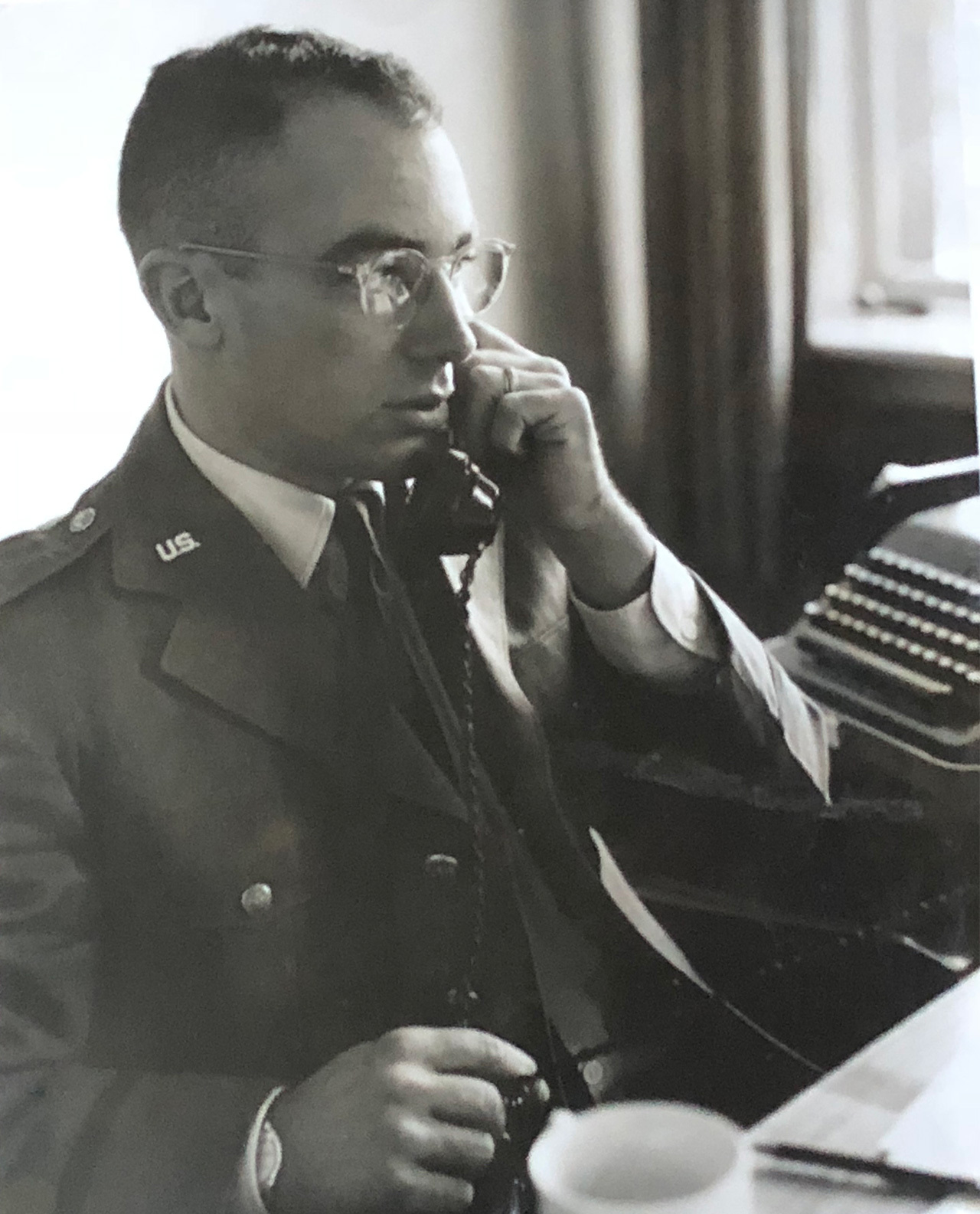
My mom was upset when she saw this photo. She said I looked sad. She was right. Fish out of water, in more ways than one.

I reported for active duty in February, 1958 and lived in the Bachelor Officers’ Quarters for three months until Sarah came over. We first lived in the nearby small town of Enkenbach (and had Sunday afternoon coffee klatches that included rich creamy German cakes with our landlady, Frau Elner and family and neighbors) until we moved into an apartment on the base.

Trouble with the Military

The job and location were great, but I disliked the military. I hated wearing a uniform. I was a second lieutenant, but didn’t feel like an officer. I never did get the officer/enlisted man relationship right. I neither liked giving orders nor being ordered around. I didn’t feel superior because I was an officer. It was awkward.

My Own Newspaper

But I liked running the newspaper, and decided to have some fun. Soon after I took over the paper—The Sembach Jet Gazette—I converted it to a tabloid and started featuring photos that the base photographer shot in his spare time, with a full-page photo on page 1.
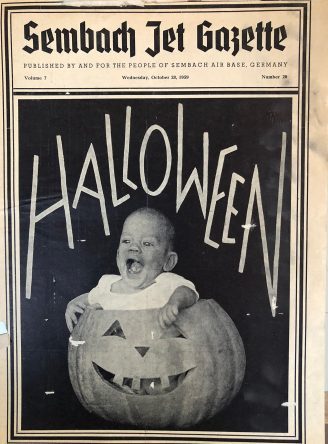
The photographer, Sgt. Jim Tyson, who was used to shooting photos of such exciting events as the Officers Wives’ Club meetings with a 4×5 Graflex camera, also had his own 35mm camera, and was happy when I told him to go out and shoot human-interest photos. He shot artistic black and white pictures and we converted a boring military publication into something quite different.

We did an April Fools’ issue that went over well. But then we did a parody of the Overseas Weekly, which was a National Enquirer-type semi-scandal sheet newspaper put out for the American military in Europe. We called our version The Overseen Locally, with the slogan “All the News That Fits, We Print.” We made fun of a lot of the base’s clubs and practices.

It didn’t go over with the brass. I was already in trouble with the base commander for refusing to pay for officers’ cocktail parties that I didn’t attend. An American journalist in Wiesbaden told me that he had heard rumors of a court-martial, the theory being that this was a subversive act, that the Russians could use it for propaganda. (Puhleeze!) It all blew over, but it didn’t endear me to the base commander.

Post a comment (1 comment)